

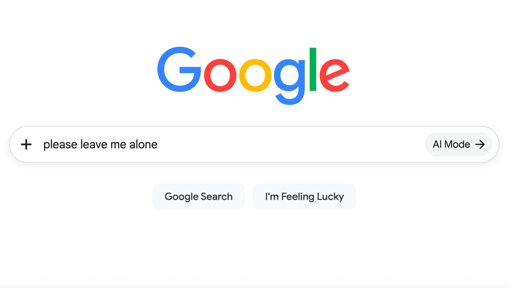
I’m aware that I’m falling into the AI trap of personifying these results, writing as if Google’s AI imagines and presumes. Google the company, of course, wants this too–it wants me to see my search results as a conversation with a helpful problem-solving buddy. The company has aims down the line to introduce actual agents that can search for you, jumping on the latest Silicon Valley obsession to basically make a version of Google Alerts that are worse for the environment. Maybe its current version of search is something of a test balloon for an eventual service it can charge for.
But the same way it drives me crazy when Stripe’s AI customer service tells me it’s so sorry, omg that must be so hard to hear about whatever utterly mundane, thoroughly unemotional issue I’ve brought it that day, Google search’s hollow facsimile of the human desire to help lays bare how badly its inventors misunderstand what regular people want and how we feel when we’re searching for information. (Full disclosure: I wrote my library school Master’s thesis literally about this, so it really riles me up!) It exposes how Google sees its users: helpless and intellectually lazy, longing for machines to solve our problems for us, unable to sit in the sometimes uneasy space of unknowing that motivates information searching in the first place. Shortcutting yourself out of this space–or, worse, letting AI do it for you–robs you of the chance to explore and discover, to let your search take you to new places and learn new things.
Hey I appreciate the insight and perspective. But I’ve got to contest the source. Its not holding any weight as a reputable and verifiable resource. I’m not saying this as a jab or attack on you. Its a world of bad info, misinformation, and where I fear your link lands - hyperbole - so please consider this resource rather than a lengthy post:
https://guides.lib.uw.edu/research/faq/reliable
Ecosia may well be exaggerating Eco claims or green washing. But to counter those claims, stronger evidence is needed.
FYI, “Pivot to AI” do aggregate “AI” news with critical commentary, but if you’d clicked through you would see they cite sources quite thoroughly.
Let me double check. I’ve admitted being wrong and missing something before, so happy to reengage.
I forgot to mention. To get Ecosia financials, you can request them from the applicable oversight office in Germany. Aggregates, like Candid, have access to that too. That’s the sort ofndue diligence I’d expect; not a link to their oversight page and suggestion they are hiding something. Many large nonprofits have financial overviews like that, and doesn’t suggest organizational rot or greenwashing in this case.
A quick glance suggests that in Germany, you can request a social benefit corp’s financials. If like nonprofit law in the USA, you can request a 990 from any 501©3 and they are required, by law, to provide one within a certain time frame.
Hi haverholm.
So I did click through again and re-read, but I stand by my assessment that the sources aren’t good. I wouldn’t consider them reputable and the author doesn’t offer verifiable information to support the sources linked. We’ve got:
If I’m missing other links, let me know. I don’t see any others. Again, I don’t see anything that suggests the claims are more than hyperbole. For their financials, for example. Show me where the problem is, speak to it, back up the claim with expert review or hard numbers. As the article is written, that chain just isn’t there and I’m left to take the authors word for it that a problem exists. Glassoldoor and LinkedIn are not evidence of malfeasance. Hence my conclusion and attempt to inform. Which the poster did not appreciate (full disclosure, I blocked them. I don’t have time for disingenuous insults).
Propublica, ICIJ, 404 media are great examples of what I’m trying to point out. And, though my white whale, helping everyone step back and evaluate what a source is and why its credible is important to me.
I appreciate you chiming in and asking me to reasses, however. Always happy to, especially if I find it helped me reveal a mistake or change my thought.
Removed by mod
Given the response, the link remains appropriate.