Yeah, I think it causes unnecessary difficulties. I actually think they’re introduced at a time when you could instead teach them as two-dimensional vectors with pointwise addition and a special multiplication and division rule, and prove that (0, 1)×(0, 1) = (-1, 0) using that rule, so that sqrt(-1, 0) = (0, 1).
Then you can establish a convention that you write (a, b) as a + bi (and i = (0, 1)).
This is too abstract for younger students, but nowadays I don’t think they learn complex numbers anyway, and I think it would be less spooky for the older students.
Imaginary numbers are typically introduced in a high school “algebra 2” course in my neck of the woods, like junior year unless you are accelerated or held back. I feel like it’s really common for them to not be taught well - the naming is something that occasionally trips up the teachers.
The teaching of them is something that really interests me - they’re the kind of thing that triggers the “when am I ever going to use this?”/rants about not learning how to do taxes. You can talk about the relevance to electronics, but DC electronics is already hard enough for most to comprehend.
I like to connect it to rotation. Show them the pattern of powers of i with physical movement - quarter turns.
The big thing is that vectors seem to be the kind of “shoved into the end of the semester if there’s time after testing” from what I’ve seen. Most of the time, even when I work with calculus students they have no idea what a vector is.
A big thing to is getting them to understand what square roots even really mean. I’ve noticed a lot of students struggle with getting sqrt(x) * sqrt(x) = x, so even just the simple “hey, can you get a negative by taking a number and multiplying by itself?” is often a hurdle cognitively. (A lot of this I suspect has to do with not understanding what multiplication or division really “are” - I usually remediate with the area model)
Wow, (potentially) omitting vectors seems like a big gap. Obviously it has huge direct practical use, but it’s probably also the first introduction to how you can take a structure and augment it with operations. In that way it’s the first step on the road to abstract mathematics.
Also tbf, rational numbers are just the lattice modded out by the equivalence relations (a, b) ~ (c, d) iff ad = bc, and the equivalence classes just happen to form an ordered field. If you show an undergrad math/science student this esoteric definition of rationals, the motivation of “2D numbers” makes a lot more sense. Of course, please don’t show this to an elementary or middle schooler, a high schooler might be able to handle this if they’re passionate about math.
Of course, please don’t show this to an elementary or middle schooler, a high schooler might be able to handle this if they’re passionate about math.
Lol, I was thinking this as I was reading.
The neat thing about complex numbers defined this way is that you don’t need to understand quotient spaces because under addition ℂ is already isomorphic to ℝ²!


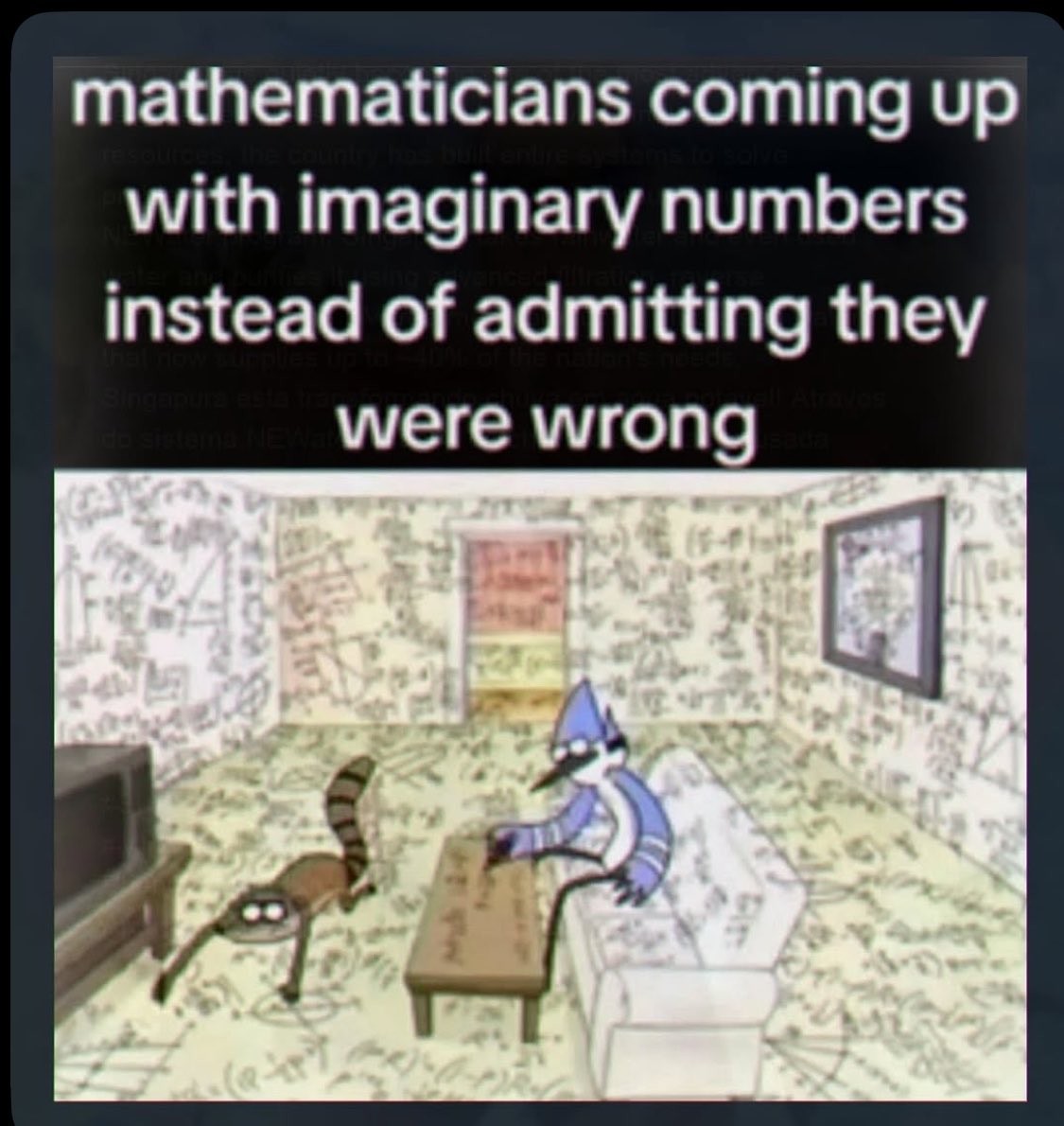
Yeah, I think it causes unnecessary difficulties. I actually think they’re introduced at a time when you could instead teach them as two-dimensional vectors with pointwise addition and a special multiplication and division rule, and prove that (0, 1)×(0, 1) = (-1, 0) using that rule, so that sqrt(-1, 0) = (0, 1).
Then you can establish a convention that you write (a, b) as a + bi (and i = (0, 1)).
This is too abstract for younger students, but nowadays I don’t think they learn complex numbers anyway, and I think it would be less spooky for the older students.
Imaginary numbers are typically introduced in a high school “algebra 2” course in my neck of the woods, like junior year unless you are accelerated or held back. I feel like it’s really common for them to not be taught well - the naming is something that occasionally trips up the teachers.
The teaching of them is something that really interests me - they’re the kind of thing that triggers the “when am I ever going to use this?”/rants about not learning how to do taxes. You can talk about the relevance to electronics, but DC electronics is already hard enough for most to comprehend.
I like to connect it to rotation. Show them the pattern of powers of i with physical movement - quarter turns.
Yeah. I think the vectors-first approach allows you to get straight to rotations, too.
The big thing is that vectors seem to be the kind of “shoved into the end of the semester if there’s time after testing” from what I’ve seen. Most of the time, even when I work with calculus students they have no idea what a vector is.
A big thing to is getting them to understand what square roots even really mean. I’ve noticed a lot of students struggle with getting sqrt(x) * sqrt(x) = x, so even just the simple “hey, can you get a negative by taking a number and multiplying by itself?” is often a hurdle cognitively. (A lot of this I suspect has to do with not understanding what multiplication or division really “are” - I usually remediate with the area model)
Wow, (potentially) omitting vectors seems like a big gap. Obviously it has huge direct practical use, but it’s probably also the first introduction to how you can take a structure and augment it with operations. In that way it’s the first step on the road to abstract mathematics.
Also tbf, rational numbers are just the lattice modded out by the equivalence relations (a, b) ~ (c, d) iff ad = bc, and the equivalence classes just happen to form an ordered field. If you show an undergrad math/science student this esoteric definition of rationals, the motivation of “2D numbers” makes a lot more sense. Of course, please don’t show this to an elementary or middle schooler, a high schooler might be able to handle this if they’re passionate about math.
Lol, I was thinking this as I was reading.
The neat thing about complex numbers defined this way is that you don’t need to understand quotient spaces because under addition ℂ is already isomorphic to ℝ²!