Do you think TSA/CBP is going to check the flash data lines to see if the MCU is scanning the flash internally?
This isn’t a standard USB flash controller… You would need to break the casing and physically probe it to figure out that something was off as far as I can tell. It’s not like the MCU broadcasts that it is scanning to the USB port.
You would have to be hitting the stick pretty hard, not just a normal file scan to notice the timing being slightly too long in a small portion of the scans. The bigger problem would be that the flash drive would be brand-recognizable if it ends up being mass produced that they might auto-confiscate it, and of course the default file that it searches for being known.
Do you think TSA/CBP is going to check the flash data lines to see if the MCU is scanning the flash internally?
This isn’t a standard USB flash controller… You would need to break the casing and physically probe it to figure out that something was off as far as I can tell. It’s not like the MCU broadcasts that it is scanning to the USB port.
You would have to be hitting the stick pretty hard, not just a normal file scan to notice the timing being slightly too long in a small portion of the scans. The bigger problem would be that the flash drive would be brand-recognizable if it ends up being mass produced that they might auto-confiscate it, and of course the default file that it searches for being known.
You’re proving my point. The device actually fails both ends of the threat model.
If it’s a casual check, custom hardware is total overkill. You take a standard 1 TB off-the-shelf drive formatted to its full 1 TB capacity as a single partition. You put normal files on it and hide the encrypted header—plus a lightweight host-side decryption utility/bootloader—inside a single JPEG using steganography. To any border agent, OS, or disk tool, the drive is just a healthy 1 TB partition containing readable files and residual random data from a quick format. There are no custom drivers installed, no modified media file sizes, and no missing drive space to trigger software or system flags. Once at your destination, you simply extract the utility from the JPEG on a trusted machine to mount the hidden sectors.
If it’s a high-scrutiny check, this custom hardware actively guarantees you stand out. CBP doesn’t need software checks—non-destructive X-ray imaging is standard screening. Under a scan, a mass-produced thumb drive shows a single integrated ASIC on NAND. The Phantom Drive immediately reveals a generic CH569 microcontroller, buck regulators, UART test points, etc.
It visually stands out like a neon sign under basic physical imaging. It doesn’t defeat the threat model—it actively creates the physical hardware anomaly.
It would have to be distinctly different from any thumb drive over the last decades. My older ones definitely weren’t just a single chip, I recon you’d need some immense training specifically on drive designs to know this isn’t just a normal one from like 2010 or 2015.
If I got it right, you could easily detect this drive by just creating password.txt. as the article says it creation is intercepted and skipped. Hence if there is no password.txt afterwards, you know what you’re dealing with.
Still, you have to know this AND care.
It looks for a string “password:xyz” bring written to any file, where xyz is the password. If you get the password wrong it’ll just write the file normally


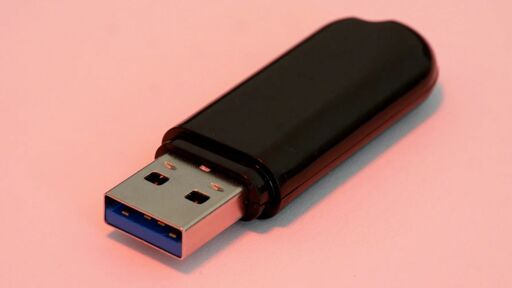
Do you think TSA/CBP is going to check the flash data lines to see if the MCU is scanning the flash internally?
This isn’t a standard USB flash controller… You would need to break the casing and physically probe it to figure out that something was off as far as I can tell. It’s not like the MCU broadcasts that it is scanning to the USB port.
You would have to be hitting the stick pretty hard, not just a normal file scan to notice the timing being slightly too long in a small portion of the scans. The bigger problem would be that the flash drive would be brand-recognizable if it ends up being mass produced that they might auto-confiscate it, and of course the default file that it searches for being known.
You’re proving my point. The device actually fails both ends of the threat model.
If it’s a casual check, custom hardware is total overkill. You take a standard 1 TB off-the-shelf drive formatted to its full 1 TB capacity as a single partition. You put normal files on it and hide the encrypted header—plus a lightweight host-side decryption utility/bootloader—inside a single JPEG using steganography. To any border agent, OS, or disk tool, the drive is just a healthy 1 TB partition containing readable files and residual random data from a quick format. There are no custom drivers installed, no modified media file sizes, and no missing drive space to trigger software or system flags. Once at your destination, you simply extract the utility from the JPEG on a trusted machine to mount the hidden sectors.
If it’s a high-scrutiny check, this custom hardware actively guarantees you stand out. CBP doesn’t need software checks—non-destructive X-ray imaging is standard screening. Under a scan, a mass-produced thumb drive shows a single integrated ASIC on NAND. The Phantom Drive immediately reveals a generic CH569 microcontroller, buck regulators, UART test points, etc.
It visually stands out like a neon sign under basic physical imaging. It doesn’t defeat the threat model—it actively creates the physical hardware anomaly.
It would have to be distinctly different from any thumb drive over the last decades. My older ones definitely weren’t just a single chip, I recon you’d need some immense training specifically on drive designs to know this isn’t just a normal one from like 2010 or 2015.
If I got it right, you could easily detect this drive by just creating password.txt. as the article says it creation is intercepted and skipped. Hence if there is no password.txt afterwards, you know what you’re dealing with. Still, you have to know this AND care.
It’s only skipping if your password matches. Otherwise it’ll just be a normal file.
Ah okay, so then I retract my statement and better my reading-skills 😁
It looks for a string “password:xyz” bring written to any file, where xyz is the password. If you get the password wrong it’ll just write the file normally
Ah okay, so then I retract my statement and better my reading-skills 😁
No worries, I had to read stuff outside of the articles to get that information