When a cushion wears out, a battery fades, or a display breaks, there’s a plausible repair ahead of you. But the heat management’s a little more buried.
VR headsets effectively need to run two 4K displays, one for each eye, and you have all the processing for controller tracking too. You also have eye tracking, they’re doing the whole foveated streaming thing everybody has been gushing over about (it’s really cool tech!). The mobile chip they used is nothing special, it’s a Snapdragon 8 Gen 3, a 3 year old smartphone processor (certainly powerful enough to run lighter PC games, but nothing more than that. It’s kind of insane that a phone can even do that nowadays!)
It’s kind of insane that a phone can even do that nowadays!
This is what also makes me very sure that being able to play offline will never go away regardless of how hard they try to push gaming into the cloud. Local processing power of common devices is more than enough for the decades of pc games that have been released sans the last decade or so, and they are also good enough to emulate a whole host of gaming devices.
The mobile chip they used is nothing special, it’s a Snapdragon 8 Gen 3, a 3 year old smartphone processor (certainly powerful enough to run lighter PC games, but nothing more than that. It’s kind of insane that a phone can even do that nowadays!)
Actually, you can totally run some more demanding PC games on it without any issues. A Snapdragon 8 Gen 2, so slightly weaker, is able to run The Witcher 3 at 720p, Steam Deck preset, in 30+ fps.
And that’s with several compatibility layers in between the SoC and the game.
Mobile ARM chips have come so far we might as well be using them for laptops instead of Intel or AMD (just like the recent MacBook Neo using an iPhone chip). More than good enough performance, especially in case of 8 Elite, at a fraction of the power draw.
It’s 2160x2160, so less than 4K (which is 3840x2160) horizontally, since it’s a different aspect ratio but it’s still more pixels. About 8 million for a standard 4K display, while it’s 9 million for the Frame. Even streaming games on such a high resolution display is performance intensive, plus you have the controller + eye tracking


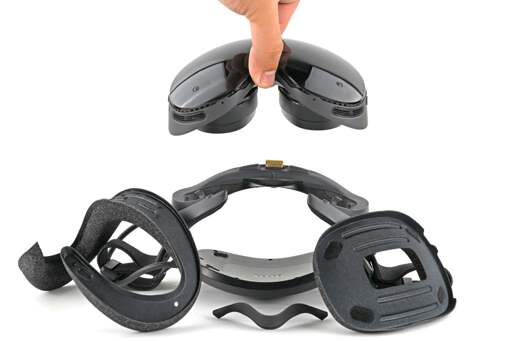
VR headsets effectively need to run two 4K displays, one for each eye, and you have all the processing for controller tracking too. You also have eye tracking, they’re doing the whole foveated streaming thing everybody has been gushing over about (it’s really cool tech!). The mobile chip they used is nothing special, it’s a Snapdragon 8 Gen 3, a 3 year old smartphone processor (certainly powerful enough to run lighter PC games, but nothing more than that. It’s kind of insane that a phone can even do that nowadays!)
This is what also makes me very sure that being able to play offline will never go away regardless of how hard they try to push gaming into the cloud. Local processing power of common devices is more than enough for the decades of pc games that have been released sans the last decade or so, and they are also good enough to emulate a whole host of gaming devices.
Actually, you can totally run some more demanding PC games on it without any issues. A Snapdragon 8 Gen 2, so slightly weaker, is able to run The Witcher 3 at 720p, Steam Deck preset, in 30+ fps.
And that’s with several compatibility layers in between the SoC and the game.
Mobile ARM chips have come so far we might as well be using them for laptops instead of Intel or AMD (just like the recent MacBook Neo using an iPhone chip). More than good enough performance, especially in case of 8 Elite, at a fraction of the power draw.
It’s 2x2k, not 4k
It’s 2160x2160, so less than 4K (which is 3840x2160) horizontally, since it’s a different aspect ratio but it’s still more pixels. About 8 million for a standard 4K display, while it’s 9 million for the Frame. Even streaming games on such a high resolution display is performance intensive, plus you have the controller + eye tracking