Attached: 1 image
Bluesky suspending antifascist researchers for sharing publicly available information about literal nazis.
Should be no surprise considering bsky constantly protects nazis, the far right, and all flavors of bigotry at the expense of Palestinians and trans women.
Fortunately, their information already spread so far and wide that at least half of the Blood Tribe nazis lost their jobs following the mass doxx. Chris Pohlhaus, leader of BT, estimated financial losses at over $2 million lol. Happy holidays!
That’s also what many other social media would do because it’s easier to ban posting of personal information regardless of where it came from because you can’t trust moderation you outsourced to some third world country to do proper checks.
Example:
Reddit is quite open and pro-free speech, but it is not okay to post someone’s personal information or post links to personal information. This includes links to public Facebook pages and screenshots of Facebook pages with the names still legible.
Posting someone’s personal information will get you banned. When posting screenshots, be sure to edit out any personally identifiable information to avoid running afoul of this rule.
Dunno if Bsky has something similar but it’s more of a cost optimisation than anything so people are getting pointlessly angry at individual companies rather than the system which has this sort of behaviour as a guaranteed outcome.
A competent programmer could write an algorithm to knock out the low hanging fruit, like public Facebook pages, in about five minutes.
Might take me a couple hours. Someone genuinely good and familiar with the space would have been done in less time than it took to write this comment.
Can’t imagine why they would do that, or why they would want to extend protections they politically must extend to marginalized people who take real precautions to assholes who know they’ll always be protected by power.
They don’t want to deal with the slightest risk of dealing with legal consequences. The ole corpo risk matrix + risk appetite as assessed by lawyers resulted in this, no IT involved ever probably.
Your solution doesn’t fully eliminate risk on it’s own and addressing that costs money - that’s about as far as a rational company has to go. They know going nuclear and banning all personal info means not having to deal with it at all and it’s a niche thing that will affect negligible amount of users. Bean counting is the core of meeting regulatory and legal requirements in case of for-profit organisations.
That doesn’t change the aspect of it being censorship. It just means that a risk adverse company is risk adverse to the degree that they will employ censorship to maintain that aversion to risk. At the end of the day, it’s censorship. The rationale for why they’ve employed it is notwithstanding.
Censorship can be good and ban on personal information sharing prevents witch hunts. Reddit banned it only after it resulted in dead people which is too late in my book.
Your example is people randomly sharing information. That is not the same as a Government entity after following the process outlined in the law, releasing information related to that Government action. We know who is awarded contracts, we know where tax payer money is going to, and so on because of disclosure requirements by Government entities.
When an elected entity has acted in a manner accordance to law, that action ought to reasonably disclose the subject of that action. That’s not to say 100% it always must be this way, but this is why we allow the public to comment on changes to those disclosure requirements.
I would like for you to understand, there’s a very fundamental difference between “random people” and “people via a method given power to rule over other people.” That fundamental difference between the two is key to the point here.
Ban on sharing of personal information in social media isn’t intended to stop witch hunts against innocent people, it’s intended to stop witch hunts, period. I’m certain you’d speak different if the roles were reversed and I imagine that won’t take long because most politicians treat judiciary as one of the spoils these days.


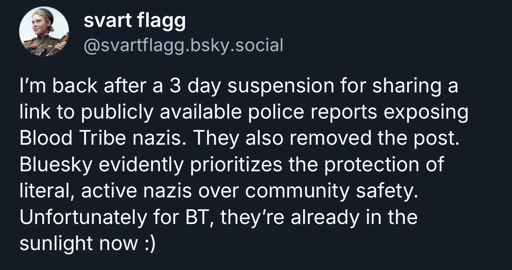
I’m completely against doxxing. But there were public reports. That’s censorship.
That’s also what many other social media would do because it’s easier to ban posting of personal information regardless of where it came from because you can’t trust moderation you outsourced to some third world country to do proper checks.
Example:
https://support.reddithelp.com/hc/en-us/articles/360043066452-Is-posting-someone-s-private-or-personal-information-okay
Dunno if Bsky has something similar but it’s more of a cost optimisation than anything so people are getting pointlessly angry at individual companies rather than the system which has this sort of behaviour as a guaranteed outcome.
can always come up with rationalizations but the fact remains there are other platforms that will not “cost optimize” it away.
Those platforms are irrelevant. Yes, I realise I’m using an irrelevant platform but being relevant is something I actively avoid in social networks.
A competent programmer could write an algorithm to knock out the low hanging fruit, like public Facebook pages, in about five minutes.
Might take me a couple hours. Someone genuinely good and familiar with the space would have been done in less time than it took to write this comment.
Can’t imagine why they would do that, or why they would want to extend protections they politically must extend to marginalized people who take real precautions to assholes who know they’ll always be protected by power.
They don’t want to deal with the slightest risk of dealing with legal consequences. The ole corpo risk matrix + risk appetite as assessed by lawyers resulted in this, no IT involved ever probably.
Totally, corporations will always go fasch, not just because they want to¹ but because it’s what they are
But
There is low hanging fruit that can be procedurally verified.
They chose this, obviously, clearly
¹they always want to
Your solution doesn’t fully eliminate risk on it’s own and addressing that costs money - that’s about as far as a rational company has to go. They know going nuclear and banning all personal info means not having to deal with it at all and it’s a niche thing that will affect negligible amount of users. Bean counting is the core of meeting regulatory and legal requirements in case of for-profit organisations.
That doesn’t change the aspect of it being censorship. It just means that a risk adverse company is risk adverse to the degree that they will employ censorship to maintain that aversion to risk. At the end of the day, it’s censorship. The rationale for why they’ve employed it is notwithstanding.
Censorship can be good and ban on personal information sharing prevents witch hunts. Reddit banned it only after it resulted in dead people which is too late in my book.
https://en.wikipedia.org/wiki/Suicide_of_Sunil_Tripathi
Your example is people randomly sharing information. That is not the same as a Government entity after following the process outlined in the law, releasing information related to that Government action. We know who is awarded contracts, we know where tax payer money is going to, and so on because of disclosure requirements by Government entities.
When an elected entity has acted in a manner accordance to law, that action ought to reasonably disclose the subject of that action. That’s not to say 100% it always must be this way, but this is why we allow the public to comment on changes to those disclosure requirements.
I would like for you to understand, there’s a very fundamental difference between “random people” and “people via a method given power to rule over other people.” That fundamental difference between the two is key to the point here.
Ban on sharing of personal information in social media isn’t intended to stop witch hunts against innocent people, it’s intended to stop witch hunts, period. I’m certain you’d speak different if the roles were reversed and I imagine that won’t take long because most politicians treat judiciary as one of the spoils these days.