

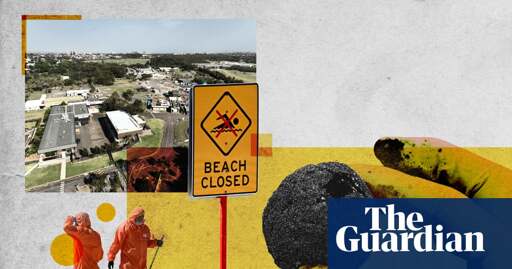
A giant fatberg, potentially the size of four Sydney buses, within Sydney Water’s Malabar deepwater ocean sewer has been identified as the likely source of the debris balls that washed up on Sydney beaches a year ago.
Sydney Water isn’t sure exactly how big the fatberg is because it can’t easily access where it has accumulated.
Fixing the problem would require shutting down the outfall – which reaches 2.3km offshore – for maintenance and diverting sewage to “cliff face discharge”, which would close Sydney’s beaches “for months”, a secret report obtained by Guardian Australia states.
“The working hypothesis is FOG [fats, oils and grease] accumulation in an inaccessible dead zone between the Malabar bulkhead door and the decline tunnel has potentially led to sloughing events, releasing debris balls,” the report concludes.
“This chamber was not designed for routine maintenance and can only be accessed by taking the DOOF offline and diverting effluent to the cliff face for an extended period (months), which would close Sydney beaches.”
Vienna, too, is known for its pure waste water. The output into the Danube river is tap water quality.
Citation needed.
I highly doubt that. There would be absolutely no reason to clean the water up to tap water quality and then discharge it into the river, instead of using it as tap water. That’s just not economically feasible.
I know a part of the Danube near Vienna is a valuable nature reserve, but even then tap water quality is not necessary.
If you have a source that proves your claim, I’d be highly interested to learn why and how they do that. I have a degree in environmental engineering, and I want to know when I’m wrong about something like this.
Not my circus or my monkeys, but I can’t sleep so I did some cursory searching. I did undergrad research that was heavy into wastewater treatment, so this did sound a bit unlikely.
I found the biological secondary is pretty extensive and is being well utilized for energy generation, so the resultant level of treatment makes more sense. It looks like the claim is closer to “you could drink it if you wanted to, but don’t”.
https://envsci.ceu.edu/article/2025-02-27/turning-waste-power-visit-viennas-wastewater-treatment-plant
https://www.wte.de/en/references/wastewater-treatment-vienna-austria/
And that’s partly my point.
“Safe to drink” means: you can drink this and not immediately die or get sick/poisoned from it.
“Drinking water quality” means: if you drink nothing but this water for your whole life, it won’t harm you. (as far as our scientific understanding goes)
That’s a bit of a gap.