
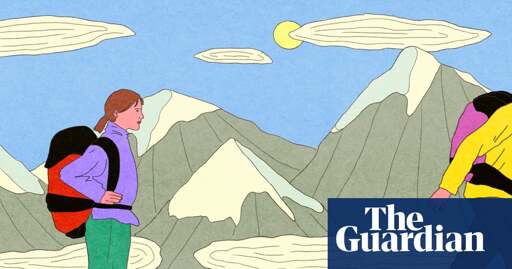
MJ calls what happened to her in Zion national park “small ‘T’ trauma”. She knows women have experienced worse from their partners. But she still feels the anger of being left behind on a hike by her now ex. “It brings up stuff in my body that maybe I have not cleared out yet,” she said.

Five years ago, MJ and a new partner – he was not exactly her boyfriend, and the pair were not exclusive – traveled from Los Angeles to Utah for an adventure getaway. MJ, who is 38 and works in PR, was looking forward to exploring Zion’s striking scenery; its vast sandstone canyon and pristine wading trails were on the list. But on the morning of their big hike, MJ was not feeling well. She could not shake the feeling that something was “off”; indeed, MJ would learn on this trip that her partner was seeing other women.

As they made their way up Angel’s Landing, MJ’s partner started walking faster than her. “I could tell it was getting on his nerves that I was slow,” she said. “I was like, ‘Fuck it, just go ahead of me.’” He did without hesitation.

When she caught up at the top of the mountain, they took a picture together. Then her partner hiked down the mountain with a woman he had met on the way up, leaving MJ to finish by herself. They broke up shortly after that trip. (MJ asked to be referred to by her initials for the sake of speaking openly about a past relationship.)

Last month, MJ opened TikTok and heard the phrase “alpine divorce”, a label she now attaches to her experience in Zion.

  • ObjectivityIncarnate@lemmy.world
    link
    fedilink
    English
    arrow-up
    4
    arrow-down
    2
    ·
    2 days ago

    The term “Alpine Divorce” isn’t a new trendy term coined from TikTok, y’know.

    Meanwhile, the very first sentence of its Wikipedia page, lol:

    Alpine divorce is a new informal term emerging in 2026 in popular and social media

    • Velma@lemmy.today
      link
      fedilink
      English
      arrow-up
      3
      arrow-down
      4
      ·
      2 days ago

      I was sincerely open to a conversation with you, but I guess downvotes and scorn is all I’m going to get from you.

      Thanks, I guess.

      • ObjectivityIncarnate@lemmy.world
        link
        fedilink
        English
        arrow-up
        1
        arrow-down
        1
        ·
        edit-2
        15 hours ago

        I was sincerely open to a conversation with you

        No, you weren’t. Your comments are dripping with condescension and sanctimony, not to mention projection (care to cite the “scorn” in anything I wrote?).

        • Velma@lemmy.today
          link
          fedilink
          English
          arrow-up
          1
          arrow-down
          1
          ·
          15 hours ago

          When you reply to my comment:

          Just because it’s a type of abuse that happens at lower rates than other types doesn’t mean it’s worthless to talk about. For these women, it is a very real occurrence that happened to them. Why not give them space to share their stories?

          with an ‘lol’ and deflection, yeah, it feels scornful.

          Just say you don’t want to hear about women’s abuse stories and be honest.

          • ObjectivityIncarnate@lemmy.world
            link
            fedilink
            English
            arrow-up
            1
            arrow-down
            1
            ·
            15 hours ago

            The only time I wrote “lol” was when I noticed that the very first sentence of the Wikipedia entry of the term “alpine divorce” directly contradicted your assertion that it “isn’t a new, trendy term”. I found that funny. That had literally nothing to do with the actual subject matter of the OP, and had everything to do with discussion of the rate of incidence of a slang term in colloquial parlance.

            It’s literally the opposite of “deflection” to directly address what you wrote (I quoted exactly what I was responding to), and it’s definitely not “scorn” to be amused by a contradiction. To even consider assigning the word “scorn” to something so trivially insignificant only bolsters your first impression of being an outrage junkie.

            Just say you don’t want to hear about women’s abuse stories and be honest.

            If anything in this thread actually deserves an exasperated “oh my fucking god” reaction (and/or a “lol”), it’s this. Come down from your cross, drama queen.

            • Velma@lemmy.today
              link
              fedilink
              English
              arrow-up
              1
              arrow-down
              1
              ·
              14 hours ago

              The entire article is women sharing stories of being abused in a specific way and the men in here are clutching their pearls about having to read about it. So many “not all men” type comments.

              I don’t care if you think I’m a drama queen. Women deserve to be heard.

              • ObjectivityIncarnate@lemmy.world
                link
                fedilink
                English
                arrow-up
                1
                ·
                14 hours ago

                I don’t “think” you are a drama queen. It’s self-evident, from what I quoted. Not a single word of anything I said could genuinely lead to the ridiculous conclusion you did, in any rational mind.

                That said, it matters much more that you don’t care about objectivity, accuracy, and intellectual honesty. You’re unfortunately more interested in labeling merited refutations of your demonstrably-bogus assertions as misogyny (which, naturally, magically justifies dismissing them outright), than actually accepting your error and learning from it.

    • Velma@lemmy.today
      link
      fedilink
      English
      arrow-up
      3
      arrow-down
      4
      ·
      edit-2
      2 days ago

      TikTokers talking about alpine divorce might not know that the phrase comes from an 1893 short story by the Scottish Canadian writer Robert Barr about an unhappily married couple who spends a weekend away in the Alps. The husband had planned to push his wife off the summit during a hike, but in an O Henry-esque twist, the wife tells him she has framed him for murder before jumping off the ledge herself, right before the police she called show up.

      Literally in the article that we’re all talking about.

      Edit: Oh my fucking god, it’s on the wikipedia page as well if you had bothered to read further:

      The origin of the term is in a 1893 short story by Scottish Canadian writer Robert Barr about an unhappy married couple that spends a weekend in the Alps. The husband plans to push his wife off the summit, but she tells him she’s framed him for murder, then she jumps, just as the police arrive.[3]

      • ObjectivityIncarnate@lemmy.world
        link
        fedilink
        English
        arrow-up
        1
        arrow-down
        1
        ·
        edit-2
        15 hours ago

        You’re being deliberately obtuse, and the feigned indignation (“Oh my fucking god”) just amplifies its obnoxiousness, in my opinion. It was used once in a short story over a century ago, but it’s only started to become a common term very recently.

        Would you argue that “sus” doesn’t count as modern slang, because it was used as slang for “suspicious” in the early 1900s? Or would it be moronic to seriously argue that, because it’s obviously only exploded as common slang much more recently?

        • Velma@lemmy.today
          link
          fedilink
          English
          arrow-up
          1
          arrow-down
          1
          ·
          15 hours ago

          Alpine divorce may not have been the most popular way to describe these type of circumstances where a man leads his partner into the wilderness and abandons her to die before this tiktok trend, but its a term that has been around for a long time and there have been plenty of men who have taken these kinds of actions against their partners.

          Facts don’t care about your feelings.

          The available data still matters, and it is worth being careful with it. A study of hiking accidents in the Austrian Alps between 2015 and 2021 found that men accounted for 80.8 percent of fatal victims, while nonfatal accidents involved more women. Those numbers are obviously not enough to make “alpine divorce” a statistical category of its own. What they do show is that the term’s recent rise does not come from some newly discovered data point. It comes from stories that expose a relational blind spot that broad accident statistics are not very good at capturing.

          Forums do not replace studies or court records, but they do bring back the scene before the tragedy—or far away from tragedy. They show the moment when someone realizes, too late, that the “we just have different paces” line they had heard for months was not really describing the situation. It was putting them in their place. That is why the term hits a nerve. The mountains do not create these power dynamics from scratch. They strip them down, speed them up, and sometimes make them impossible to ignore.

          That may be why “alpine divorce” has landed so hard. The term is imperfect, but at least it makes one thing visible: the outdoors are not somehow outside society. Trails, ridgelines, approaches, and long descents do not magically wash social power dynamics away. They carry them with them. And when one person walks ahead and treats their own stride as the only measure of the world, that is not just a story about cardio. It is also a story about power.>>

          • ObjectivityIncarnate@lemmy.world
            link
            fedilink
            English
            arrow-up
            1
            arrow-down
            1
            ·
            edit-2
            14 hours ago

            Firstly, cite what you quote from elsewhere in the future, if you want to be taken seriously. I found it myself, so no need in this case, anymore.

            Secondly, that cited study of hiking accidents has literally nothing to do with ‘alpine divorce’—it makes no differentiation between hiking injuries following from someone being abandoned by someone else (much less specifically a man abandoning a woman) after going hiking together, and accidents that happen under any other circumstances. It’s a study about hiking accidents overall, and it’s extremely disingenuous to even attempt to reach any conclusions about ‘alpine divorce’ based on its data.

            This is the study that was cited. Here are the variables about the accidents it had access to:

            For each victim, the following characteristics were reported: sex, age…, alcohol intake on the day of the accident (yes, no, not specified), rescue by helicopter and/or terrestrial rescue, type of trail…, and accident happening during the ascent or descent. Furthermore, the report specified the injury cause…, injury degree…, injury type…, and injury location…

            Can’t help but notice not a single data point related, at all, to even going hiking with someone else, much less anything about being separated from them during the hike.

            It’s a massive, desperate straw grasp by the author to cite this study in support of any assertion about the frequency of ‘alpine divorce’, and no less of one by you to try and bolster your assertion with it.

            “Facts don’t care about your feelings.” Once again, your own words come back to bite you; it’s obvious your feelings/biases led you to willfully discarding the part of your brain that would easily have seen how nonsensical that article’s claims are. I can find literally no data about how common this ‘phenomenon’ even is, much less anything about it becoming more or less frequent over time, and from what you’ve written so far, I have a feeling that I’ve ironically looked harder for it than you have, being the one of the two of us who isn’t driven by bias.