

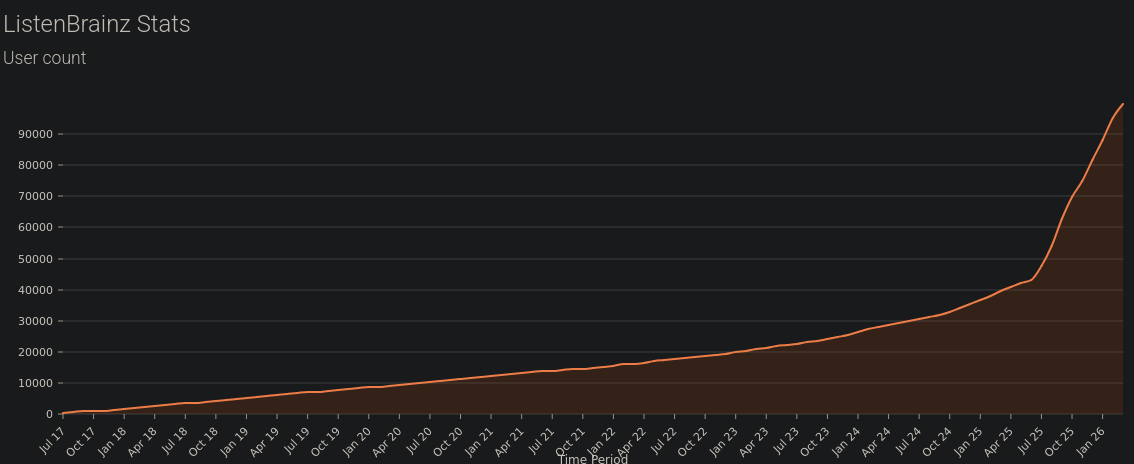
Allow me to spread the word about ListenBrainz , the occasion being that ListenBrainz is about to hit 100.000 users.
ListenBrainz is a FOSS project that aims to crowdsource listening data and release it under an open license. Basically it’s Last.fm but better. Whatever you use to listen to music, you can probably link it up with ListenBrainz. For instance you can connect Spotify, Apple Music, Soundcloud, Last.fm . You can link it up with loads of music players . If you’ve kept track of your what music you’ve listened to up to this point, don’t worry, there are several ways to import them into ListenBrainz.
All ListenBrainz listening data is available for all to use. This means that we don’t need to rely on big companies like Spotify for recommendation algorithms. We can use whatever algorithm suits us best. All sorts of other services could be build to make use of the ListenBrainz data set. The dataset can also help analyze other services’ algorithms, for instance the Fair MusE project uses LB-data and LB-users to investigate the fairness of different music service algorithms.
Obviously ListenBrainz initially suffered from being a comparatively small service, For good recommendations you need loads of data. But it’s growing every day and I feel like the 1 billion listens is an impressive milestone. And ListenBrainz has the advantage of having listening data from several services, Spotify could never recommend you music that’s not on Spotify. ListenBrainz, because it’s open, doesn’t have such inherent blindspots.
I am not working for ListenBrainz in any way, I just really like this project as well as MusicBrainz , and I like to spread the word. I think the aims of the ListenBrainz probably align with some Fediverse-folks. If you don’t care about the service itself, you could still link up to support FOSS music services, not only LB itself, but other services that are, can and will be built using LB’s data. If you use another service to store your own listening data, for instance Last.fm, you could use ListenBrainz as a backup for you data in case the other sevice ever enshittifies. Note: you shouldn’t sign up if you want your listening data to be private, that’s not what LB is for. I care very much about privacy, but in the case of LB I consciously choose to share my music listening data with others for my own benefit.
Curious to hear peoples thought on all this.
P.S. I have posted about LB over a year ago. I don’t intend to spam this service, but i feel like it could be useful for folks on here, and I think most of you folks would support the spreading of FOSS. And LBs usercount rising from 36k january last year to 100k now seemed like a good celebratory occasion to spread the love once more.
So what happens to the data? As far as I can see you’re uploading your music listens to the service and you don’t have a private profile, it’s always public and everything is being provided as a download for everybody. So everybody can get the full amount of my listening history, including Metadata telling them for example when I was awake, listened to sad songs or drinking songs on a thursday night?
Yes, there is not a feature for private profiles. If your listening data is a privacy concern to you it’s better not to use LB.
I felt a bit weird about it at first, but the one thing keeping me tied to Spotify was how useful it was for discovering new music (though even that had been degrading by the time I cancelled it).
If you’re someone who either prefers to listen to music that they already know and love, or someone who enjoys discovering new music through manual effort, then Listenbrainz isn’t for you
However, if you’re currently relying on the recommendations of a service like Spotify, then it’s at least worth considering. For me, I became a lot more at ease with Listenbrainz when I realised that this kind of music recommendation simply isn’t possible without other people’s data — and that part of the “price” for being able to access recommendations built from that data is that my listening history gets added to the pool of listening data used by the recommendation system.
If it’s Spotify’s pool that I’m contributing to, then I feel like I’m getting a pretty bad deal, because they hoard that data like a digital dragon, and then use it to further entrench their monopolistic position in the market. I don’t like that — it makes me feel complicit in the grossness.
Whereas with Listenbrainz, I’m contributing to a data commons of sorts. Listenbrainz’s recommendation algorithm has gotten so much better in the couple of years that I’ve been using it, and that wouldn’t be possible without a growing pool of data. Independent researchers and developers are able to benefit from it, and the more people we have making stuff in this space, the more we chip away at Spotify’s power.
Like I said, having my data be so public does make me feel a tad uneasy, but with data like this, it tends to only be valuable in bulk (meaning the system doesn’t care about any individual’s sad drinking songs), or hypothetically, to individuals who are excessively concerned with another individual (such as stalkers, I guess). However, that last point doesn’t concern me, because I made my Listenbrainz account under a username that’s unconnected to any of my others, and my profile shows no indication of who I am on Spotify.
I’m sure that someone dedicated and skilled enough could retrieve my Spotify account name from the system, because I linked my account way back when I did have Spotify, but I trust Listenbrainz with my data a hell of a lot more than I do Spotify. Spotify definitely have way more money to hire cybersecurity folk to prevent exfiltration of user data, but they’re so opaque that even if there were a breach, I wouldn’t trust them to tell me. I’ve been following Listenbrainz’s development for a while, and they’re pretty cautious and transparent with how they go about things.
To be clear, I’m not formally affiliated with Listenbrainz in any way. I have contributed to improving documentation a few times (because that’s usually the best way I can support open source projects, as a mediocre programmer), but that stems from the same thing that made me write this comment: I just really like what they’re trying to do, and I think the world would be a little better if more people joined it. (also, I am just a huge nerd for metadata schema, and the affiliated musicbrainz project has so much cool stuff for me to learn about)
Yeah, I think one issue is how this aggregate data is being provided for download. Is it really “this user has listened to this song on this day at this minute”, or is it kind of an aggregate data like “users who listen to Metallica also listen to Pantera” and “the most listened song for Taylor Swift is shake it off”?
Yes I think it is like you describe.
Here is someone from MetaBrainz explaining why.