

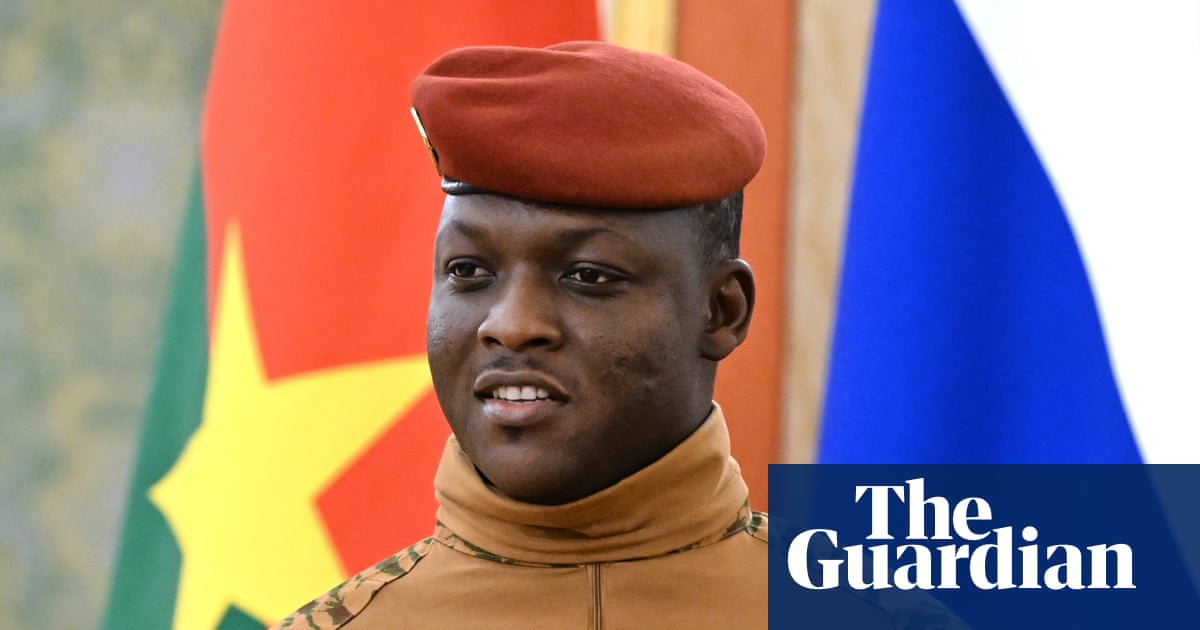
Ibrahim Traoré, who took power in 2022 coup, tells state broadcaster ‘we must tell the truth, democracy isn’t for us’

People in Burkina Faso should forget about democracy as it is “not for us”, the military president, Ibrahim Traoré, told the country’s state broadcaster.

Traoré took power in a coup in September 2022, toppling another junta that had taken power just nine months earlier. He has since stifled opposition and in January banned political parties outright.

A transition to democracy had originally been planned for 2024, but that year the junta extended Traoré’s rule until 2029.

“We’re not even talking about elections, first of all … People need to forget about the question of democracy … We must tell the truth, democracy isn’t for us,” Traoré said in an interview on Thursday with the state broadcaster Radiodiffusion Télévision du Burkina (RTB).

  • Keeponstalin@lemmy.world
    link
    fedilink
    English
    arrow-up
    1
    ·
    2 hours ago

    First, thank you for well written response

    It’s true that Fanon himself did not write too much on neocolonialism, as it was a bit past his time. However, if you understand how reactionary sentiments foment in the process of an anti-colonialist revolution, it’s not difficult to understand how that persists in the face of neocolonialism, as western empires continue to subjugate these nations with modern methods.

    In the case of Burkina Faso, we can’t ignore France’s neocolonialist actions since their independence. They have not been sovereign in the same sense that western nations have. While western nations were able to develop civil rights free of the constant battle against neocolonial dominance, this is still not the case for countries like Burkina Faso. France has still been a constant threat against their sovereignty, and as such, the anti-western hardliners continue to stay in power.

    Spoiler

    Unlike what they did in Indochina and Algeria, France granted independence to most of its West and Central African colonies peacefully in the 1960s. Just because these new countries were independent in name, however, does not mean they were sovereign… the African Financial Community (CFA) franc monetary zone, which is inherently unequal and rooted in exploitative practices.

    For decades, France had a certain level of control of Burkina Faso’s monetary situation through their establishment of the CFA Franc zone, This monetary union between numerous West African countries and France, stipulated that these countries maintain their monetary reserves within French treasuries [8]. This monetary policy resulted in an economy that increasingly favored French imports instead of attempting to rely on domestic production, which maintained the historical level of dependence on France that existed within the country and neighboring regions. This dependence on France has made it difficult for Burkina Faso to sustainably develop local communities due to economic policies that favor foreign influences instead of local development.

    On 15 October 1987, the socialist president of Burkina Faso, Thomas Sankara, was assassinated, aged 37. He was killed in a military coup that is suspected to have been backed by France, the former colonial power.

    After Sankara’s death, Burkina Faso entered a period of political instability, marked by coups, military regimes, and civil unrest. During this time, France played a significant role in Burkina Faso’s political affairs, supporting various regimes and exerting its influence on the country’s economic policies. This led to the emergence of neocolonialism, where France maintained its grip on Burkina Faso’s political and economic systems, despite the country’s formal independence.