

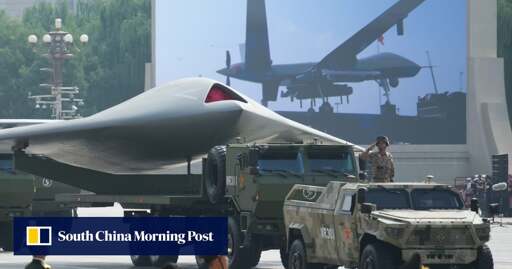
Scientists in China have demonstrated a wireless power transmission system that uses a ground-based microwave emitter to beam energy to an antenna array mounted on the aircraft’s underside. Importantly, they were able to do this while both the drone and charging system were in motion.
In tests, the car-mounted system kept fixed-wing drones in the air for up to 3.1 hours at an altitude of 15 metres (49 feet). The key challenge that the team overcame was maintaining alignment between the emitter and the drone during flight, wrote Song Liwei, the project’s leader.
I have the feeling that current refueling in flight procedures are clearly more vulnerable than this approach that do not require physical coupling, for whatever these are useful (increasing operation autonomy, etc) the same for having to land in air carriers to extend patrolling times, this electric alternative seem safer in both scenarios, and at least with no more weak points than the fuel alternatives.
If is necessary to reload ammo no refueling-in-flight technology applies of course.
And if something blow up the damage radio clearly propagate immediately further than a battery fire, though regaring the situation a persistent fire can become also problematic, but these battery issues are still experiencing improvements, same happened with fuel counterparts (self sealing deposits, etc).
If this technology matures also recharging times will drop, we are seeing huge advances in plugged batteries.
I still see many advantages to the concept.
I think they are equally vulnerable, only in different ways.
My point earlier: while it is true that fuel explode and the damage propagate faster, it is easier to replace a tank (trucks) than a battery that can be made useless just damaging it, no need to destroy it.
Up to a point yes, but it has physical limits (not unlike fuel refuelling, only diverse)
It can. It need to be seen if it is scale well enough to be used on more than a test in a real life situation.
Physical coupling and emergency decoupling of a fuel tube in flight due to engaging or having to land and take off from an air carrier seems necessarily more slow and risky than beam interrumpion or nor having to land/take off at all.
Current batteries have not been under the same amount of research than fuel deposits, so I think that being matture enough, contacless repowering seems a great asset in any scenario.
Refuelling could be slower, I agree, but I am not sure that is more risky, wireless recharging simply has a different set of problems.
True, but as far as you can advance contactless recharge, I am afraid physic and air are not on your side.
But as I said, I am curious about the development of this technology, leaving aside the fact that basically you cannot deploy it anyware if not your home county (or allied) and that in my opinion is a way bigger limit to it usefulness.