

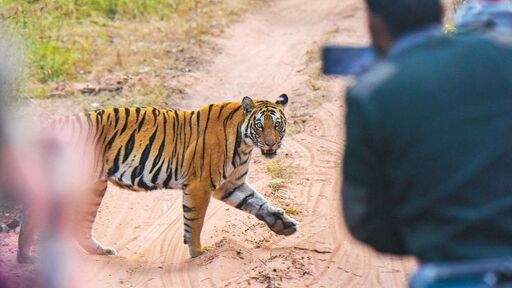
You’re riding in a Jeep through a sun-dappled forest in India, when right before your eyes, a majestic tiger appears from the undergrowth. You immediately reach for your phone, angling it so you can capture your awestruck face and the majestic cat in the same frame. Success – you get the shot right before the predator slinks away.
Capturing such an image is the stuff of travel dreams. But thanks to a ruling from India’s Supreme Court, it’s a scene India’s forests won’t see for much longer. A supreme court ruling passed in November 2025 has led to the banning of mobile phones from the core tourism zones of some of the country’s tiger reserves, deeming the devices – and the behaviour safari tourists exhibit when using them – too dangerous to humans and wildlife alike.
This February, a shocking viral video illustrated how bad things have got. In it, a wild tiger in Ranthambore National Park, Rajasthan is surrounded by multiple safari vehicles and is forced to pick its way around them to escape to the forest, while metres away, tourists snap photos and shout. The tiger appears cornered and stressed. In India, these kinds of overcrowded wildlife moments, termed “safari jams”, are increasingly common.
Yeesh…
My first thought was at least people with actual cameras can at least be annoying from further away, but this comment from the guide reminded me this is still a problem in a lot of areas with easy access everywhere. I’ve seen plenty of scenes where an animal will live in a readily accessible place and people just swarm the location. Just because they can take a photo further away still doesn’t necessarily make it the photo they want. People will always want better.
Ecotourism can be great, but the focus needs to be on the animals, and the tourism needs to come second. Pretty much all of these animals are “rare” because people couldn’t be bothered to leave them alone.
These seem like basic, common sense rules. I see no problems here. It’s a good start.