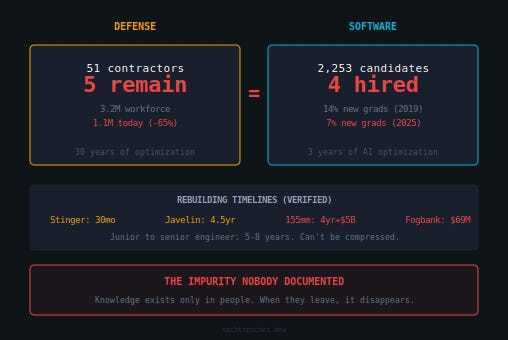
The defense industry lost the ability to make weapons when crisis hit. The same pattern is eroding software engineering skills. The timelines are identical.
This article is slop written by a brainwormed NAFO liberal who thinks he ate wisdom by the spoonful.
Apart from this:
I run engineering teams in Ukraine.
Which should already raise some eyebrows; the author compares a process in the weapons industry that occurred over multiple decades with a phenomenon that has existed in its current form for a little over 3 years, and has been viable for coding for maybe a year at this point.
That is not enough time for talent to be irreversibly lost, and it is frankly doubtful whether the current AI models can sustainably remain active. In all likelihood, they cannot, as usage prices are already skyrocketing, the compute power isn’t there and can’t be built on time (relating directly to the manufacturing problem), and the quality of output is hitting a limit that makes it unsuited for any application that requires high precision (which is to say, most of them), thus requiring manual review, which in turn requires people.
The following paragraph tells me that this is a liberal who has recently discovered facts about industrial manufacturing that people on Hexbear have been aware of for years:
I wrote about the talent pipeline collapse before. The hiring numbers and the junior-to-senior problem are documented. So is the comprehension crisis. What I didn’t have was the right historical parallel. Now I do.
But the comparison is nonsense, because manufacturing went away not because there was some miracle tool that Techbros believed in, but because demand disappeared as the Soviet Union collapsed and the West moved to Financialization and an ever increasing service industry; an area for which programmers are essential.
And for that service industry, the demand for programmers hasn’t actually gone down. Instead, corpos are riding a hype wave in a misguided belief that their miracle Wunder-Tool can automate the programmers away. In the long term, it can’t, and by the time this scheme collapses, the people that were fired will still be around.
Now map that onto software. A junior developer needs three to five years to become a competent mid-level engineer. Five to eight years to become senior. Ten or more to become a principal or architect. That timeline can’t be compressed by throwing money at it. It can’t be compressed by AI either.
After 5 years of experience in this industry, and knowing people in other companies who have worked for decades, I can confidently say that this distinction is highly domain-specific and mostly irrelevant. I’ve worked with seniors who had far less drive and ingenuity than mid-level engineers, and those mid-level engineers were rewarded with much lower pay. And if you uprooted both groups out of their current focus within IT, and sent both to work with different tools and languages while still in the software industry, they would likely perform very similarly. A lot of the knowledge you acquire isn’t transferable. Arguably the most important skill is adaptability and the speed at which you can learn new concepts.
Your Stinger Missile equivalent might be a legacy Solaris server or the ATM backend running on COBOL, which requires a dwindling set of experts to maintain. This knowledge has disappeared because the industry evolved so fast that more modern approaches are now more widespread, easier to find jobs for, and are hence more likely to be taught and learned. Some existing businesses could not adapt in time and as a result now depend on hard-to-come-by knowledge. But unlike the arms industry where decade-old weapons systems are still the state of the art, the software industry struggles with legacy systems that were too slow to adapt to a rapidly changing landscape. A problem that has existed since long before AI.
A METR randomized controlled trial found that experienced developers using AI coding tools actually took 19% longer on real-world open source tasks. Before starting, they predicted AI would make them 24% faster. The gap between prediction and reality was 43 percentage points. When researchers tried to run a follow-up, a significant share of developers refused to participate if it meant working without AI. They couldn’t imagine going back.
Which is exactly why AI won’t work out for business in the long run. This statistic tells me that it makes developers more comfortable and less stressed out. They perform comparably, maybe worse, while offloading the energy expense to AI. That’s not what porky wants.
The software industry is in year three of the same optimization.
At the start of year two at best. Claude Code launched in February 2025 and only started being used actively around September. Before that, AI generated code was very limited.
But even that doesn’t solve the deeper problem. The skills you need to be effective now are different. Technical expertise alone isn’t enough anymore. You need people who can take ownership, communicate tradeoffs, push back on bad suggestions from a machine that sounds very confident. Leadership qualities. Our last hiring round tells you how rare that is: 2,253 candidates, 2,069 disqualified, 4 hired. A 0.18% conversion rate. The combination of technical skill and the judgment to know when the AI is wrong barely exists in the market anymore.
This entire paragraph is bunk and reveals that the author is clueless. First of all, technical expertise was never enough. Even in absence of AI, a good software engineer always needed to be able to take ownership of their work, be able to formulate requirements and tradeoffs, and most importantly: be able to review code and push back on bad ideas from OTHER ENGINEERS. It almost seems to me like the concept of a code review was alien to this person before the advent of AI.
If you lacked these qualities, you were bad at your job. These are not “leadership qualities”, these are essential to the job of a software engineer. And the claim that only 0.18% of candidates fulfilled this requirement seems highly doubtful. Truthfully, this paragraph gives me a rather contradictory impression that the author, or the place he worked at, viewed Software Engineers as code monkeys to be outsourced and replaced (again, a pre-existing problem, long before AI).
But the real problem with the AI hype is that skilled engineers who HAVE these qualities cannot find work anymore.
Also:
the judgment to know when the AI is wrong barely exists in the market anymore.
What do you mean “anymore”? Given how recent this tech is, the judgement either existed, or it never did. And besides; if you are able to tell when a grifter is peddling bullshit, you are able to tell if an AI is doing the same.
But crises don’t send calendar invites. Nobody expected a full-scale land war in Europe in 2022. The defense industry had thirty years to prepare and didn’t.
History started in 2022 and there was NO WAY anyone could have predicted it. There was certainly no 8 year long civil war leading up to it. And gee, I wonder what happened 30 years ago that might have cause the West to wind down the arms industry… wait, what the fuck? He clearly has to be aware, otherwise he wouldn’t specifically point out 30 years.
The West already made this mistake once. The bill came due in Ukraine.
Ah, because he’s a NAFO dipshit who is likely very horny at the thought of erasing Russia. That’s why he mentioned 30 years. He’s mad that porky didn’t properly arm up for the coup-de-grace.
The defense industry thought peace would last forever, too.
Suuuuuuuure buddy, the US spending over 25 years im the Middle East killing millions of innocents sure sounds like “peace lasting forever”.
Oh no disagreement on any of the points, but the core thesis that the west is rapidly losing the skills needed to build either physical things or software is very much correct in my opinion. And once those skills are gone, getting them back will not be an easy process.


This article is slop written by a brainwormed NAFO liberal who thinks he ate wisdom by the spoonful.
Apart from this:
Which should already raise some eyebrows; the author compares a process in the weapons industry that occurred over multiple decades with a phenomenon that has existed in its current form for a little over 3 years, and has been viable for coding for maybe a year at this point.
That is not enough time for talent to be irreversibly lost, and it is frankly doubtful whether the current AI models can sustainably remain active. In all likelihood, they cannot, as usage prices are already skyrocketing, the compute power isn’t there and can’t be built on time (relating directly to the manufacturing problem), and the quality of output is hitting a limit that makes it unsuited for any application that requires high precision (which is to say, most of them), thus requiring manual review, which in turn requires people.
The following paragraph tells me that this is a liberal who has recently discovered facts about industrial manufacturing that people on Hexbear have been aware of for years:
But the comparison is nonsense, because manufacturing went away not because there was some miracle tool that Techbros believed in, but because demand disappeared as the Soviet Union collapsed and the West moved to Financialization and an ever increasing service industry; an area for which programmers are essential.
And for that service industry, the demand for programmers hasn’t actually gone down. Instead, corpos are riding a hype wave in a misguided belief that their miracle Wunder-Tool can automate the programmers away. In the long term, it can’t, and by the time this scheme collapses, the people that were fired will still be around.
After 5 years of experience in this industry, and knowing people in other companies who have worked for decades, I can confidently say that this distinction is highly domain-specific and mostly irrelevant. I’ve worked with seniors who had far less drive and ingenuity than mid-level engineers, and those mid-level engineers were rewarded with much lower pay. And if you uprooted both groups out of their current focus within IT, and sent both to work with different tools and languages while still in the software industry, they would likely perform very similarly. A lot of the knowledge you acquire isn’t transferable. Arguably the most important skill is adaptability and the speed at which you can learn new concepts.
Your Stinger Missile equivalent might be a legacy Solaris server or the ATM backend running on COBOL, which requires a dwindling set of experts to maintain. This knowledge has disappeared because the industry evolved so fast that more modern approaches are now more widespread, easier to find jobs for, and are hence more likely to be taught and learned. Some existing businesses could not adapt in time and as a result now depend on hard-to-come-by knowledge. But unlike the arms industry where decade-old weapons systems are still the state of the art, the software industry struggles with legacy systems that were too slow to adapt to a rapidly changing landscape. A problem that has existed since long before AI.
Which is exactly why AI won’t work out for business in the long run. This statistic tells me that it makes developers more comfortable and less stressed out. They perform comparably, maybe worse, while offloading the energy expense to AI. That’s not what porky wants.
At the start of year two at best. Claude Code launched in February 2025 and only started being used actively around September. Before that, AI generated code was very limited.
This entire paragraph is bunk and reveals that the author is clueless. First of all, technical expertise was never enough. Even in absence of AI, a good software engineer always needed to be able to take ownership of their work, be able to formulate requirements and tradeoffs, and most importantly: be able to review code and push back on bad ideas from OTHER ENGINEERS. It almost seems to me like the concept of a code review was alien to this person before the advent of AI.
If you lacked these qualities, you were bad at your job. These are not “leadership qualities”, these are essential to the job of a software engineer. And the claim that only 0.18% of candidates fulfilled this requirement seems highly doubtful. Truthfully, this paragraph gives me a rather contradictory impression that the author, or the place he worked at, viewed Software Engineers as code monkeys to be outsourced and replaced (again, a pre-existing problem, long before AI).
But the real problem with the AI hype is that skilled engineers who HAVE these qualities cannot find work anymore.
Also:
What do you mean “anymore”? Given how recent this tech is, the judgement either existed, or it never did. And besides; if you are able to tell when a grifter is peddling bullshit, you are able to tell if an AI is doing the same.
History started in 2022 and there was NO WAY anyone could have predicted it. There was certainly no 8 year long civil war leading up to it. And gee, I wonder what happened 30 years ago that might have cause the West to wind down the arms industry… wait, what the fuck? He clearly has to be aware, otherwise he wouldn’t specifically point out 30 years.
Ah, because he’s a NAFO dipshit who is likely very horny at the thought of erasing Russia. That’s why he mentioned 30 years. He’s mad that porky didn’t properly arm up for the coup-de-grace.
Suuuuuuuure buddy, the US spending over 25 years im the Middle East killing millions of innocents sure sounds like “peace lasting forever”.
This article is junk.
Oh no disagreement on any of the points, but the core thesis that the west is rapidly losing the skills needed to build either physical things or software is very much correct in my opinion. And once those skills are gone, getting them back will not be an easy process.