

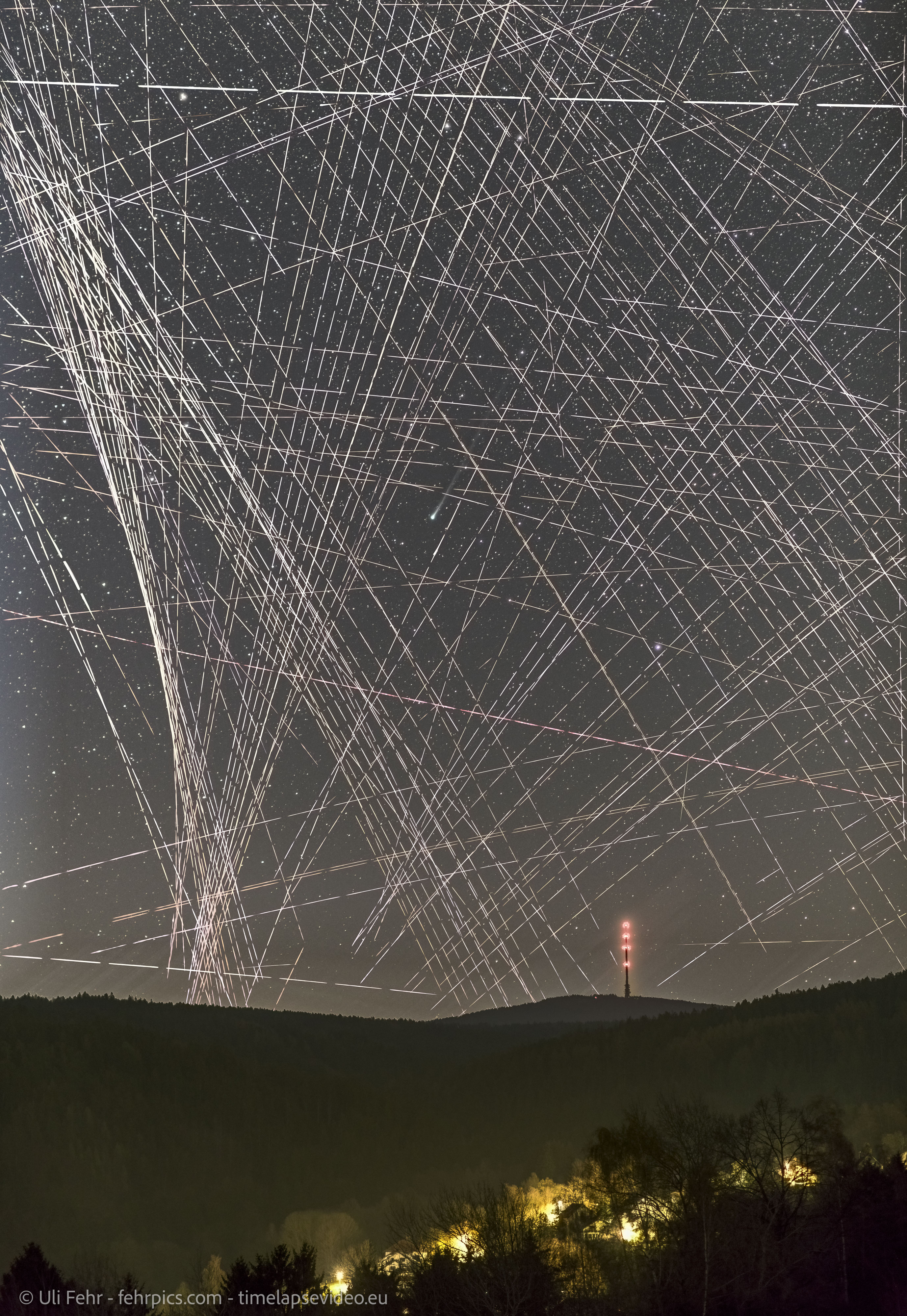
“a bright visitor passing through the inner Solar System. Now, the orbiting satellites themselves only appear as streaks because of the long camera exposure, over 10 minutes in this case. On the contrary, to the eye, satellites appear as points that drift slowly across the night sky and shine by reflecting sunlight – primarily just after sunset and before sunrise. The featured image was taken just before sunrise two weeks ago from Bavaria, Germany.”
I guess the only ways to access the natural sky is to leave the atmosphere or to use AI to remove the trails.
Stupid question: Are they blinking or is that light reflecting? If they’re blinking, why do they blink with visible light?
They aren’t blinking. The apparent blinks are due to intermittent, rather than continuous exposure. The gaps you’re seeing are where the satellites were when the camera wasn’t capturing.
What’s really happening here is that they’ve used a post processing method specifically designed to highlight the satellites rather than the comet. This method would have rejected the satellites.
The post says it’s the reflecting sunlight at dawn/dusk. Just need to read beyond the headline.
Well, I did say it was a stupid question. xD
They often slowly blink, but I think that’s because they are rotating.
Almost all, if not every satellite is going to be reflection. And it’s going to be significantly worse at sunset and dawn since that’s when the satellite is still in the sun but the ground is dark. That just happens to be when comets are typically most visible.
To give a little more context. The tail is created by the solar wind, and is strongest when the comet is closest to the sun. Being near the sun makes it appear close to the sun in the sky (obviously). That puts comets in the daytime sky and impossible to see. It only dawn and dusk when you’re still able to see in the right direction and the sky is dim enough that you are able to observe comets.
May be an artifact of stacking. Each line in the segment could be a single long exposure.