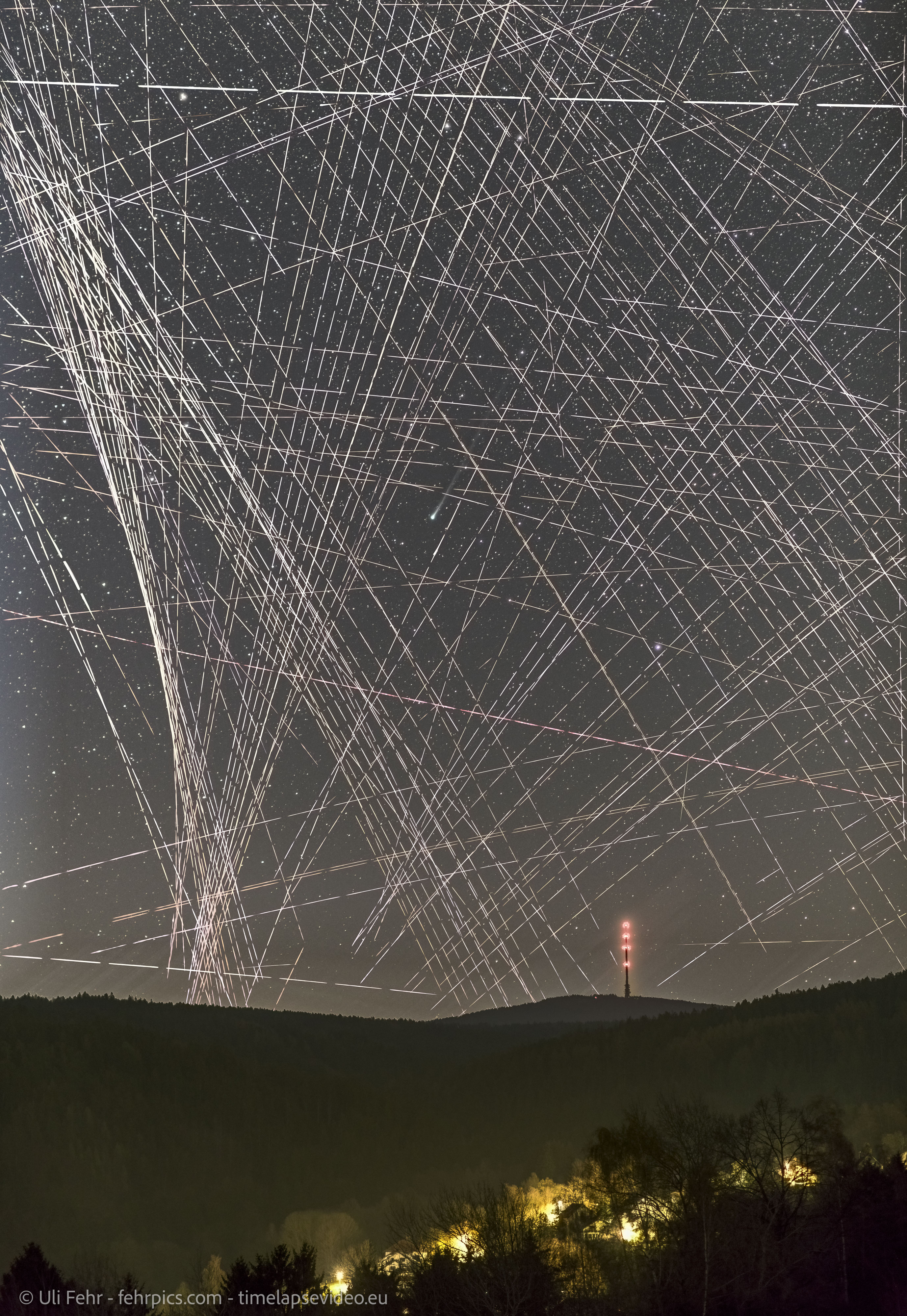
“a bright visitor passing through the inner Solar System. Now, the orbiting satellites themselves only appear as streaks because of the long camera exposure, over 10 minutes in this case. On the contrary, to the eye, satellites appear as points that drift slowly across the night sky and shine by reflecting sunlight – primarily just after sunset and before sunrise. The featured image was taken just before sunrise two weeks ago from Bavaria, Germany.”
I guess the only ways to access the natural sky is to leave the atmosphere or to use AI to remove the trails.
Wouldn’t that have hidden the comet too?
Adding on to the other comment: the specific method I linked is a little crude, and intended to separate perfectly-still objects from all moving objects.
You can fine tune this technique to specifically capture or reject objects moving at certain rates. You could tune it to capture the slow rotation of the stars as the planet turns,for example, while rejecting the movement of the satellites.
Another example: The criss-crossing satellites are at different altitudes and travel at different speeds. You could fine tune this technique to selectively gate either set of satellites while rejecting the other set.
The point is that even though astrophotography is certainly degraded by these satellites, the degradation is not nearly as significant as this particular image would suggest. This image was synthesized by specifically targeting these satellites for inclusion, rather than exclusion.
No, the comet stays almosf stationary to the stars during such a short time. Hence, it is in every image and therefore also in the final median image.
For average astrophotography satellite trails are not really a problem as it may seem here. Almost any image is processed in such a way in any case. But there are special projects which are heavily impacted, for example the search for asteroids. There you need to look at each individual image, as fast moving asteroids would be deleted with this method.