

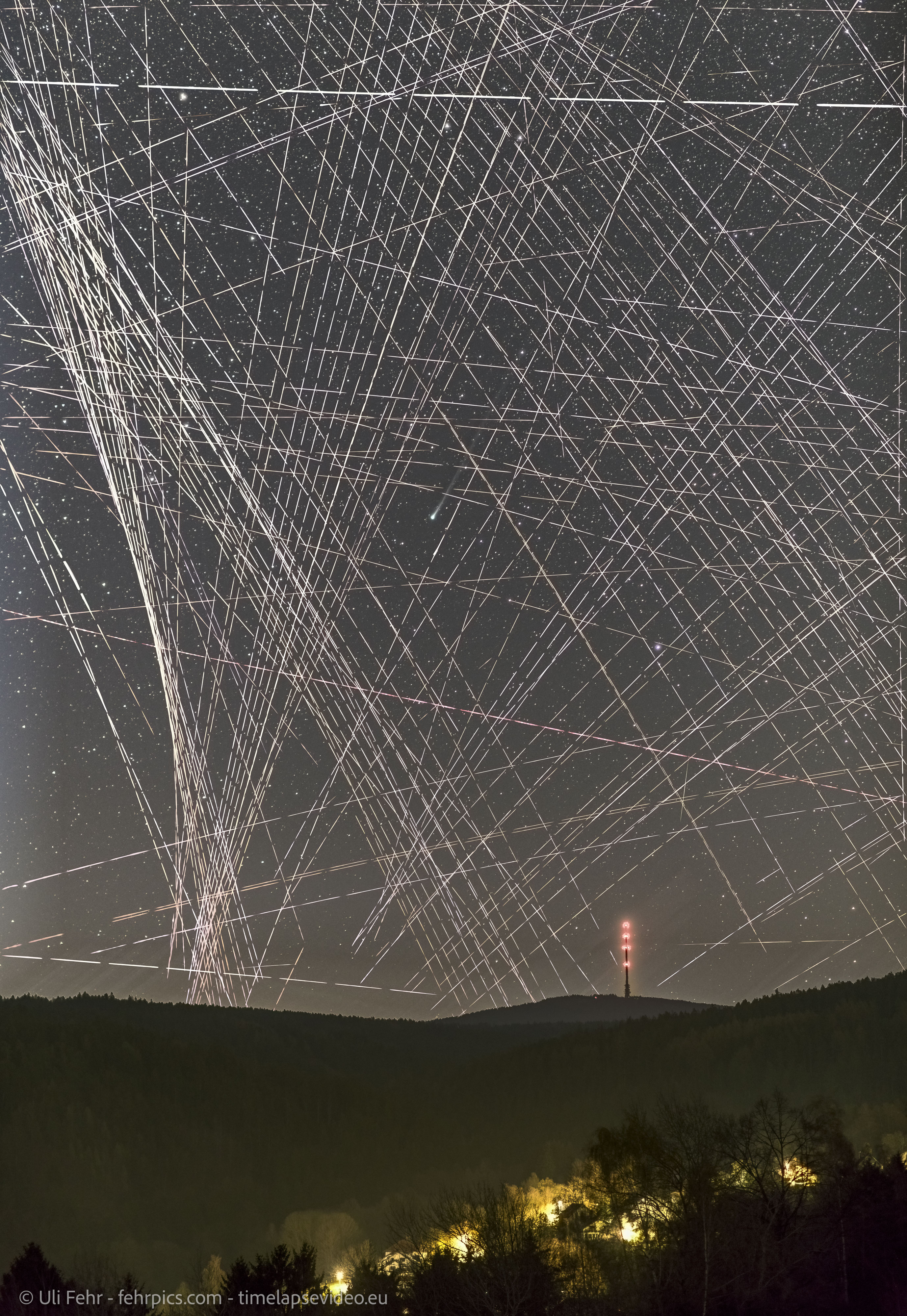
“a bright visitor passing through the inner Solar System. Now, the orbiting satellites themselves only appear as streaks because of the long camera exposure, over 10 minutes in this case. On the contrary, to the eye, satellites appear as points that drift slowly across the night sky and shine by reflecting sunlight – primarily just after sunset and before sunrise. The featured image was taken just before sunrise two weeks ago from Bavaria, Germany.”
I guess the only ways to access the natural sky is to leave the atmosphere or to use AI to remove the trails.
I find it odd you’d say light pollution is worse since LEDs. I thought the design of lights was generally far more directional with LED design and avoided shining light upwards. Now you can fly over large areas with street lighting and only see dimmer reflected light from roads and not the streetlights themselves.
Its true that how we use them makes a big impact. If I recall correctly, some policy changes in France reduced the problem massively. But they’re so cheap and efficient that we’re simply emitting more lumens than ever. For something like $40 USD you can get a flashlight 100,000x brighter than the sun. This is driving rapid lighting in developing countries.
Another factor is that human eyes are much more sensitive to blue wavelengths at night, which LEDs emit more of.