I feel this. I help where I can and it feels like an infinitely deep abyss of need unfillable by what resources I can provide. In times past I’ve been able to come up with $1000 to help someone and before its been the difference between life success and failure. Now $1000 may only fix a single problem for the person and they have 3 to 4 other problems of equal weight with equal consequences. So fixing the one still causes their lives to go off the rails from the other remaining problems.
It makes me feel helpless to not be able to do anything meaningful.
you can still have a huge impact on people in poorer countries
You can pay someone else to presumably benefit from the strong dollar relative. But you’re still playing a trust game with a lot of unknowns.
The “nets for malaria” charity is a great instance of people trying to moneyball the short term pay-off without thinking about long term and second order consequences. Most notably, use of malaria nets for fishing. Counterintuitively, you’d do better supplying a community with fishing nets. Because then they won’t use the malaria nets improperly.
That’s not even to say “don’t send these charities money”. Please do. But chucking money down the “Charity” hole and hoping it lands where it needs to is an act of faith as profound as any religious belief. You are, at the end of the day, playing a game of telephone with everyone between you and the intended recipients.
You rarely, if ever, get to meet the people you’re supposed to benefit. You never get to see the long-term social returns on your investment, particularly when it is happening on the other side of the planet. You don’t build community with any of the people you’re aiding and you’re not anticipating any kind of reciprocal aid in your own time of need.
The impact you have is ultimately invisible to you. The broader social benefits are invisible. The returns are, at the absolute best, a momentary personal sense of good-vibes. There is no virtuous cycle you’re participating in, just an endless void you’re expected to bleed into.


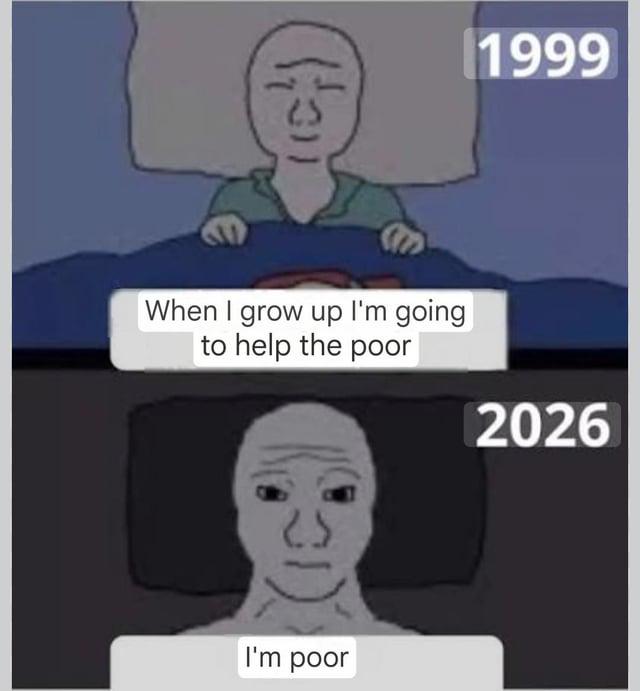
I’m not even poor. But by god, it’s hard to find hours in the day or money in the bank to do anything that feels material and meaningful.
That’s being poor
You can sustain yourself (very comfortably) without having the industrial scale resources to affect your community in the aggregate.
If you don’t have time for life, then you’re poor. The French would have burned down a hundred cars by now
I feel this. I help where I can and it feels like an infinitely deep abyss of need unfillable by what resources I can provide. In times past I’ve been able to come up with $1000 to help someone and before its been the difference between life success and failure. Now $1000 may only fix a single problem for the person and they have 3 to 4 other problems of equal weight with equal consequences. So fixing the one still causes their lives to go off the rails from the other remaining problems.
It makes me feel helpless to not be able to do anything meaningful.
i’m in a similar situation, not poor, but not making enough to get ahead or do anything.
that’s not poor. i’ve been poor. this isn’t that
I’ve got great news for you! Even with little money (from a Western point of view) you can still have a huge impact on people in poorer countries
You can pay someone else to presumably benefit from the strong dollar relative. But you’re still playing a trust game with a lot of unknowns.
The “nets for malaria” charity is a great instance of people trying to moneyball the short term pay-off without thinking about long term and second order consequences. Most notably, use of malaria nets for fishing. Counterintuitively, you’d do better supplying a community with fishing nets. Because then they won’t use the malaria nets improperly.
That’s not even to say “don’t send these charities money”. Please do. But chucking money down the “Charity” hole and hoping it lands where it needs to is an act of faith as profound as any religious belief. You are, at the end of the day, playing a game of telephone with everyone between you and the intended recipients.
You rarely, if ever, get to meet the people you’re supposed to benefit. You never get to see the long-term social returns on your investment, particularly when it is happening on the other side of the planet. You don’t build community with any of the people you’re aiding and you’re not anticipating any kind of reciprocal aid in your own time of need.
The impact you have is ultimately invisible to you. The broader social benefits are invisible. The returns are, at the absolute best, a momentary personal sense of good-vibes. There is no virtuous cycle you’re participating in, just an endless void you’re expected to bleed into.