

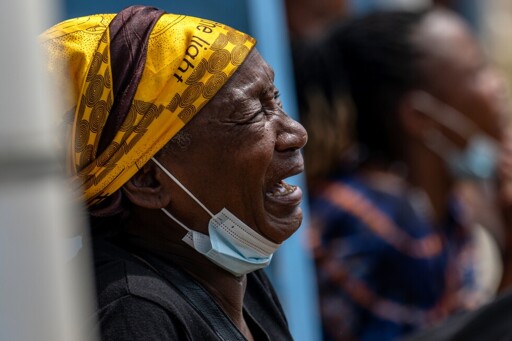
People set fire to an Ebola treatment center in a town at the heart of the outbreak in eastern Congo on Thursday after being stopped from retrieving the body of a local man, a witness and a senior police officer said, as fear and anger grow over a health crisis that doctors are struggling to contain.
The arson attack in Rwampara reflects the challenges of health workers trying to curb a rare Ebola virus by using stringent measures that might clash with local customs, such as burial rites. The disease has been spreading for weeks in a region lacking in health facilities and where armed conflict has displaced many people.
The dangerous work of burying suspected victims is being managed wherever possible by authorities because the bodies of those who die from Ebola can be highly contagious and lead to further spread when people prepare bodies for burial and gather for funerals.
That policy can be extremely unpopular with victims’ families and friends, who aren’t given the chance to bury their loved ones.
ebola virus and the spread by local burial tradition been a thing for a decade now. was the prevention or mediatory unsuccessful?
i have no doubt the science works but looking back at covid and future diseases there is def a human aspect thats clearly still lacking.
I was in this region in the 90s at the height of HIV working with NIH and CDC.
None of this is surprising. There is a very common belief in witchcraft and a distrust of foreigners explaining viral transmission. People will avoid doctors and hospitals and seek churches first and local healers who claim to cure everything with herbs. It’s where parts of US are heading.
For HIV, we did not anticipate that Africans in some regions have sex differently. In that culture, they practice vaginal drying prior to penetration, which led to a very high HIV transmission rate between men and women. Nothing we did to educate likely made any difference.
What exactly is vaginal drying and why does it lead to higher transmission rates?
I can answer the 2nd, but also curious about the first.
HIV transmits easiest through blood, so if two people both bleed during intercourse, that gives a much higher transmission rate.
Same reason why it has a higher transmission rate among gay men.
Edit: did some extra research, its not just because of blood, also other fluids make transmission easier through thin rectal tissue. So the gayen part doesn’t really apply
It’s not quite as easy as “stop kissing corpses” though. It’s more like “don’t go near your loved ones as they slowly die in terrible pain”, which is very easy to say, but probably a LOT harder to do.
My best friend died of COVID. His loved ones weren’t able to be by his side in those last moments, for obvious reasons, and that left a wound that really disrupted my ability to grieve in the wake of his death. If I had been allowed to be there with him, I know that to actually do so would expose myself to a lot of risk, even though it was likely that we had been infected with the same strain of COVID (due to us being bubbled together and falling ill at the same time — me and his housemate had recovered by the time he died, but it would’ve still been risky for us to be there).
Despite this, I honestly don’t know whether I would have been able to stop myself from being there with him at the end. It’s easy to have disdain for people being foolish in this way, but I also have a lot of sympathy for people who make this choice — it’s not necessarily a case of people being unaware of the risk.
Ebola is endemic in the region (I think bats carry it). As a result, there will be contagion sometimes, specially more so with climate change and destruction of habitats. Until a cure is developed, we need to treat the sick and try to prevent spread. There is no easy solution to this problem, or MERS, or Hantavirus, or…. Well, you get the point.
And this isn’t just a case of more exposure to the source zoonotic exposure vector thanks to climate change or humans encroaching on their habitats, this is a concerning strain that had more cases discovered in the first 48 hours than the worst previous cases of spread have at their max after weeks or months of spread. That makes these containment efforts very necessary and very smart.
I appreciate this being a reply that engages with the human experience folks are having there as much as the need for treatment and containment measures
Obviously its not helpful to burn treatment clinics. And also, very clearly theres a large cultural and human need that needs to be addressed in some way to manage the current crisis.
Kinda just a sad situation all around. Burial traditions and the grieving process are really important, and being denied the ability to participate in them must be deeply painful. I hope that medical and cultural practices can somehow adjust over time and find something more stable long term