

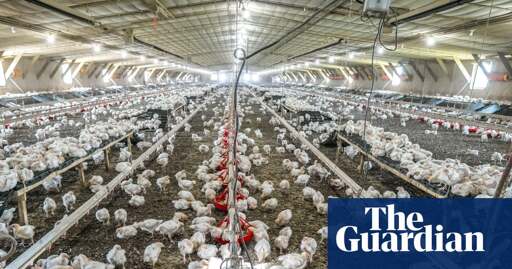
UN report says global meat supply has risen fourfold in last 60 years and is expected to keep rising

The average person eats about six times as much chicken and twice as much pork as their grandparents’ generation did, data from a UN report suggests, with global meat supply having risen fourfold in the last 60 years and expected to keep rising.

The supply of poultry rose from below 3kg a person in 1961 to 17kg in 2022, according to data from the Food and Agriculture Organization (FAO). Pork supply doubled to 15kg a person over the same period, while beef, the most polluting food, stayed steady at 9kg.

Agriculture is the second most polluting sector of the global economy. Its planet-heating emissions are forecast to rise by 7.6% over the next decade, according to the FAO’s review of the science on the drivers of meat supply and demand, with livestock responsible for an estimated 80% of the increase.

  • Arcanepotato@crazypeople.online
    link
    fedilink
    English
    arrow-up
    5
    ·
    2 days ago

    The “we” here is global, so I don’t think your question has a neat answer that can be applied in all regions.

    From the report:

    The global supply of terrestrial animal source food (TASF), namely milk and dairy products, eggs and meat, has rapidly increased between 1961 and 2022. The increase in per capita supply of TASF was driven by three commodities: eggs, poultry meat and pig meat.

    This chart is not talking about causes but it is interesting:

    More protein is consumed overall in higher income countries but less is coming from plants and more from animals.

    Poultry is projected to account for about half of the global growth in meat production (see Figure B39 and Figure B40) due to sustained profitability and favourable meat-to-feed price ratios.

    About two-thirds of all meat is expected to be consumed by one-third of the world’s population in 2032, which is only a slight improvement from the base period (see Figure B42).

    Increases in meat consumption have raised concerns about long-term sustainability, given the pressure that this consumption exerts on global resources, as well as the meat production sector’s contributions to greenhouse gas (GHG) emissions. These mounting environmental and health concerns are expected to continue to shift consumer preferences away from red and processed meat, notably beef, towards leaner and allegedly more environmentally friendly alternatives, notably poultry and fish. These shifts are especially pronounced in consumers in Europe and Northern America. In sub-Saharan Africa, demand for poultry will primarily be driven by the greater affordability of poultry compared to beef, rather than by long-term sustainability concerns.

    So:

    1. Greater overall global consumption of protein
    2. As protein consumption increases more it comes from animal flesh and excretions vs plants
    3. Cost is a large factor in how much animal flesh is consumed
    4. Production of foods from poultry flesh is profitable
    5. Foods from poultry flesh are more affordable than foods from other animal bodies, driving up the consumption of poultry flesh.