I corrected my first comment in the comment you just replied to:
In both slate and rivian’s case (I think), they seem to use a hybrid of both
Everywhere I’ve found calls it a hybrid or mix of both options. This is how Rivian does their bodies as well, which means Slate may not fully fix this “more expensive to repair than standard body-on-frame” problem. At least, Rivian calls it a “unique” body on frame.
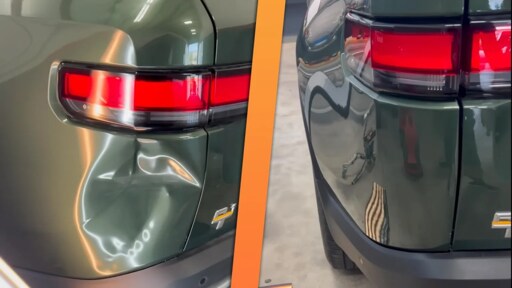
Here’s an R1T, for example and to compare:
I do see that the Slate’s bed body is less of a unibody compared to the R1T, however it otherwise is very similar. I’m betting that the Slate will be cheaper to repair in the rear, from a labor and material sense, however I think it will suffer from similar problems elsewhere.
Don’t get me wrong, I’d love to have a Slate regardless. R2 is a full unibody, which will almost definitely make repairs more costly, as well.
Frame on rails doesnt save you any money in repairs if the frame is damaged. The real key is to hace rapairability as part of the design. The problem with the rivian isnt that its unibody, its that the exterior pannels are part of the unibody, so a small exterior dent is essentialy frame damage. That being siad, its likley cosmetic damage.
EVs will never be frame on rails due to battery packaging. The most likley similar design would be body on “skateboard” as they call it. But the hybrid approach does make better cars. Frame on rails has issues with twisting and flex that unibody solves. This makes the cars drive softer and handle better.
But either way, any design could have easy replacable exterior panels. Most unibody designs still have replacable bumpers, front quarter panels, mirrors, doors, trunks, etc. For some reason though they dont do usually do it on rear quarter panels, which is where the costs skyrocket. Just like in that r1t picturee above. The rear quarter panel could have been a replacable part. There may be a good reason for this, but i suspect its mostly production cost savings, with maybe a bit of weight savings.


I corrected my first comment in the comment you just replied to:
Everywhere I’ve found calls it a hybrid or mix of both options. This is how Rivian does their bodies as well, which means Slate may not fully fix this “more expensive to repair than standard body-on-frame” problem. At least, Rivian calls it a “unique” body on frame.
Here’s an R1T, for example and to compare:
I do see that the Slate’s bed body is less of a unibody compared to the R1T, however it otherwise is very similar. I’m betting that the Slate will be cheaper to repair in the rear, from a labor and material sense, however I think it will suffer from similar problems elsewhere.
Don’t get me wrong, I’d love to have a Slate regardless. R2 is a full unibody, which will almost definitely make repairs more costly, as well.
Frame on rails doesnt save you any money in repairs if the frame is damaged. The real key is to hace rapairability as part of the design. The problem with the rivian isnt that its unibody, its that the exterior pannels are part of the unibody, so a small exterior dent is essentialy frame damage. That being siad, its likley cosmetic damage.
EVs will never be frame on rails due to battery packaging. The most likley similar design would be body on “skateboard” as they call it. But the hybrid approach does make better cars. Frame on rails has issues with twisting and flex that unibody solves. This makes the cars drive softer and handle better.
But either way, any design could have easy replacable exterior panels. Most unibody designs still have replacable bumpers, front quarter panels, mirrors, doors, trunks, etc. For some reason though they dont do usually do it on rear quarter panels, which is where the costs skyrocket. Just like in that r1t picturee above. The rear quarter panel could have been a replacable part. There may be a good reason for this, but i suspect its mostly production cost savings, with maybe a bit of weight savings.
I think on the Slate, the only part of the frame that is exposed as outer body are the A pillars. Everything else is a panel that bolts on.
I think that is their plan. But until we start seeing production cars, i will remain skeptical.
Car magazines and Youtubers will whine about panel gaps.
Frame on rails wil never pass crash testing. This is a loophole for trucks and yet people think big trucks are safer, they aren’t.