

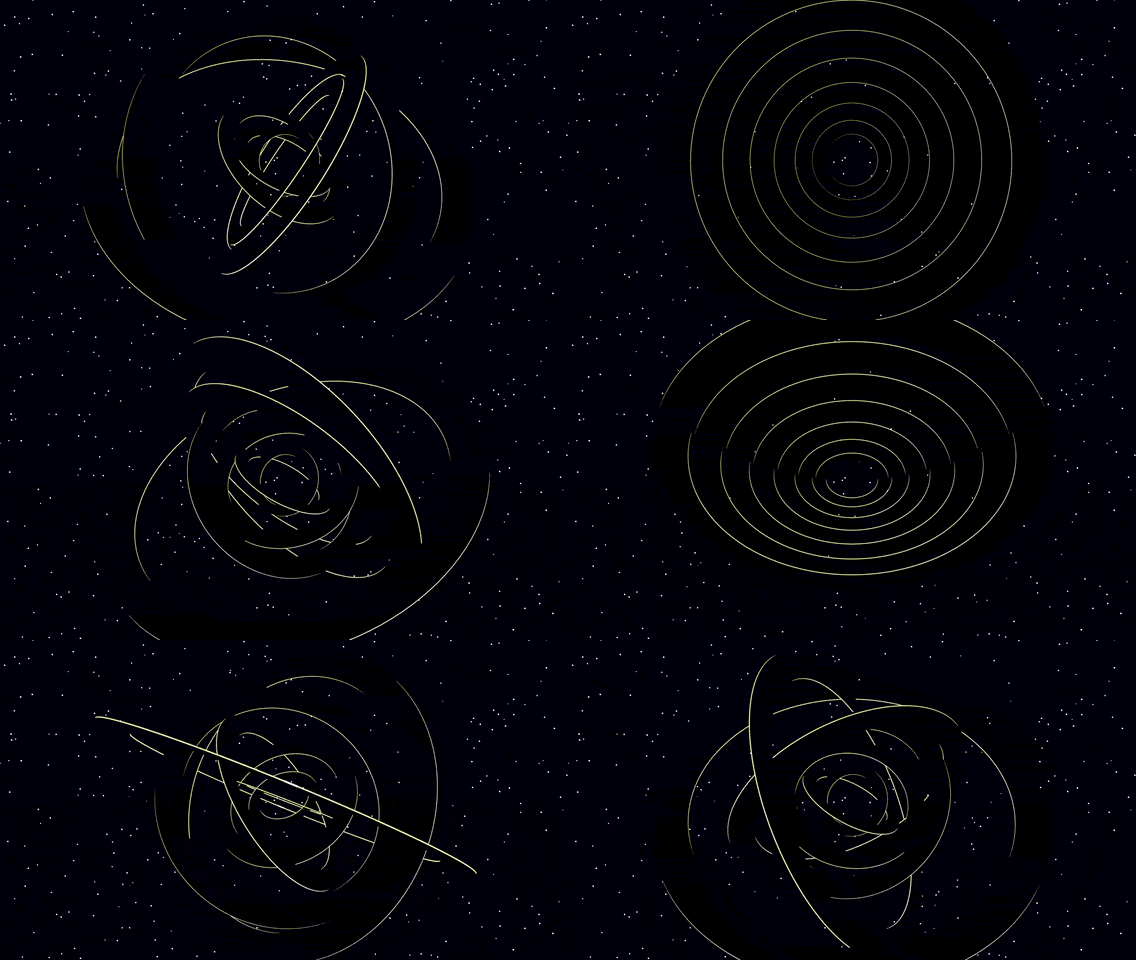
I made a blender model and animation of this thing I experienced to show how it looks like and moves, and to use that as a way to find out if someone knows what it is, where or why. I don’t know much more and am wondering what others know based on their encounters. It’s somewhere at some time, seems huge. The discs are flattish and don’t reflect light other than from the edges. I’ve tried posting in a few communities and get mostly aggravated answers, or overtly focusing on how I got this knowledge (almost like I’ve done something forbidden when it’s not an aspect I care about), and one got modded hidden.
Look up “gimbal lock”.
Yes that is actually similar. What would more discs than 3 spatial axii mean in this case? The blender object has something like 7 but I’m not sure if it’s the correct number. More than x, y and z axii definitely tho.
What could lock into the middle is another question. The sense of scale of it feels huge, like anything between a space station and a planet
The same thing can happen with 4, 7, or 100 rings. If they are allowed to “flatten out” to a single plane, you get gimbal lock, no matter how many rings there are. However, more rings don’t actually give more degrees of freedom. 4 rings are enough to provide all degrees of freedom plus guarantee that you never get gimbal lock, but only if you ensure that the innermost and outermost rings are perpendicular to each other at all times.
As for the “meaning” behind it, sense of scale, or whatever you might be feeling, I have nothing to say. Gimbals can be built in all sizes.
Ah gimbal lock is the alignment phase? Thanks for the clarification
Yes, and it’s generally a bad thing.
Oh that I didn’t get from skimming Wikipedia. Because of a loss of freedom/control or am mistaking the concept?
I didn’t understand the timing of why these discs align so it’s not accurate in the animation but it seemed cyclical/mechanical/mathematic, like a pulse towards various different directions
Gimbals might be free-spinning or driven by motors, it depends on what they’re used for, what their purpose is. Either way though, they usually don’t move all that much, it’s just shown in animation for demonstration purposes. (And in sci-fi because it’s cool.)
For example, there are camera gimbals which are designed to keep a mounted camera steady while the gimbal is held by a shaky human. In that case the gimbal only rotates as a counter-reaction to the rotation of the handheld part. If you have a steady hand, the gimbal would hardly move at all.
I should note that camera gimbals don’t look like those fancy rings, but mechanically they do the same thing.
I can’t tell you any more than that (frankly that’s all I know), but since you seen interested you should take your time to read up on it and watch YouTube videos about it.
appreciate it thanks. I’m familiar with camera gimbals and such as a steadying tool, but didn’t connect that topic with whatever this is.
Hi. I’ll be your “that guy” today. It’s “axes” pronounced “ax-eez”, not “axii”.
explanation
“Axis” is from Greek, and the general rule is that singular “-is” becomes “-ēs” in the plural, which happens to apply here. We don’t usually write the overline when it’s adopted into English, so “axes”, but with a Greek-derived pronunciation.
The rule you’re thinking of is that Latin “-ius” usually becomes “-ii”, but Latin or not, there’s no “u”, so we should avoid using that rule here.
I was rewriting the word so many times I couldn’t trust the word in any form anymore :D
Semantic Satiation