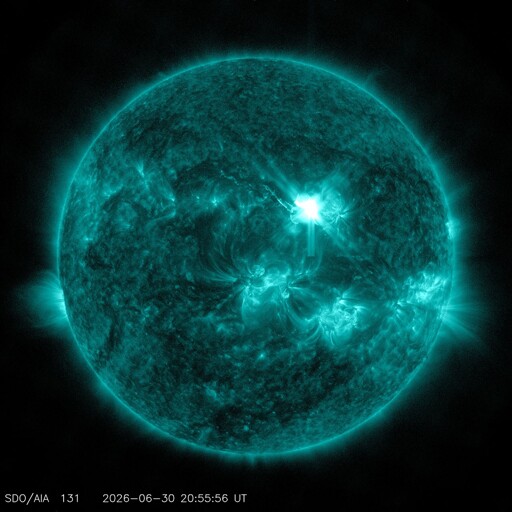
The Sun emitted a strong solar flare, peaking at 4:50 p.m. ET on June 30. NASA’s Solar Dynamics Observatory, which watches the Sun constantly, captured an
That’s be a CME, not a flare. A flare is a near-light-speed tight stream of energetic particles. A CME (coronal mass ejection) is a lower-speed cloud of plasma. It’s CMEs that generally cause the big, disruptive geomagnetic storms (if they’re big enough, don’t diffuse too much in-transit, and make a direct hit on the Earth). CMEs and flares are correlated, but not all that tightly. Flares are closely connected to holes in the corona. CMEs are believed to be triggered by shockwaves that occur when lines of flux collapse on the corona. There’s some great satellite imagery out there that shows those lines of flux, they look like jug handles.


That’s be a CME, not a flare. A flare is a near-light-speed tight stream of energetic particles. A CME (coronal mass ejection) is a lower-speed cloud of plasma. It’s CMEs that generally cause the big, disruptive geomagnetic storms (if they’re big enough, don’t diffuse too much in-transit, and make a direct hit on the Earth). CMEs and flares are correlated, but not all that tightly. Flares are closely connected to holes in the corona. CMEs are believed to be triggered by shockwaves that occur when lines of flux collapse on the corona. There’s some great satellite imagery out there that shows those lines of flux, they look like jug handles.