

I am reading up on logic circuits, families and levels because it’s fun. I have no formal education in physics, computing or electronics.
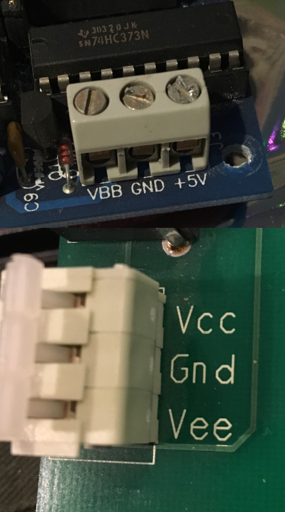
For power supplies, sometimes one of the supply rails is referred to as ground (abbreviated “GND”) – positive and negative voltages are relative to the ground. In digital electronics, negative voltages are seldom present, and the ground nearly always is the lowest voltage level. In analog electronics (e.g. an audio power amplifier) the ground can be a voltage level between the most positive and most negative voltage level.
I know from previous reading, that electricity - at least when it comes to direct current, but perhaps even when it comes to AC? - has a way in (“line”?) and a way out (“neutral” or “ground”? - disregarding for a second the fact that ground also carries current in case of a ground fault).
Again, from previous reading, I know that we work computers by either supplying them voltage or not (or in some circuits a higher voltage and a lower voltage). In any case, it’s a choice between one or the other, since that is what we are trying to represent: boolean true or false.
So, what is this “negative voltage”? Is this a figure of speech or can voltage actually have a negative value? The part from the article that I quoted above states in relativistic terms, that “the ground can be a voltage level between the most positive and most negative voltage level” (italic text by me), which makes me assume “yes”. But if voltage is electromotive force, how can it be negative? I amusingly imagine a force “sucking” the current backwards. 🤭
Explain it to me as if I was five. 👶
Often times we use earth ground as the source of 0V. Can you end up with differences in potential on different “earth grounds”?
Safety disclaimer: Treat this as a thought experiment, some actions which I describe are dangerous in reality. Never experiment with electricity if you’re unsure if what you’re doing is safe.
To avoid some confusion which might occur otherwise: I’m using technical conventions and I’m thinking about electrons flowing from hills (+) to valleys (-).
Take the words earth and ground literally, it’s really a thick metal rod which gets hammered into the ground when a house gets built.
A voltage source like a battery or a generator creates a difference in electric potential between its poles (by separating charge).
Think of hills and valleys separated by a solid wall on isolated islands floating in the sky for some reason… 😅 The islands are of arbitrary height and free floating, but their height difference is fixed. On each of them you could do the ball on a hill experiment and it would yield the same result.
You can connect the hills and valleys of each island by attaching a highway with its own wall. This is the equivalent of connecting the poles via a resistor (lower electric resistance means more and bigger holes in the wall, hills/valleys will deplete faster).
You could also connect these islands in a way so that the valley of one and hill of the other touch. If you use low resistance wires there is nothing stopping electrons to freely flow from one island to another, whatever height difference there initially was between the valley and hill of the two islands, instantly drops and the islands get pulled together. But no electrons actually flow (no height difference is driving them), no hill and valley of any individual island gets depleted, no energy transferred - that’s essentially what chaining 9V batteries to yield multiples of 9V is.
If you ground one pole of a generator, you pull the island toward the earths surface, which in itself can be considered a flat, but practically infinite valley/hill. Earth acts as a kind of mass storage for electrons not changing its height much when letting charged particles flow into it or vice versa.
So if you had two grounded generators:
If you were to connect the hill of the 200V generator to the valley of the 100V generator, the valley and hill of the 200V generator would be directly connected by the ground resistor (and its own ground resistor but that can be neglected in this example), pulling the ground pin of the 100V generator to 200V and its hill to 300V above earth - and that’s the answer to your question. In theory every grounding point isn’t actually a grounding point, but we do our best to keep resistance as low as possible so that we can safely touch metal objects in our houses.
Oh and things like „instant depletion transferring energy“ essentially means short circuiting a voltage source, so do not experiment with this, even if it’s low voltage like 9V batteries, they can start a fire too and in practice there are also chemical hazards. In the generator example a fuse would blow if there was one, stopping the depletion and preventing a fire or a molten generator. Use circuit simulators like falstad.