

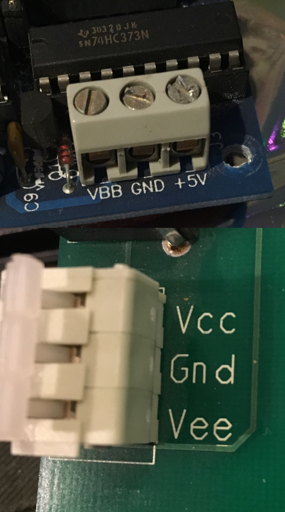
I am reading up on logic circuits, families and levels because it’s fun. I have no formal education in physics, computing or electronics.
For power supplies, sometimes one of the supply rails is referred to as ground (abbreviated “GND”) – positive and negative voltages are relative to the ground. In digital electronics, negative voltages are seldom present, and the ground nearly always is the lowest voltage level. In analog electronics (e.g. an audio power amplifier) the ground can be a voltage level between the most positive and most negative voltage level.
I know from previous reading, that electricity - at least when it comes to direct current, but perhaps even when it comes to AC? - has a way in (“line”?) and a way out (“neutral” or “ground”? - disregarding for a second the fact that ground also carries current in case of a ground fault).
Again, from previous reading, I know that we work computers by either supplying them voltage or not (or in some circuits a higher voltage and a lower voltage). In any case, it’s a choice between one or the other, since that is what we are trying to represent: boolean true or false.
So, what is this “negative voltage”? Is this a figure of speech or can voltage actually have a negative value? The part from the article that I quoted above states in relativistic terms, that “the ground can be a voltage level between the most positive and most negative voltage level” (italic text by me), which makes me assume “yes”. But if voltage is electromotive force, how can it be negative? I amusingly imagine a force “sucking” the current backwards. 🤭
Explain it to me as if I was five. 👶
Generally, my understanding, is there is a “flow” and a negative reading would be flowing the other direction. Thinking about a multimeter - it usually expects flow from red to black, but if you swap those around, you get a negative number as it flows from black to red.
The actual number is usually (not always) the important part - the potential difference between the two ends or something like that. That difference is going to behave similarly no matter which direction, but we assigned it numbers like that to make talking about voltages easier.