
- cross-posted to:
- technology@lemmy.ml
- cross-posted to:
- technology@lemmy.ml
You must log in or register to comment.
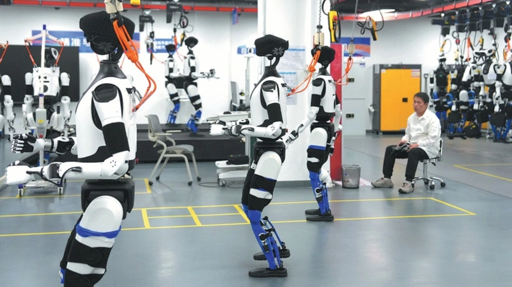
But what do they do? Other then enter kungfu mode while helping the staff at a restaurant?
-> Coolest thing ever
pretty much anything you can imagine:
- Final assembly in car factories (installing wheels, dashboards, windows)
- Performing screwdriving and bolt-fastening tasks on production lines
- Dispensing medication 24 hours a day in pharmacies
- Working as store clerks in retail kiosks
- Serving as elderly care companions
- Acting as robot dogs for live street-traffic deliveries
- Performing comedy sketches and martial arts routines at the lunar new year gala
- Serving as backup dancers at concerts
- Unstacking cardboard boxes in electric vehicle factories
- Sorting and packing boxes in industrial settings
- Acting as traffic cops to admonish cyclists who stray into motor lanes
www.theguardian.com/technology/2026/mar/19/inside-chinas-robotics-revolution
Most of that list are tasks performed by non-humanoid robots.
The idea is that the humanoid robots can work in human focused infrastructure in factories rather than just replacing the whole thing, they just replace the factory job with a robot that does the same thing, which I guess they think will be easier and more efficient than needing to tear out the entire factory floor and replace it with other machinery? I’m not too sure how effective this will be, but they seem pretty confident that it is a good idea.
The article that list is derived from has photographs of the non-humanoid robots performing the tasks included in the list. Real AI summary vibe tbh.
I’m not advocating for it, just given the explanation that I’ve been given for it.
it’s cool
I think Yogthos probably knows more about it, it’s an area he’s pretty interested in.
The advantage of a humanoid robot lies in versatility. With specialized robots, you need a robot per task, and that means you need a separate supply chain to build each one, you need to store replacement parts for them individually, and you need to get a robot for each task you’re doing even if you’re not doing them concurrently. Then if the nature of the task changes then the robot becomes useless.
A humanoid robot can perform a wide range of tasks, you have a single supply chain with a single set of parts to repair them, and if you have new types of work, then you can use the same robots to do that too.
It’s a tradeoff, versatility comes at the cost of never being quite as good as specialization. It makes sense in some contexts, but I think most robots are always going to be specialized.
Exactly, if you have a well ironed out process that’s not going change often then specialization makes a lot more sense.
Humanoid stuff bothers me on some level. Not sure how much I’d care to champion this personally, but what do I know.
The fact robots are designed to mimic us only emphasizes how little big tech values us as humans. It’s pure mockery.
Uncanny valley
I will never understand this. Why create a robot designed to look like a human if you’re focused on maximizing efficiency?
The fact that we know this (ahem factories) but continue to waste time and resources on this slop leads me to believe this is a gimmick