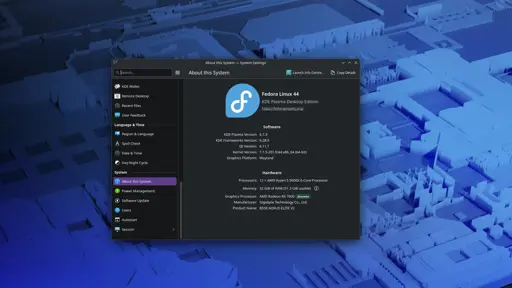
Two years into full-time Linux and I’m finally burning the distro-hopping cycle. I fell for the Arch/AUR trap for a while, but I got tired of spending my weekends debugging file manager crashes instead of maintaining my home lab.
Switched back to Fedora, and it’s boring in exactly the way I need it to be. It’s a stable launchpad for my projects, not the project itself.
I recently switched to Fedora after using PopOS for years. I like it because it’s just less… fiddly? Like, I don’t like COSMIC because it just doesn’t feel ready yet, and I honestly prefer DNF over APT. It has a very ‘set it and forget it’ sort of feel, which is great for a server.
Just read the title and made me realized I use 4 different OS…
Main pc: cachyos Steamdeck: steamos Tiny server: Ubuntu server RaspberryPi: dietpi
I mean yo could say two if you just say “2 arch based and two Debian based”
But never thought about it.
M’linux
Did the same. We’re a mostly fedora shop these days. Debian based for servers.
Why use Debian for servers over Fedora?
I honestly think it’s the best distro so far. Which sucks since it is so reliant on RedHat. I prefer to avoid corporate related distros like Fedora and Ubuntu, but I must admit they have a better experience right out of the box. I still want to give NixOS a try and maybe Gentoo, but after that I will probably come back to Fedora just like you…until something I think might be better comes along.
I would say for most people Fedora is one of the best options due to having a release cycle that is quick but not too quick, coming with all sorts of different DEs (GNOME, KDE, Cinnamon, Cosmic, XFCE, hell, even Budgie), and not really having any issues in terms of usability (aside from installing Nvidia drivers, apparently that isn’t very smooth but I have no experience with this)
Mint is nice too and super easy to use, but you need to like Cinnamon (or XFCE and MATE).
I personally love EndeavourOS, which is Arch-based and minimal OOTB, but it is definitely not for everyone. CachyOS falls under a similar box, being an Arch-based distro.
To be honest, in the modern age, there is no such thing as a bad Linux distro (except maybe Manjaro, which feels a bit like the worst of all worlds). Fedora, Mint, the buntus, the Arch derivatives, etc. are all really neat pieces of software!
I personally prefer OpenSuSE, but Fedora is reasonably close second.
One reason OpenSuSE wins out for me is admittedly just because it’s not a US based project or related to a US based company like RedHat. Not that SuSE is “good” as a sponsor company; it’s just based in Germany and owned by a Swedish investment company, which edges out based in the US and owned by a mega corp like IBM. I know both OpenSuSE and Fedora are mostly independent, but both are under some control of their main corporate sponsors. So I prefer European.
Maybe that’s silly, but I have lost a lot of trust in the US legal system, project governance and their ability to exist without interference by the US state.
but fedora really is community driven. ibm (redhat) could disappear today and fedora would continue with out interruption
Tumbleweed is a very cool project
Are you talking about Leap or Tumbleweed?
As far as Leap goes. Isn’t it a bit behind compared to Fedora in terms of software package versions? And aren’t their package repos a bit smaller/limited in terms of what’s available?
I’m shopping for a new long term distro myself and can’t seem to make up my mind. I was set on Debian stable, but the software is kinda old. Especially for desktop environments like KDE Plasma. There’s some really cool stuff that came out in the more recent versions and I don’t want to wait 2 years before getting them.
PikaOS is Debian-based and maintaining its own repository based on trixie and unstable with similar patches to Bazzite & team. I’ve been using it as a daily driver on 3-4 systems for at least a year or two with no serious issues, and the updates are quick to fix any minor issues. Excellent for gaming. It’s probably not up to CachyOS gaming standards nor Debian stability but I find it’s a comfortable spot for me.
Fedora is limited to non-licensed products in the base repos IIRC. But there is EPEL and RPMfusion that provide a lot of additional packages.
There are also copr repos which I think are similar to AUR in that they are user submitted.
I’ve been rocking PikaOS for a little while now and I’m pleasantly surprised. Debian Cid based with prepackaged gaming tools. It’s been good
I was interested in Pika, but I took the leap and just went straight Debian. I’m happy.
Are you on the stable branch? Curious how it is for gaming. I was having issues on Mint (which is similarly stable), but they all went away when I swapped to PikaOS, kinda skipped over Debian
It’s great, the bad experiences I’ve had are due to my shitty non muxing or whatever dual graphics card laptop, which pika won’t fix. Just make sure you check your card is supported by the current version of the driver. I’ll reply again to show you where you can look for that info.
I’m assuming you can also “back port” it from unstable.
Pika might fix that actually. Most of the patches and custom stuff Pika adds is around obscure and difficult graphics card configurations, with extra kernel modules and stuff like that specifically for gaming on modern graphics hardware. That’s literally its main value proposition. You could try a LiveUSB and see if it works any better, but the PikaOS second-stage installer (after the base system is installed) also has a bunch of options for various driver and kernel versions and variations that might help.
That said if you’re happy where you’re at there’s no reason rocking the boat, and Debian’s pretty solid. But maybe keep it in mind for next time you feel like trying something different on that system.
Recently switched to Fedora myself, and I could not be happier ❤️
Tried Fedora Silver blue or universalblue spins? Unless you do serious embedded development work (which takes more setup on atomic distros), then I have experienced that it is less work in general in setup and upkeep.
Yeah, Silverblue is nice; not my main distro, though. I came from many years of Gentoo on almost all machines I had. Debian stable is currently the most practical for me.
The immutable variant of Fedora is nice for the low maintenance computers, although I needed to get my head around podman to not overuse
rpm-ostree. So far so good. I think it will not replace the distro on my main machine, but I see the way it works as a general potential future. An immutable variant of Debian stable would be something I’d consider switching for.
I’m actually switching from Fedora today. miserable experience.
Care to elaborate? Not saying I doubt you, it’s just the polar opposite of my experience and I’m curious why that is.
i don’t know if it was just the hardware I had it on or what but had to reinstall it a couple times as for whatever reason the desktop manager kept breaking, it wouldn’t kick over to a TTY when hitting ctl+alt+f2, it decides on a whim when it will or won’t display the grub menu, audio issues as well as AMD GPU issues of all things which I found weird, random kick outs back to the desktop manager or just straight up crashing (using Fedora KDE which I wish I picked a different “spin”) and I found it sluggish as well as dnf being slow regardless of the fact I edited the dnf.conf to set install_weak_deps to false, max parallel downloads to 10 and fastestmirror to true.
Sorry but I just don’t like it. Not to say I think it’s a bad distro it’s just clearly not one for me.
Oof, yeah, that sounds painful. It does sound like some kind of hardware-related issue, maybe the default settings in the Fedora kernel are seriously aberrant when mixed with one or more of your hardware components? Given the broad range of issues (GPU, network speed, audio), I’d be inclined to suspect the problem was related somehow to something core/common like CPU or mobo. Almost certainly not a pure hardware fault, given the problems didn’t follow the hardware when you changed distros.
Sorry but I just don’t like it. Not to say I think it’s a bad distro it’s just clearly not one for me.
I totally get it. Doesn’t take much of that kind of frustration to leave a bad taste in your mouth. I had some perplexing intermittent lockup issues years ago that turned out to be BTRFS, or at least the issue went away when the VMs were rebuilt with a different root FS. I’m still leery of BTRFS, even though it was a fairly esoteric stack (SLES, ESX, NFS datastores served from a ZFS-backed storage server), so entirely possible the fault didn’t lie exclusively with the filesystem. But I still avoid it, just because I’ve been burned once.
Yeah wondering what could have possibly made it miserable
Add the repos for RPM fusion.
I already have them, didn’t improve anything.
Fair enough.
It shows you haven’t tried Void Linux. 🤪
OP posted to this sub with an article about void 17 days ago. OOP, sure maybe.
I’m trying Void on old hardware and it feels pretty usable. Package availability still an issue*. I’ve also noticed some dependencies not getting added (
gitnot included with programming lang that needs it for its package manager, installed archive managerengrampaand it couldn’t actually open zips until I added another package for that). I’ll probably keep this on my old machine just for testing musl compilation.* appimages might help, other solutions with redundancy not so much with extra downloading
Yes, the installation is similar to Arch, it gives you the versatility to do an installation however you want without software blobs.
I have looked at Void a little but honestly the handling of the package manager and even it’s name just throw me of for some reason. Why do you like it?
Precisely, the package manager is one of the best things about it. Quite fast. I like it because it doesn’t have systemd and it’s one of the few distros left with a Unix philosophy. A very well-made distro.