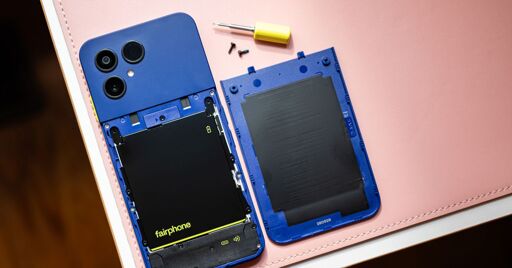
More than a decade after launching in Europe, the Netherlands company is now selling its repairable phones in the US, starting with the Fairphone (Gen 6+).
I’ve had GrapheneOS for a little bit now, and while it’s great that ‘Google’ has been stripped from it, but the giant warning that you can’t avoid when restarting the phone, so many services simply breaking, it feels a lot like the old days of custom ROMs. Maybe for certain people it can be a daily driver, but goodness it’s difficult to diagnose and fix bugs when it all comes back to Google permissions and services that you really can’t get around.
I’ve been using it for almost a month and I’m a big fan. I was planning to wait for the Motorola phone but my screen on my old phone was rapidly becoming unusable.
I’m using it to divorce Big Tech. I created two secondary profiles, one for work and one for Big Tech. The Big Tech profile is where I’ll enable Google services and permissions. I don’t let it run in the background so once I switch back its like I turned off Big Tech. I can still use all the apps and services I’m used to, but I added enough friction that it’s causing me to explore alternatives every day.
My owner profile has Play and Play Services totally disabled. I get push notifications for Signal using Sunup for UnifiedPush. I get apps mostly through Accressent, Obtainium, and Aurora. If apps complain about missing Google services too much, they get relegated to the Big Tech profile while I find an alternative. Most of the apps that complain about it (like Ring) still work fine. Most of the “apps” I use are just PWAs that run in Vanadium and have icons on the home screen.
The biggest issues I’ve had were around RCS messaging. I was able to get it to work in the Owner profile, but it’s a known issue that it doesn’t work in secondary profiles. I’m just not getting group texts from iPhone users anymore. Oh well, everyone who matters will contact me on Signal or SMS directly. I was never able to get E2EE working over RCS with iPhone users anyways, even though my carrier supposedly supports it and the iPhones were updated.
It’s also exposing just how much I depend on Big Tech. I’ll probably be switching to Proton for mail, calendar, and VPN. My one gripe is they don’t have a way to sync contacts to my phone. Still, Ill happily pay $10 a month for storage and services that don’t spy on me for advertising instead of paying $3 a month for a service where I can’t expect any privacy.
I’m still using Big Tech while driving unfortunately, haven’t explored alternatives to Maps and Spotify yet.
I use Organic Maps very often. It’s not perfect. It wrongly identifies a shop next to me. It also occasionally gives less than ideal for my taste directions. However, it is subjectively 99% good and right about the map objects and the directions. It is reliable, basically.
Google’s app has given me issues too in the past. It’s not like Google is without its chinks.
So I am happy with it and would recommend it at least for a spin. For me it’s a daily driver app.
Apparently a bunch of lead devs for Organic Maps split off (and forked) to make CoMaps. I don’t know much beyond that, but CoMaps is getting regular updates
Thanks for the tips. Amazon/Alexa/Ring are next on my list after the de-Google.
Fastmail seems like it’s worth a try. Privacy from data brokers and ad companies is my main goal so Fastmail gets a green check mark there. It doesn’t seem like they claim E2EE but they do claim encryption.
I guess I was thinking Proton because the E2EE “we can’t even see your data” claim is appealing in an age where corporations are hungry for data to train their AI models.
I am also interested in the bundled VPN with Proton, but yeah the price is a little off-putting and it seems like it is going up.
Been meaning to check out Librewolf, but Vanadium has been pretty good so far.
I’ve used Proton for quite a bit, and it’s well worth it personally, just the VPN blocking ad’s is pretty fantastic, along with storage and everything else. For Maps, I haven’t found a ‘great’ solution, and instead of Spotify, I just run a Navidrone server at home, and that easily allows me to stream all my audio at the bit rats that I want.
I can see it not working for everyone, but I already used custom ROMs and I don’t use basically any services on my phone. If you’re using GrapheneOS and using Google Play Services in a sandbox, it does get quirky and break some things. I didn’t want Google anywhere near my phone anymore. As soon as I can use the OS without a Pixel I’ll be doing that since I hate that I am even using their hardware.


I’ve had GrapheneOS for a little bit now, and while it’s great that ‘Google’ has been stripped from it, but the giant warning that you can’t avoid when restarting the phone, so many services simply breaking, it feels a lot like the old days of custom ROMs. Maybe for certain people it can be a daily driver, but goodness it’s difficult to diagnose and fix bugs when it all comes back to Google permissions and services that you really can’t get around.
deleted by creator
I’ve been using it for almost a month and I’m a big fan. I was planning to wait for the Motorola phone but my screen on my old phone was rapidly becoming unusable.
I’m using it to divorce Big Tech. I created two secondary profiles, one for work and one for Big Tech. The Big Tech profile is where I’ll enable Google services and permissions. I don’t let it run in the background so once I switch back its like I turned off Big Tech. I can still use all the apps and services I’m used to, but I added enough friction that it’s causing me to explore alternatives every day.
My owner profile has Play and Play Services totally disabled. I get push notifications for Signal using Sunup for UnifiedPush. I get apps mostly through Accressent, Obtainium, and Aurora. If apps complain about missing Google services too much, they get relegated to the Big Tech profile while I find an alternative. Most of the apps that complain about it (like Ring) still work fine. Most of the “apps” I use are just PWAs that run in Vanadium and have icons on the home screen.
The biggest issues I’ve had were around RCS messaging. I was able to get it to work in the Owner profile, but it’s a known issue that it doesn’t work in secondary profiles. I’m just not getting group texts from iPhone users anymore. Oh well, everyone who matters will contact me on Signal or SMS directly. I was never able to get E2EE working over RCS with iPhone users anyways, even though my carrier supposedly supports it and the iPhones were updated.
It’s also exposing just how much I depend on Big Tech. I’ll probably be switching to Proton for mail, calendar, and VPN. My one gripe is they don’t have a way to sync contacts to my phone. Still, Ill happily pay $10 a month for storage and services that don’t spy on me for advertising instead of paying $3 a month for a service where I can’t expect any privacy.
I’m still using Big Tech while driving unfortunately, haven’t explored alternatives to Maps and Spotify yet.
deleted by creator
I use Organic Maps very often. It’s not perfect. It wrongly identifies a shop next to me. It also occasionally gives less than ideal for my taste directions. However, it is subjectively 99% good and right about the map objects and the directions. It is reliable, basically.
Google’s app has given me issues too in the past. It’s not like Google is without its chinks.
So I am happy with it and would recommend it at least for a spin. For me it’s a daily driver app.
Apparently a bunch of lead devs for Organic Maps split off (and forked) to make CoMaps. I don’t know much beyond that, but CoMaps is getting regular updates
Thanks for the tips. Amazon/Alexa/Ring are next on my list after the de-Google.
Fastmail seems like it’s worth a try. Privacy from data brokers and ad companies is my main goal so Fastmail gets a green check mark there. It doesn’t seem like they claim E2EE but they do claim encryption.
I guess I was thinking Proton because the E2EE “we can’t even see your data” claim is appealing in an age where corporations are hungry for data to train their AI models.
I am also interested in the bundled VPN with Proton, but yeah the price is a little off-putting and it seems like it is going up.
Been meaning to check out Librewolf, but Vanadium has been pretty good so far.
deleted by creator
Comaps is really good but I haven’t found anything that provides traffic data… So also using google maps for driving
I’ve used Proton for quite a bit, and it’s well worth it personally, just the VPN blocking ad’s is pretty fantastic, along with storage and everything else. For Maps, I haven’t found a ‘great’ solution, and instead of Spotify, I just run a Navidrone server at home, and that easily allows me to stream all my audio at the bit rats that I want.
I can see it not working for everyone, but I already used custom ROMs and I don’t use basically any services on my phone. If you’re using GrapheneOS and using Google Play Services in a sandbox, it does get quirky and break some things. I didn’t want Google anywhere near my phone anymore. As soon as I can use the OS without a Pixel I’ll be doing that since I hate that I am even using their hardware.