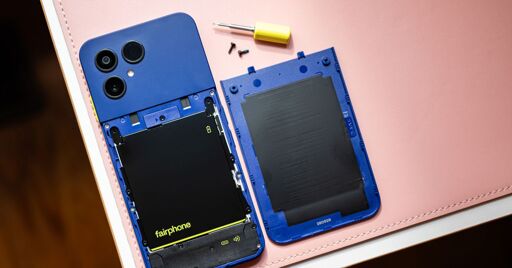
More than a decade after launching in Europe, the Netherlands company is now selling its repairable phones in the US, starting with the Fairphone (Gen 6+).
No lol, they have a list of specific hardware security requirements for a device to have, the biggest one being a secure element. Without a secure element there is no hardware-backed key derivation throttling, so it’s much more possible for an attacker to brute force your phone’s PIN.
Support forusing alternate operating systems including full hardware security functionality
Complete monthly Android Security Bulletin patches without any regular delays longer than a week for device support code (firmware, drivers and HALs)
At least 5 years of updates from launch for device support code with phones (Pixels now have 7) and7 years with tablets
Device support code updated tonew monthly, quarterly and yearly releases of AOSP within several months to provide new security improvements (Pixels receive these in the month they're released)
Linux 6.1, 6.6or6.12 Generic Kernel Image (GKI) support
Hardware accelerated virtualization usable by GrapheneOS (ideally pKVM to match Pixels but another usable implementation may be acceptable)
Hardware memory tagging (ARM MTE or equivalent)
Hardware-based coarse grained Control Flow Integrity (CFI) for baseline coverage where type-based CFI isn't used or can't be deployed (BTI/PAC, CET IBT or equivalent)
PXN, SMEP or equivalent
PAN, SMAP or equivalent
Isolated radios (cellular, Wi-Fi, Bluetooth, NFC, etc.), GPU, SSD, media encode / decode, image processor and other components
Support for A/B updates of both the firmware and OS images with automatic rollback if the initial boot fails one or more times
Verified boot with rollback protection for firmware
Verified boot with rollback protection for the OS (Android Verified Boot)
Verified boot key fingerprint for yellow boot state displayed with a secure hash (non-truncated SHA-256or better)
StrongBox keystore provided by secure element
Hardware key attestation support for the StrongBox keystore
Attest key support for hardware key attestation to provide pinning support
Weaver disk encryption key derivation throttling provided by secure element
Insider attack resistance for updates to the secure element (Owner user authentication required before updates are accepted)
Inline disk encryption acceleration with wrapped key support
64-bit-only device support code
Wi-Fi anonymity support including MAC address randomization, probe sequence number randomization and no other leaked identifiers
Support for disabling USB data and also USB as a whole at a hardware level in the USB controller
Reset attack mitigation for firmware-based boot modes such as fastboot mode zeroing memory left over from the OS and delaying opening up attack surface such as USB functionality until that's completed
Debugging features such as JTAG or serial debugging must be inaccessible while the device is locked
Until the collaboration with Motorola produces a device, only the recent Pixels meet the requirements.
Fairphone is also one of the worse OEM’s when it comes to how slowly they patch and releases security vulnerabilities, and they are known to be quite sloppy, in the past they have published their private keys. I wouldn’t trust keeping anything remotely private or sensitive on a Fairphone.
nah. grapheneos requires open source drivers and immediate security updates from the oems as well as an unlockable bootloader. pixel just happens to be the only one who fits the bill for all of those. as an example, the Samsung I had before my pixel wouldn’t get security updates for months after an Android release which was really annoying. Motorola will soon comply with these standards too, but they have their own line of flock camera alternatives so I won’t be touching their products with a 10 foot pole.


Aren’t Graphene’s hardware requirements “be a Pixel”?
No lol, they have a list of specific hardware security requirements for a device to have, the biggest one being a secure element. Without a secure element there is no hardware-backed key derivation throttling, so it’s much more possible for an attacker to brute force your phone’s PIN.
Support for using alternate operating systems including full hardware security functionality
Complete monthly Android Security Bulletin patches without any regular delays longer than a week for device support code (firmware, drivers and HALs)
At least 5 years of updates from launch for device support code with phones (Pixels now have 7) and 7 years with tablets
Device support code updated to new monthly, quarterly and yearly releases of AOSP within several months to provide new security improvements (Pixels receive these in the month they're released)
Linux 6.1, 6.6 or 6.12 Generic Kernel Image (GKI) support
Hardware accelerated virtualization usable by GrapheneOS (ideally pKVM to match Pixels but another usable implementation may be acceptable)
Hardware memory tagging (ARM MTE or equivalent)
Hardware-based coarse grained Control Flow Integrity (CFI) for baseline coverage where type-based CFI isn't used or can't be deployed (BTI/PAC, CET IBT or equivalent)
PXN, SMEP or equivalent
PAN, SMAP or equivalent
Isolated radios (cellular, Wi-Fi, Bluetooth, NFC, etc.), GPU, SSD, media encode / decode, image processor and other components
Support for A/B updates of both the firmware and OS images with automatic rollback if the initial boot fails one or more times
Verified boot with rollback protection for firmware
Verified boot with rollback protection for the OS (Android Verified Boot)
Verified boot key fingerprint for yellow boot state displayed with a secure hash (non-truncated SHA-256 or better)
StrongBox keystore provided by secure element
Hardware key attestation support for the StrongBox keystore
Attest key support for hardware key attestation to provide pinning support
Weaver disk encryption key derivation throttling provided by secure element
Insider attack resistance for updates to the secure element (Owner user authentication required before updates are accepted)
Inline disk encryption acceleration with wrapped key support
64-bit-only device support code
Wi-Fi anonymity support including MAC address randomization, probe sequence number randomization and no other leaked identifiers
Support for disabling USB data and also USB as a whole at a hardware level in the USB controller
Reset attack mitigation for firmware-based boot modes such as fastboot mode zeroing memory left over from the OS and delaying opening up attack surface such as USB functionality until that's completed
Debugging features such as JTAG or serial debugging must be inaccessible while the device is locked
Until the collaboration with Motorola produces a device, only the recent Pixels meet the requirements.
Fairphone is also one of the worse OEM’s when it comes to how slowly they patch and releases security vulnerabilities, and they are known to be quite sloppy, in the past they have published their private keys. I wouldn’t trust keeping anything remotely private or sensitive on a Fairphone.
nah. grapheneos requires open source drivers and immediate security updates from the oems as well as an unlockable bootloader. pixel just happens to be the only one who fits the bill for all of those. as an example, the Samsung I had before my pixel wouldn’t get security updates for months after an Android release which was really annoying. Motorola will soon comply with these standards too, but they have their own line of flock camera alternatives so I won’t be touching their products with a 10 foot pole.
But you touch Google?
Those cameras are from Motorola Solutions, which is a seperate company to Motorola Mobility.
That’s two entirely different unrelated companies. They split ages ago