


Direct link to the LLM Policy Discussion: https://invent.kde.org/plasma/plasma-workspace/-/work_items/187
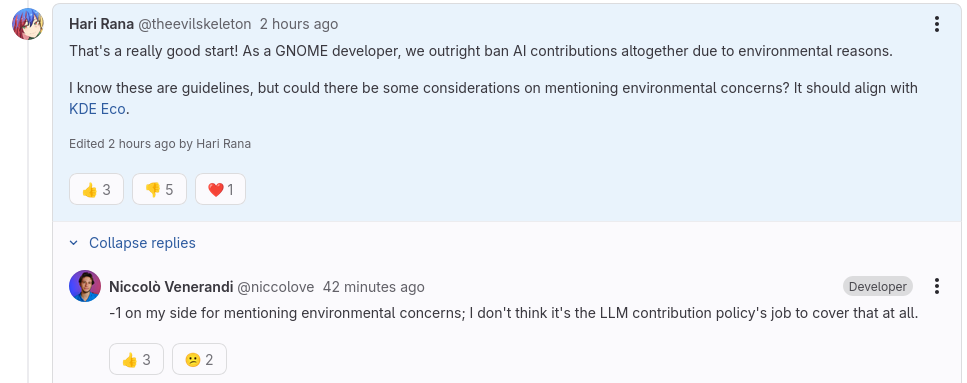
Example of a KDE dev not wanting environmental concerns to play any role, despite KDE having an environmental project:
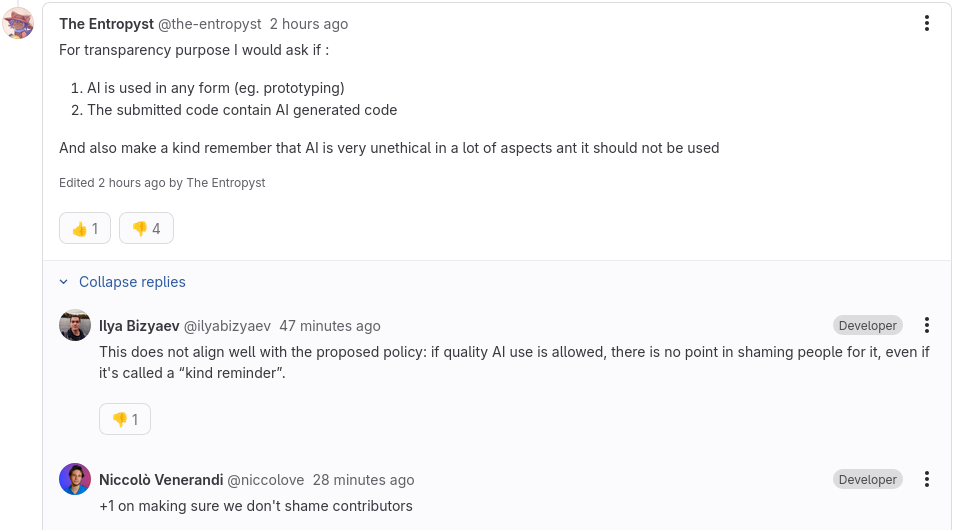
Devs rejecting any notion of transparency by disclosing AI usage in code submissions (in direct opposition to advice from the FSFE):
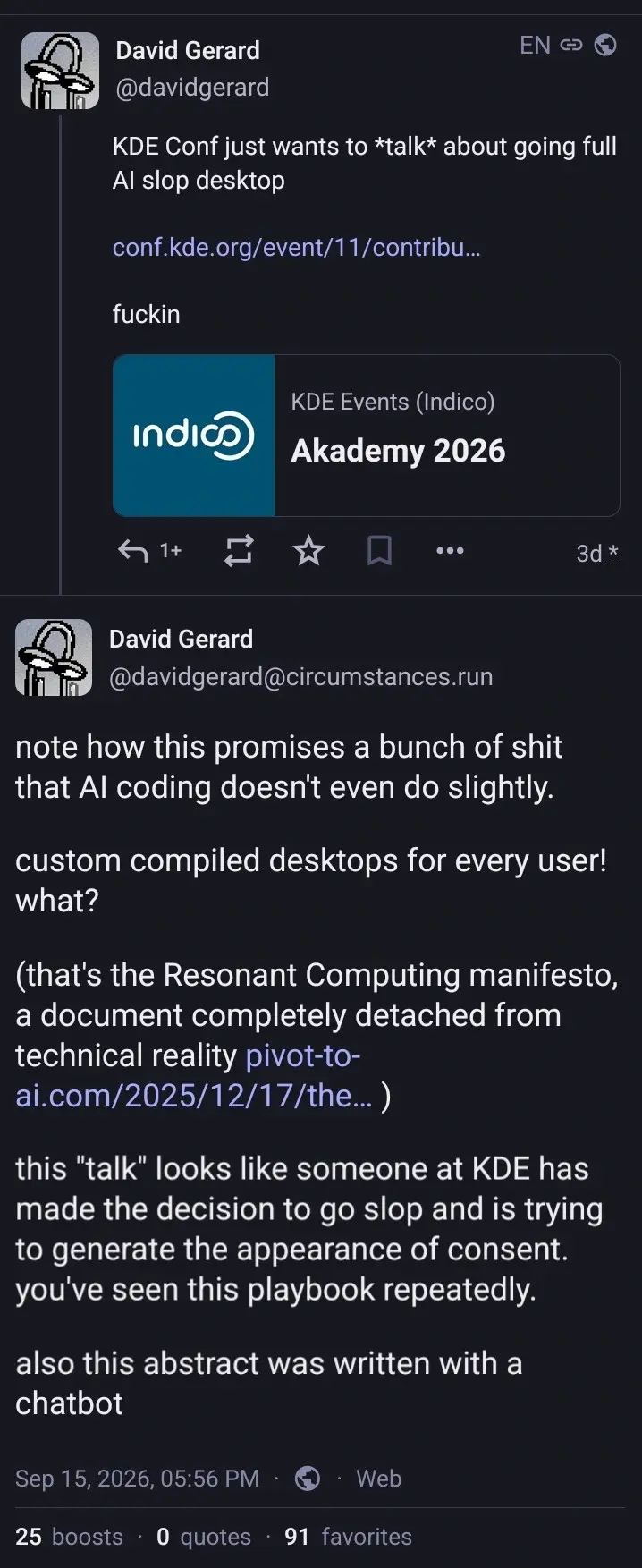
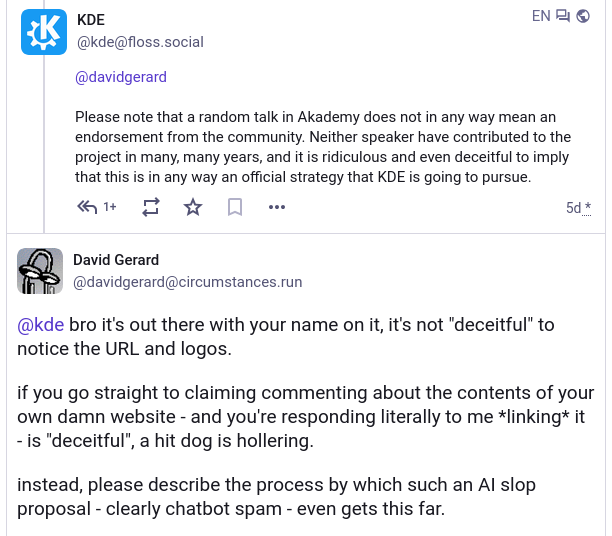
And all of this is coming right after the debacle with an AI slop project being allowed to give a presentation at Akademy, and the person asking how this was allowed being blocked by KDE:
https://lemmy.nz/post/42029517

as well as the discussion thread bringing up legitimate concerns about AI usage being closed:
https://discuss.kde.org/t/sorry-to-bring-up-a-contentious-topic-kde-ai-llm-policy/46333/164
As someone who genuinely loves KDE, and has even donated to the project multiple times, I sadly have to accept that the majority of KDE have hopped onto the Pro-AI train, and they will not be dissuaded otherwise.
So when will we ban code snippets? And autocoplete? Actually, lets go back to punch cards already!
I’m seriously getting sick and tired of this topic. AI is a tool, if you don’t like it, don’t use it, but let others do what they want. I hate vibecoders as much as I hate full anti-AI haters since both are equally wrong. AI is a powerful tool and the next step for assisted coding, but that’s it, do not let it do all the work and just allow it to work on it’s own without double-checking what it is actually doing. If you prefer to type everything yourself, letter by letter, go ahead. If you found an AI that produces perfect output that doesn’t need any adjustment/corrections, send me a link. If you have no idea what you’re doing, I do not want your code on my pc, no matter if you wrote it yourself or let an AI generate it for you and anything in-between. It’s that simple. Or at least it should be.
And if the environment is your biggest concern, LM Studio is free, so is Qwen, Gemma, Mistral, GPT-OSS and a ton of other models that you can run locally on your PC. You will need a somewhat powerful PC and some more patience than with the top models running on almost unlimited resources in a datacenter, but they get the job done eventually nontheless. The job of assisting you, that it, no vibecoding! They’ll break your stuff even faster if not kept in check.
There is no such thing as “just a tool”.
Even so, some technology (like the examples of “autocomplete” you give) are effectively harmless to anyone else. But some technology is harmful to others even if those others don’t use it.
I’m happy to let others do what they want where it harms no one else.
LLMs as currently deployed are not that. Their use, by anyone, is harmful to us, and we need to resist it for the sake of everyone.
The first article has really interesting views, although it is a bit too philosophical for my taste. “Tools influence/change people and the environment they are used in”, sure can’t argue with that. But change is nothing to be afraid of and should be embraced, although you’d have to consider if change happens for the better or worse. And I see AI more like a knife in this situation: I can use a knife to slice food into smaller pieces that are easier to eat or to stab people. With great power comes great responsibility and a bit of self control topped up with rational thinking helps with the decision how to use what you have available in the best way possible. I will not refuse to touch a knive because I could hurt myself or others and I will force restraint upon myself to not give in to the intrusive thought of running up to people stabbing everyone in my vicinity. The same way I will not refuse to use AI because I could get too lazy to do my job and just vibe code everything while endangering every system that runs my code, I’ll force myself to do the right thing and use it to help me with my projects while keeping a close eye on every change it makes, validating that the output is safe, actually working and performing well. That’s my interpretation of the article at least, it may not be “just” a tool, but it is a tool, and just like every tool, is should only be used by people that know how to use it. If I missed the point or misinterpreted it then I’d like to reiterate that I’m not very good with philosophical metaphors.
The second article, which is written with AI assistance itself, sweet irony, is a bit too much for me to counter-argue every point written there, and I refuse to also use AI for this task in a similar fashion than the author even tho it would make the task easier. In summary, most points seem to not apply to coding at all or only apply to vibecoding, which I will not try to argument against since I agree that AI is not flawless and has its dangers (like pretty much everything else in life) and I too hate vibecoders. If you use AI as I described, as a tool that assists you, most counterpoints are non-issues. To highlight some of the more important mentioned concerns: Code Quality will not suffer if you review the output carefully and manually fix issues that made its way into the output, De-skilling of Developers might be of concern if you really leave most of the tasks up to AI but this once again leans more towards vibecoding than AI assisted coding, if you still write the majority of code yourself and you carefully check the output of the generated parts you will still have to understand what is going on any why it is written the way it is. One argument that I have conflicting views with is “Intellectual Property and Licensing” but this is a topic I could start an argument even outside of AI context. On a smaller scale, one example I like to bring up is that there are only so many ways you can sort an array and usually there’s always only one fastest/most efficient way, so should we allow this algorithm to be copyrighted/licensed in the first place? On a higher level, let’s look at the video games industry, if game mechanics are patented like Nintendo is famous for, it usually only hurts the industry as a whole, especially with more trivial things. And where should one draw the line? Where does inspiration stop and code theft start? And can you even claim ownership for your product after you probably also got lots of code from projects on Github or snippets from StackOverflow? That’s why most of my projects are open source as well, I took from the wider coding community so now it is my turn to give back as well, learn and take from me like I learned and took from you. But I think this topic by itself is very subjective and there are lots of opinions on the matter. To get back to the AI context, I don’t know how much of a difference it makes if the AI now takes your code and a ton of code from other people, then mashes it together into a different shape so that it fits my project or if I take just yours and adjust it myself using my skills and experience. One thing I do acknowledge and criticize is that the AI companies not only never asked for permission, but also never financially (or otherwise) compensated the creators of the training data while trying to charge you for using the service AIs provide, which is why I never paid for AI, neither for tokens nor via a subscription. You got the data for free, I use the AI for free. And at the same time, I may have “stolen” code in my works, but my work is also open source so feel free to “steal” it back.