What is the accelerating rise of m-dashes from approximately 2014-2019 about? That trend apparently continued until very recently, even slowed down a bit, before exploding at some point in 2025 or 2026 for obvious reasons.
I wonder how many em dashes are real vs interpreted.
I love an em-dash, but I have never typed one on purpose; they are all just two minus in a row and I use them wrong – with a space around (*inspect source to see that lemmy translates for me). I abuse them like I abuse semicolons. They are a typographical tick that indicates a pause or pivot when I translate my thoughts to text.
I can imagine a human manuscript editor turning punctuation like a comma into an em-dash when it makes sense, but I can’t imagine a developer ever specifically typing out one – with the need to either know or look up the unicode for it. The only relevant place would be a comment, but even then IDE’s are not generally known for their tendency to replace typed characters with something else.
Maybe some tool in the pretty-print/code-formatter ecosystem added that as a feature? But var-- is so common that I can’t imagine that’d be a good idea, even in a comment.
If the graph is not just using made up data, then it also measures absolute em-dashes, not em-dash density, so possibly could be an increase in interest in contributing to the kernel?
By a factor of roughly 10-fold? Maybe. It could indeed be a measure of overal absolute contribution. But post 2025 that could be influenced by m-dash density especially.
The OP graph is just absolute count on the y axis, so I also assumed it was basically measuring LoC, but looking at this chart, the em-dashes do appear to be definitely more of a modern phenomenon compared to raw LoC:
Maybe some policy/tooling change around 2014? A guess is perhaps something to do with allowing UTF-8 in source files, but that’s a pretty long shot.


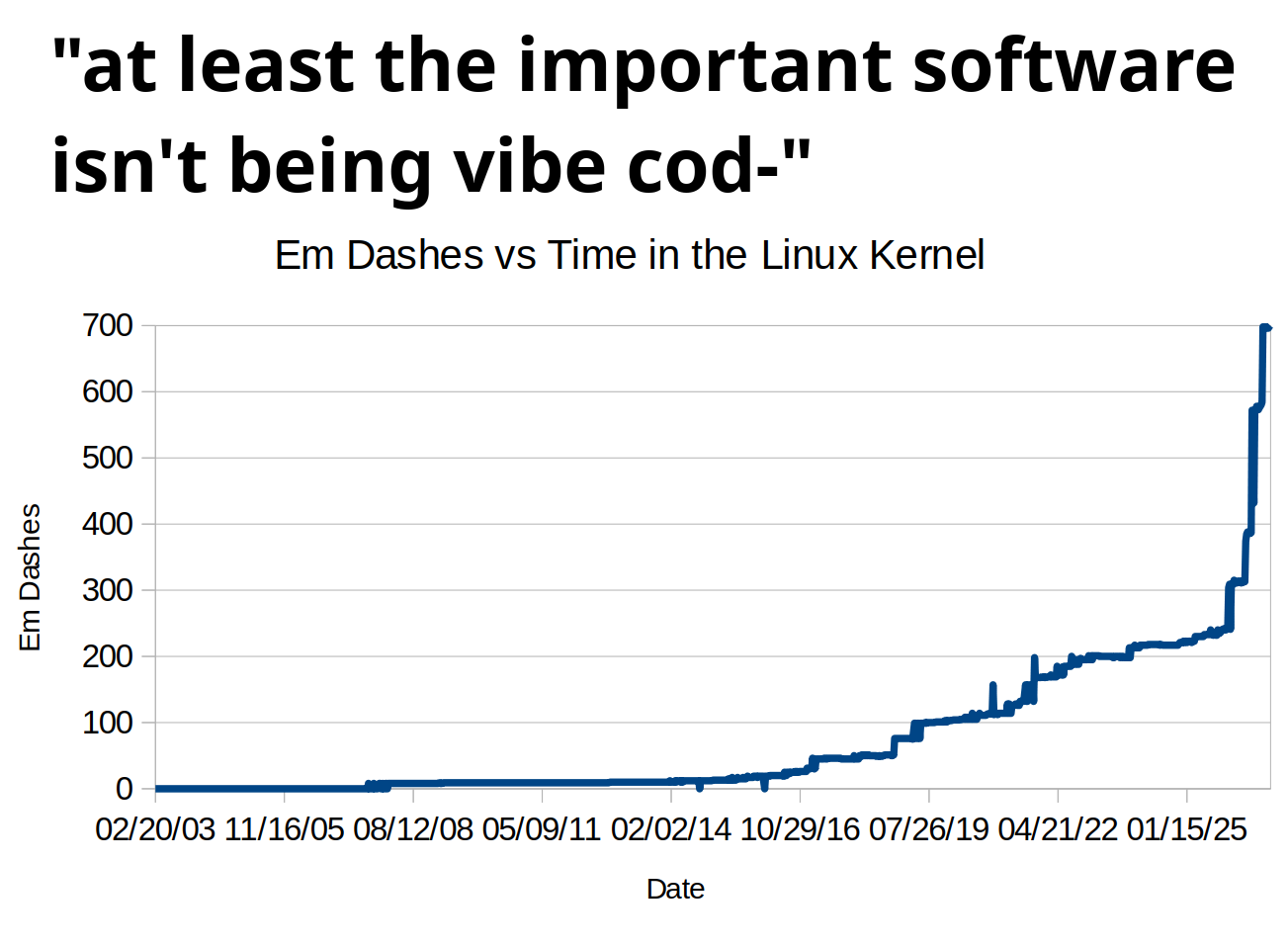
What is the accelerating rise of m-dashes from approximately 2014-2019 about? That trend apparently continued until very recently, even slowed down a bit, before exploding at some point in 2025 or 2026 for obvious reasons.
Does anyone have a theory?
People slowly learned to use their keyboards for proper typography?
That was a good one.
I wonder how many em dashes are real vs interpreted.
I love an em-dash, but I have never typed one on purpose; they are all just two minus in a row and I use them wrong – with a space around (*inspect source to see that lemmy translates for me). I abuse them like I abuse semicolons. They are a typographical tick that indicates a pause or pivot when I translate my thoughts to text.
I can imagine a human manuscript editor turning punctuation like a comma into an em-dash when it makes sense, but I can’t imagine a developer ever specifically typing out one – with the need to either know or look up the unicode for it. The only relevant place would be a comment, but even then IDE’s are not generally known for their tendency to replace typed characters with something else.
Maybe some tool in the pretty-print/code-formatter ecosystem added that as a feature? But
var--is so common that I can’t imagine that’d be a good idea, even in a comment.For pedantry’s sake:
Two dashes –
--– in Markdown is usually rendered as an en-dash – more common in British-adjacent styles and usually surrounded by spaces.Three dashes—
---—in Markdown is rendered as an em-dash—more commonly associated with American styles and usually (though not always) without spaces.They probably write code in Microsoft Word
I used to write websites in Notepad. It was kind of like digital Amishness.
At least notepad won’t fuck with your formatting for you
Absolutely insane ide choice. Wonder if visual studio tries to add those too.
It, thankfully, does not
If the graph is not just using made up data, then it also measures absolute em-dashes, not em-dash density, so possibly could be an increase in interest in contributing to the kernel?
By a factor of roughly 10-fold? Maybe. It could indeed be a measure of overal absolute contribution. But post 2025 that could be influenced by m-dash density especially.
No, the comment I responded to was about the ~2014 uptick, not the recent one.
The recent one is obviously AI one way or another. Absolute contribution rate is higher due to AI as well.
Yeah sure, no I am not surprised about post 2025. My question was indeed about the post 2014 uptick.
The OP graph is just absolute count on the y axis, so I also assumed it was basically measuring LoC, but looking at this chart, the em-dashes do appear to be definitely more of a modern phenomenon compared to raw LoC:
Maybe some policy/tooling change around 2014? A guess is perhaps something to do with allowing UTF-8 in source files, but that’s a pretty long shot.
Looking at that, the lines of code cannot really be the full story. M-dash count really just appears to rise from 2014 onwards.
I assume it’s due to phone keyboards.
I don’t think a lot of kernel devs are programming on their phone
That’s why the number was low before.