

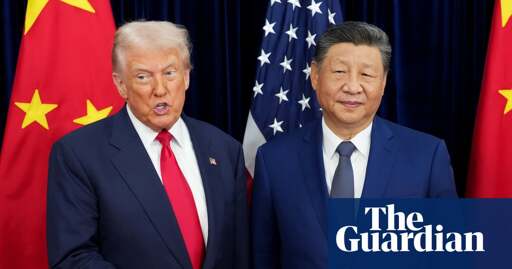
The 21-country survey for the influential European Council on Foreign Relations (ECFR) thinktank also found that under Trump, the US is less feared by its traditional adversaries, while its allies – particularly in Europe – feel ever more distant.
The poll, of nearly 26,000 respondents in 13 European countries, the US, China, India, Russia, Turkey, Brazil, South Africa and South Korea, found majorities in almost every territory surveyed expected China’s global influence to grow over the next decade.
China is making China great. They’re proving to the rest of the world that their economic model is better than the West’s.
It’s why Americans need to artificially inflate the prices of EVs by restricting the sale of Chinese EVs in their country.
Everyone you see driving a Tesla is a moron who played right into the hands of their oligarchs.
Economically, yes.
Diplomatically, China is gaining a treasure from Trump’s agressive and unprincipled behaviour.
The US has been a preferred ally to cooperate with for many countries, and a safe haven for investing money for many decades - because the US was reliable, had independent courts and an independent central bank, and was considered a stable democracy despite the problems it had.
It was possible to rationally predict a US reaction to certain problems. The state seemed to have principles, and government seemed to listen to experts.
Now the choice is between a distant country unlikely to invade anywhere except its proximity (China), even if highly authoritarian - and an unstable democracy where experts are ignored and independent institutions subverted, whose foreign policy is overtly agressive and follows no principles.
…as for economy…
From an Eastern European perspective, what could the US offer to me? Microsoft, Netflix, Tesla, Starlink… all except Starlink are needless expenses, and Starlink can be replaced. What does China offer? Batteries, electric motors, combustion motors, generators, motor controllers, 3D printing eqipment, sensors, cameras, radio electronics, optics and fiber optics… the list is long. The only (and massive) downside to China is their intent of invading Taiwan - from where everyone, including China, get their most advanced processors and memory.
There are many different economic models in “the WestTM”, whatever you mean by that in this case:
You have nordic social democracy, you have murican ultraneoliberalism (which also varies by state), canadian neoliberalism lite with public healthcare, you have the german city-factory+superstar spenders model, the french model, very centralized with a strong social safety net and labour protections…
Man, I bought Tesla before Trump was elected… and I did that because in Europe there weren’t any alternative for that price… in evs
Curious, how do you judge that? There are metrics like GDP, GDP per capita, currency exchange rate, etc but being able to compare those means having reliable numbers. AFAIK China stopped publishing some of those metrics (US too! labor related numbers iirc) and the exchange rate does not apply because the RMB is fixed. Going in countries themselves to “check” means little as you can walk through Potemkin villages.
I’m not saying you’re wrong only wondering how you reached that conclusion.
I gave an example with EVs. It’s still fairly new technology, but China has proven that they can make EVs better and cheaper than their Western counterparts. They can do this with fewer resources and lower GDP than the US and other Western nations.
The West has gotten bloated and complacent. All they do now is focus on funneling as much money as possible to oligarchs and grifters. They cannot compete anymore and EVs are a symptom of that reality.
That’s a specific technology with resources they have an advantage on (rare earth elements) with a very shaped market (subsidies, tariffs, etc). Countries have historically been very protective of the car industry. They might very much dominate this market more and more (and arguably justified) yet I don’t think it’s correct to generalize from that example. Also cheaper is not a good metric when the country is known for having work camps or that underpricing a market is in itself a strategy.
Again I’m not trying to downplay the progress made there (because it is impressive) but I think when a comparison is made it has to be done properly. Here there are quite a few factors that make it difficult plus there is an extrapolation from an example that is not necessarily representative of a trend.
All that said this it does not justifies problems in the West, including how slow EV adoption was. Both can be painful yet true.
Notice how the EU just succumbed to lobbying from part of the European Auto Industry and cancelled the whole “ICE car sales ban from 2035” having even before that put extra tariffs on EV cars from China (so, not quite as extreme as the US, but none the less a caving to EU auto makers) to help big auto makers in Europe who refuse to transition to EVs (and this at a time where Diesel polution kills about 10,000 people a year in the EU, so they’re literally putting the interests of large auto makers over the lives of people).
You know what they could’ve done instead?
Subsidies for European auto manufactures with a large percentage of EV car sales relative to ICE cars (which, if high enough would mean lots of money for subsidizing smaller companies to grow and replace the larger ones if the large makers don’t increase their EV sales rather than keeping on extracting juicy margings from ICE SUVs).
The problem in Europe is political capture by dinossaur businesses which would rather make believe the next great Tech Revolution - around Renewables - isn’t happening and have pretty much bought politicians to make sure Europeans and smaller European companies can’t easilly benefit from it.
Europe has the Tech capability to go there but the current political structure (late stage Neoliberal Capitalism) were politicians mainly represent large economic interests (not only above citizens but even above small and mid-size businesses) means that at best politicians simply refuse to send serious money to forward-looking disruptive businesses or forcing the pricing-in of things like Environmental costs in products made by large companies, whilst at worst actually making laws to reduce everybody’s options to move away from buying the products of said large companies.
It might look as an economic and progress problem at first sight, but dive any further and you’ll see Economic options being shaped by Politics (in some cases simply by Politicians in Europe choosing “not to intervene in Markets” but only for markets dominated by big players, in other cases by making laws which de facto activelly obstruct adoption of improved Tech) and in turn Politics being shaped by Big Money.
I think the previous poster was absolutelly correct in their interpretation of the West’s problem in this as broader societal problems.
Mind you, I don’t even think that China’s political system is all that great - rather I think that in the present day the power structures in the West (more in the US, but also to quiet an extent in Europe) are actually hindering the moving forward even whilst there’s plenty of capability to do so (certainly in Europe which mainly has invested massivelly in things like Higher Education).
Policy. Their economic policy is better. Their government has some far-reaching strategies, creates comprehensive policies to develop them, and maintains those policies consistently across many years. They effectively guide competition and long term vision into their market, just like any competent government ought to do
That’s also the biggest place we’re failing. Lack of vision, lack of strategy, no consistency. Even worse when your administration enriches themselves, plays favorites, outright takes bribes, holds themselves above the law, rules out of spite and personal feelings, focuses only on short term
buying a used tesla makes a lot of sense these days with everyone wanting to get rid of them
Everyone? I drive a Tesla sometimes because my sister’s leased Tesla is blocking my car in. Also she leased it before Musk was commonly known as a buffoon.
I didn’t know you could sign lease terms that long
She’s getting ripped off. He made it obvious in 2018 when he called a rescue diver a pedophile. I’m sure a 7 year auto loan would have been much less.
She’s been leasing it for over 7 years? 2018 is when he called the rescue diver for the kids in Thailand a pedophile because they turned down his submarine. He dropped his mask almost immediately after that.