

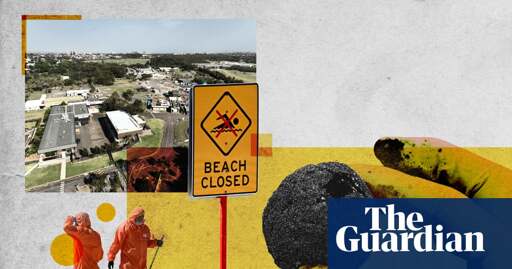
A giant fatberg, potentially the size of four Sydney buses, within Sydney Water’s Malabar deepwater ocean sewer has been identified as the likely source of the debris balls that washed up on Sydney beaches a year ago.
Sydney Water isn’t sure exactly how big the fatberg is because it can’t easily access where it has accumulated.
Fixing the problem would require shutting down the outfall – which reaches 2.3km offshore – for maintenance and diverting sewage to “cliff face discharge”, which would close Sydney’s beaches “for months”, a secret report obtained by Guardian Australia states.
“The working hypothesis is FOG [fats, oils and grease] accumulation in an inaccessible dead zone between the Malabar bulkhead door and the decline tunnel has potentially led to sloughing events, releasing debris balls,” the report concludes.
“This chamber was not designed for routine maintenance and can only be accessed by taking the DOOF offline and diverting effluent to the cliff face for an extended period (months), which would close Sydney beaches.”
I’m certain a lot of people raised the same question during construction, and the answer was definately “it’ll be too expensive”.
As long as capital is the foremost concern, sensibility, sustainability and common good will never be. Can never be.
Everything needs to change before that becomes an option. A revolution has to happen, on a large enough scale to change that.
Funny story there (well, not “haha” funny). I recently finished my bachelors in Architectual Technologies and Construction Management in Denmark. The exam for this bachelors is defending a project you’ve worked on for 4-ish months. It’s a construction project, where you alone have to design a building of a decent size while making sure you don’t break a bunch of laws or building codes. My exam was a catastrophe. Part of what made it so incredibly bad, was that I insisted on making a building that was good for the end-user. Unfortunately, part of our building codes here in Denmark is that we have to build a building that is good for the customer, not the end-user. This meant that I went directly against code, by e.g. soundproofing the building better than the nationally agreed minimum soundproofing, because that would be more expensive for the customer, or by insulating the building more than legally required, because we live in fucking Denmark, and heating of a building is a big environmental factor.
According to our codes (apparently), you have to only ever do the absolutely legal minimum when designing a construction project, unless the customer has expressly stated otherwise, because if not, you’re not securing your customer’s interest. So in other words, the quality of the building isn’t important, only the cost of it.
Do you not interact with your customer? As a software engineer, it’s part of my job to sell the project manager or customer on details they haven’t thought of or may not fully understand
In a real life scenario, I interact with customers on a daily basis, but I’m further along the chain in the construction process, and don’t deal with design in any way. However, the exam was a completely fictional scenario with a fictional construction project, so no customer to talk to. The examiners decided they didn’t care much for sound proofing, and didn’t care for my reasoning.
That’s rage inducing!