

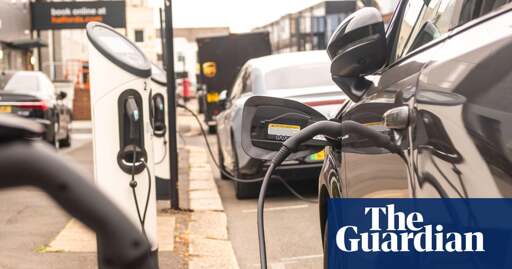
While most hybrids are said to use one to two litres of fuel per 100km, a study claims they need six litres on average
Plug-in hybrid electric cars (PHEVs) use much more fuel on the road than officially stated by their manufacturers, a large-scale analysis of about a million vehicles of this type has shown.
The Fraunhofer Institute carried out what is thought to be the most comprehensive study of its kind to date, using the data transmitted wirelessly by PHEVs from a variety of manufacturers while they were on the road.
. . .
According to the study, the vehicles require on average six litres per 100km, or about 300%, more fuel to run than previously cited.
The scientists of the Fraunhofer Institute found that the main reason for the higher-than-stated fuel usage was due precisely to the fact that the PHEVs use two different modes, the electric engine and the combustion engine, switching between both. Until now it has been claimed by manufacturers that the vehicles used only a little or almost no fuel when in the electric mode. The studies showed that this was not in fact the case.
Why are people so bizarrely defensive about this?
This isn’t sensationalism. It’s a scientific study of actual real-world fuel use based on data from thousands of vehicles (at least ten thousand, I assume, based on earlier studies). If, as the study author says, internal combustion engines are being used more frequently than estimated, should it not be addressed? Should we not be aiming for higher efficiency in these vehicles? If tests aren’t accurately predicting usage, should we not develop more accurate tests?
Its not defensiveness it’s just recognizing the issue for what it really is. You can change the estimation calculation all you want, but it will always be wrong because the variables being used don’t blend together well. You can make gas engines that get 100MPG or even 1000MPG but it won’t make for an accurate estimation when averaged out with ∞MPG or 0GPM.
That’s a problem with the estimation not with the manufacturers. The manufacturers tell you exactly what the electric range is and also what the ICE fuel economy is. It’s trivial to apply these values to your driving habits to get an estimation for your use case.
As an example, I’ve been eyeballing the Prius PHEV with its 44 mile range (and 47MPG hwy). My commute is about 45 miles each way and I have access to chargers at work, so my daily fuel consumption would either be 0.04 gallons (charge at home and work) or 1 gallon (charge at home only) giving a 2400% variation in fuel economy for the exact same trip based solely off my actions alone, having absolutely nothing to do with the car itself.
Here you’re conflating two separate issues and highlighting exactly why people are calling this misleading. You can change the calculation all you want but that isn’t changing the efficiency of these vehicles and this study doesn’t demonstrate that these vehicles are inefficient. All it shows is “your MPGe or l/100km is greatly effected by how often you stay on electric power” and that factor is solely dependent on the driver and ranges from near zero to infinity regardless of the vehicle chosen.
It doesn’t get more accurate. We should just scrap the combined “MPGe” (and EU equivalent) and stick with “electric range” and “MPG”. Both of those can be fairly accurately predicted as separate values. How they combine is entirely up to the individual.
I agree with everything you’re saying, but this part. As you stated before, those are intended to allow for an apples to apples comparison and make it easier for the consumer to judge a car’s funel economy, without having to do their own math (which - lets face it - most people suck at).
If the underlying usage pattern doesn’t reflect a typical average use, that’s an issue, that can be adressed. And when studies show that they don’t why not take that as a call to improve upon the methodolooy?
There’s always going to be the caveat that one’s one usage pattern might deviate greatly from the standard, and absolutely it’s a must, that the individual values are indicated, so people CAN do their own math. But having a standard combined measure is still a useful tool.
Addendum. I have to admit to really only having read the article just now.
This is the real underlying issue here. It’s the EUs regulation on CO2 emissions reduction, that car manufacturers are abusing here. They are designing their car in such a way, that they look good on paper and can pass the requirements of the regulation, while their real-world emissions are much higher. (And in that regard, it’s not too unlike Dieselgate. Minus the intentional technical manipulation ofc.)
While your claim, that it’s the individuals responsibilty how they use their car is obviously true for an individual car’s fuel consumption, that realization is also utterly useless as a basis for effective policy. There needs to be a standard, and that standard better reflect an empirical assessement of reality.
The issue isn’t really that the estimate is wrong, it’s that it’s wrong by an enormous amount – and one that’s been increasing every year. I don’t think that the study is trying to say that these vehicles are inefficient as some kind of absolute judgment, but that they’re less efficient than estimated (although there are big differences based on vehicle make and model).
I don’t think the problem really lies with manufacturers, it’s that the current tests aren’t accurate enough to predict real-world usage closely enough. Although, driver input is mediated by computer systems and if on-board systems are being too aggressive in switching over to ICE, I suppose that’s a manufacturers problem.
Really, they’ve been doing these very large studies for a long time. The sample size is large enough to capture the full diversity of driving styles and it cannot be a few outliers skewing results. Since 2012, the disparity between estimated and observed fuel usage has grown every year. Why? Why is it changing and why is it always changing in the same direction?
It getting worse over time I would think is partially a function of customer mix changing.
You start with early adopters who are more eco conscious and then now entering mainstream, and also people choosing plug-ins for performance purposes.
This is about owner behavior, not the design of the vehicle. If I had a PHEV, for my commute, I would use no fuel if I charged overnight.
Idiots are paying extra for PHEVs, then not plugging in. What is the point.
Likely these owners actually have no idea how their cars work.
On the assumption phevs have the combustion engine off unless they are in hybrid or performance mode:
I think it’s decisive because the article’s focus is fuel consumption but fuel consumption in phevs is actually just a proxy for driver behaviour. (Once you factor out differences between models)
So while the study does show that phevs technically have worse fuel economy in real world usage, it doesn’t show they use more fuel in either electric mode or in hybrid mode than previously believed.
The conclusion is useful for understanding the overall impact of phevs on petroleum consumption, air quality and global warming, but it’s misleading when evaluating what kind of car you should buy.
Since you know how you drive, learning new information about average driver behaviour doesn’t factor into your decision on what kind of car you buy.
The environmentally conscious answer is still no car if possible, electric if you need a car but most journeys fall within the range limit and phev if you need a car for frequent long range usage.
Tldr; it’s contentious because the article reports information useful for policy decisions to a general public who are making individual consumer decisions where the information is misleading.