

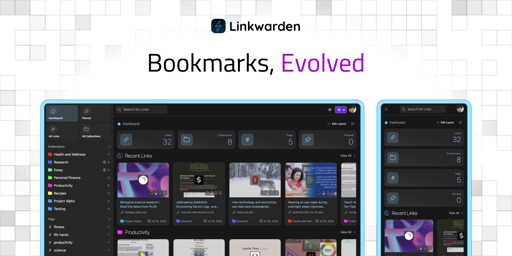
Hello everyone!
It’s been about 3 months since the last release, and this one took a bit longer than usual. A lot of work went into polishing and refining both the web and mobile apps to make sure it was worth the wait.
Today, we’re excited to announce Linkwarden 2.14!
For those who are new to Linkwarden, it’s a tool for collecting, organizing, reading, and preserving webpages, articles, and documents in one place. Linkwarden is available as a Cloud offering, or you can self-host it on your own server.
This release focuses on performance, usability, security, and platform upgrades.
What’s new:
🗂️ Improved team collaboration
Collections and subcollections got some important improvements.
Members and their permissions can now be propagated to subcollections, and collection admins can now create subcollections as well.
🏷️ Improved tag browsing with pagination
Tags now support pagination, making large tag lists easier to browse.
This helps keep things faster and more manageable, especially in places like the sidebar and tags page.
⚡ Faster interface with optimistic rendering
We added optimistic rendering to some of the slower parts of the app, especially around links and collections.
That means actions like updating or deleting items can now feel much more immediate, since the UI updates right away instead of waiting for the full request to finish.
🚀 Platform upgrades: Next.js 15 and Expo 54
Linkwarden now runs on newer foundations across both web and mobile:
- Next.js 15 for the web app
- Expo 54 for the mobile app
These upgrades improve compatibility and give us a stronger base for future improvements.
✨ Improved user experience
This release brings a number of user experience improvements across the app, especially around search and settings.
Search is now more helpful and easier to discover, while settings are cleaner and easier to navigate.
🔒 Security improvements for submitted links
We improved how submitted links are validated on the server for safer and more reliable processing. We recommend updating to 2.14 as soon as possible.
✅ And more…
As always, this release also includes smaller fixes, UI cleanups, dependency updates, and under-the-hood improvements across the app.
Full Changelog: https://github.com/linkwarden/linkwarden/compare/v2.13.5...v2.14.0
Thanks!
Thanks to everyone who’s been using Linkwarden, reporting bugs, suggesting improvements, contributing, and supporting the project along the way.
This release took a little longer than usual, but a lot of care went into making sure it was worth the wait. It also gives us a much stronger foundation for what’s coming next, and we’re looking forward to sharing more with you in the coming months.
If you’re interested in trying Linkwarden without dealing with server setup and maintenance, our Cloud offering is the easiest way to get started.
We hope you enjoy Linkwarden 2.14!
I feel like I’m going crazy, because I distinctly remember checking out this project a couple of years ago (before they were called Linkwarden, and then when they renamed it) and noticing all the ai-looking commits (especially after the rename) in the repo so I wrote off the project. Also notice how OP doesn’t deny that they’re using it, just says he started the project before ChatGPT. I went through his profile and the AI profile picture and https://github.com/daniel31x13/gstack fork are pretty telling.
Let’s be honest, a lot of FOSS projects have been inundated with ai pull requests, and I looked at some that were merged. At least the dev looks like they’re being responsible about them. Look at the contributors for the last 6 months, claude is right there: https://github.com/linkwarden/linkwarden/commit/8bd3bd376316332693c5074a59dc3ab03559f1dc. Look at that contributor’s profile and website. For another one: https://github.com/linkwarden/linkwarden/pull/1553. Look at that user’s GitHub profile, look at the activity, look at his website. I’m not saying he’s not a good programmer or anything like that, but be for real, he’s absolutely using AI for his code, if not an ai agent of some sort.
I also find it hard to believe an app that features ai tagging wouldn’t also use ai. So it seems disingenuous to tag their Reddit post with “No AI” in r/selfhosted.
At the end of the day, I’m not personally invested, and they’re free to use ai in their project (it is a tool after all and can be used responsibly). But I’m really developing trust issues with how dodgy some projects are about disclosing their AI usage. Like just say you use it to debug, qa, brainstorm, or write your docs, and or that the outputs are actually reviewed by a person.
While i dislikes ai i think it’s one of the only ways to create a foss software with a small time with a reasonably small number of people. But this does indeed just look like a no-effort ai post
And I get it, I do, but I think what rubs me the wrong way is how cagey the dev is about AI disclosure.
Use it for your project, it’s open source (which allows me to see that AI is being used) and free to self-host. Like I mentioned previously, I do see the dev being pretty responsible about their usage from the few merge requests and individual commits I looked at.
Personally, I feel like FOSS is built on a foundation of trust, and I find it very hard to trust a dev/project that (in my opinion) lies by omission. So, while I won’t use/contribute/pay for this project, I’m not judging anyone who does and I wish y’all the best. At the end of the day, it’s your time, effort, money (if you donate and or pay for the hosted plan), and or hardware (if you choose to self-host).
Especially, after fiascos like Booklore (another project I now feel vindicated for writing off early) and the general trend of enshittification for almost all software and services, can you blame people for being a bit more skeptical?