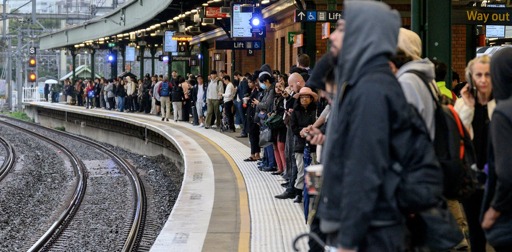
…The relatively small difference between Victoria, where public transport was free, and NSW – where fares remained unchanged – suggests price is not the main constraint on mode shift. Access, travel time, service reliability and the ability to make specific trips appear to matter more.

  • arbilp3@aussie.zoneOP
    link
    fedilink
    English
    arrow-up
    4
    ·
    5 days ago

    And it needs to do that by improving, not by simply adding barriers to alternatives.

    What improvements would you recommend? This is important. More ideas need to be discussed.

    • Hanrahan@slrpnk.net
      link
      fedilink
      English
      arrow-up
      5
      ·
      edit-2
      5 days ago

      What improvements would you recommend? This is important. More ideas need to be discussed.

      Not the OP

      PT in Australia is an afterthought shoe horned in around car stupidity and it needs citizens to think about it all if they want to make use of it eg living near a train station deliberately etc. been there, done that.

      Good PT takes decades of planning and has last mile issues (solved with quality separate infrastructure for hire ebikes and personal escooters).

      A good example of this travesty I bring up is near where I used to live on the Gold Coast, Helenesvale Station; has a heavy rail stop, is the terminus for the light rail down to the beach at Broadwater, Southport and soon Burleigh etc and for a bus line. It has a massive shopping centre (supermarket, specialty, medical, fruit and veg, banks etc) and is surrounded by … a huge fucking car park.

      What it should have is nearly no car park and 10 x 15 story apartment blocks on site. (that’s 1500 homes right there and zero koala habitat needs clearing, zero roads built etc and workforce right near 1000s of jobs). You wouldn’t even have to think, walk down stairs for shopping, medical etc and a train to Brisbane, or Tram to the beach, or to work for many, many people.

      Instead, 100s of workers drive there and park in the car park, as do commuters, a fucking mess.

      As an aside, I now live in rural Tassie (climate change saw me move) and there is 1 bus a day where i live. It used to be $6 each way, it’s now free to Launceston. I am sure there are many who don’t dive as much but with the free PT I catch that bus in once a week to the “big smoke” for a day out, rather than drive my ecar every other month for just chores.

    • postnataldrip@lemmy.world
      link
      fedilink
      English
      arrow-up
      3
      ·
      5 days ago

      A few things come to mind, with the caveat of course this is all from a layman’s perspective and may be misinformed, dumb, or otherwise not feasible.

      Basic stuff:

      • More frequent services. Aside from the sardine tins they can become during peak times, lengthy waits, particularly in bad weather, aren’t great. It also softens the blow if there’s a service fault (only a few minutes until the next one comes by).
      • Disincentivise service cancellations, a late service is better than one that doesn’t run at all. It won’t always be possible to avoid cancelling, but I’m told the cancellation penalty can be less severe than the punctuality one.
      • Chain/rework service SLAs with an “overall service” goal. It’s frustrating when your service has been delayed, and the connecting service you would have caught leaves empty but on time to meet their own timeliness metrics.
      • Perhaps linked to that, I have to wonder how wise it is to contract these things out. Not sure what the answer is as having it all be govt-run doesn’t fill me with optimism either, maybe rethinking how contracts are written and awarded needs a rethink - but moving the focus from serving the public need to minimising cost/maximising profit cannot possibly be in the best interests of the commuter.

      More ambitious:

      • There need to be trains that go between the existing lines, concentric circles around the city essentially. To visit a friend who lives only about 15km from me, using PT the train-only option involves travelling into the city, swapping trains, then travelling out of the city on his line. It’s over 2 hours of travel. Adding buses brings that down to about 75-80 mins. Driving there takes me 20.
      • Smarter express services that make a meaningful difference to trip times. Eg buses where the pickup/dropoff stops are preset (bookable?), maybe even dynamic routes based on the stops required? Dunno, this is a tough one but on my commute the current “express” option saves only 3 minutes lol.
      • More separated roadways for buses, so they are less at the mercy of other traffic. That has the added benefit of reducing the volume of that other traffic, so things get better for both PT and private vehicles.
      • More 3+ line rails, to allow for passing. That would reduce the flow-on impacts of delays to a service, and would allow for more express services that don’t have to accommodate catching an all-stops one.
      • Better start-of-trip options. Park and ride sounds good but they are always packed, and are basically just a shopping centre for car thieves who know the owners will likely not be back until 5pm or so. We’ve already lost one car this way, insured but it was a massive headache. Airport-style shuttle buses perhaps? Something that might allow a pushbike to be transported too, as that might help with the last-km issues.
      • More of a societal thing than being PT-specific, but move away from the “one big CBD” model. Everybody wanting to converge on more or less the same point puts a huge amount of concentrated pressure on a system. That system has to be designed and funded to accommodate these enormous peaks, but will be massive overkill at other times. Distributing the destinations reduces that concentration, but also helps to justify better services in areas that everyone currently leaves because they have to go to the city instead.

      There are no doubt tons of others but that’s a start.

      • arbilp3@aussie.zoneOP
        link
        fedilink
        English
        arrow-up
        2
        ·
        5 days ago

        Wow, pretty impressive! With the petrol situation not going to improve any time soon and climate action desperately needed this is an opportune time for governments to get input from commuters such as yourself throughout Australia and start transforming our PT systems according to the needs of different population centres.

        I think your last point about the faulty one CBD model was already recognised long ago. Sydney has 3 major business/admin centres: city centre, North Sydney and Parramatta. I haven’t lived in Sydney for a while so there may be more for all I know. There’s probably similar set ups in other cities but I don’t personally know.