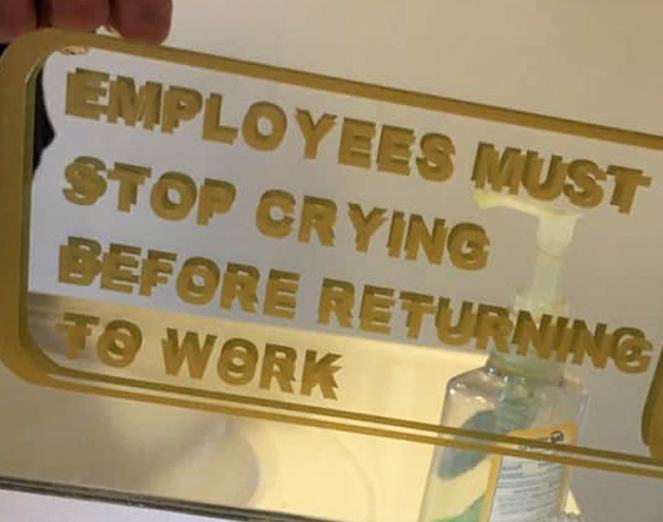

This is deliberate
Keep people on the edge of ruin, and threaten their healthcare if they dare leave an exploitative employer
Slavery never went away in the US, it merely expanded to include more people and was rebranded as “the free market”, or “rugged individualism” or some bullshit
And this is also why nobody is willing to actually rock the boat in the US. Everyone is too scared to lose what they have, our employers have us by the balls for our paychecks and healthcare, the banks have you by the balls because of debt and if you own a home and lose your job you could lose the home too.
The US has been turned into a giant company town. As soon as you get paid the money gets taken away.
Everything has been designed to extract the maximum money from people. From all the middlemen stealing convenience fees to subscription services to your increased medical premiums.
But this argument always sounds so weird to me.
All throughout human history, in every part of the world, there have been revolutions, uprisings, riots, strikes and protests, not despite terrible living conditions, but because of them. Or do you imagine all these people had job security, great quality healthcare and public safety nets? Of course they didn’t, because then they wouldn’t have had to rise up.
Only in America are the bad conditions used as an excuse not to act.
All throughout human history, in every part of the world, there have been revolutions, uprisings, riots, strikes and protests
yeah but all throughout human history, people have had meaningful human connections to each other. meanwhile, in the western world today, it feels like you can be accused of sexual harassment for looking at somebody too long.
I’m a little confused. Are you saying people are not rioting because they’re scared of being accused of sexual harassment? Or do you think that sexual harassment used to be seen as something harmless and ‘meaningful?’
Do you believe that people would be more likely to act if sexual harassment was (still) accepted? I guess I just don’t get your point.
Well, you just outed yourself as a part of the problem
If you’re constantly being accused of being a creep, I’m going to go with the simple answer
You’re a creep
It’s amazing how I’ve never had this problem, and have many meaningful connections with all sorts of people
i’m going to go with the simple answer
“I’ve never had this problem” sounds a lot like “it works on my machine”. or “there’s not a police problem because i’ve never been targeted”. it really just means that you’re part of the favored part of society with favored traits and characteristics.
Wow, I had no idea that Americans were that poor. And here I thought I was poor.
I’ve never understood why people get so excited about tax refunds, but this provides some context.
Tax refunds act as forced savings for many people. It’s not a good way to save as the government pays no interest on the savings. The the people then blow the money immediately on major purchases or paying down debt buildup.
Personally, I always tried to make it so that I didn’t get a tax return. I always figured it cost me significant money in cash flow through the year. Always pissed me off to overpay in taxes when I could have used the money for critical things I needed during the year.
the government pays no interest
I can’t remember the last time I saw a bank pay interest, either. If you want to grow a principle balance, you need to invest it, and that gets real iffy when the demented gameshow host decides to manipulate the markets.
It seems like my 401k dips $5k every afternoon when Trump promises something insane, then bounces back the next morning when he doesn’t follow through.
What does cash savings even mean? I would assume that most people have their savings in a bank account…
That’s becoming my take, too. What surveys mean to ask is liquid assets, money people have immediate access to. But most Americans are too uneducated to understand what that means, so they ask about cash. But many people probably think that’s a question about how much paper money they have.
Basically, they ask a question in a dumb way to get around how dumb Americans are, but the result is a dumb statistic.
Unable to save, or unwilling to? Even when I was earning £8k several years ago I was able to comfortably keep a few thousand in the bank. Just made sure not to spend more than I earnt.
A lot of those habits remained. Now I don’t know what to spend money on, saving multiple hundreds a month and my only increased expense is that we bought a house. Give it a few more years of inflation and that won’t even cost much more than renting a bedroom did.
I like cooking all my meals so why would I change? Costs like £10-15 a week each. Now that I have a house with a small amount of garden space I have also started growing herbs, if anything that is reducing my food bill. Unlimited rosemary!
several years ago
Unless this was post COVID, you were working with a vastly different economy than the people of today.
I read an article a few months ago that two people out of university into average graduate jobs and renting in my (non capital) city, would not likely be able to afford to rent a flat together and have enough remaining for bills and food, let alone any discretionary spending, based on prices at the time. If they offset that by living away from the city and similarly priced suburbs, the costs just shift to transportation costs (fewer and fewer are offering fully remote jobs now). This is all while allowing for zero expenditure towards hobbies and social life, which are things that are pretty well understood to lead to mental health problems when we can’t prioritise them.
Many people don’t have the luxury of any garden space, let alone some with enough sun to actually grow anything. Those same people might also not have the luxury of a car to be able to drive to the big supermarkets with the best prices and bring back a big shop, so they’re pushed towards the more expensive local supermarkets. IIRC people in that situation typically have to spend something crazy like 20-25% more on food than someone who has the means to go to a big supermarket regularly.
From everything I’m seeing, unless you’re lucky enough to end up in a well paid job, saving money is very much a luxury for people younger than us.
Started living there and working in that job before covid, continued after. Never lived in a city though, that was a mid sized town. At the time I didn’t have a car or garden. Still don’t have a car.
In the United States (which I’m mentioning because that’s the location of the survey we’re discussing), something like 85%–90% of people live in places that are car-dependent. It’s closer to 100% outside of cities. So a vehicle is an expense that can’t be avoided. We’re looking at loan payments (probably), insurance (definitely), gas, and repairs. The lower your income, the better the odds that all four of those expenses go up, as you’re less likely to have a good down payment or buy in cash, and more likely to have your options reduced to older and lower-end vehicles. That typically means lower gas mileage and guarantees more frequent repairs. You’re also likely to live in a lower income area with higher insurance premium rates.
Of course, despite the rate of car dependence, about a third of Americans do not have reliable access to a dependable vehicle. That’s some very unfortunate math.
It’s hard to be poor in the U.S.
A lot of people own cars here too and insist its required. Either way I don’t have one. Scooters are pretty cheap to run if you actually need to drive around.
Most of the United States is designed to be so hostile to alternative transportation that scooters and bikes are mainly reserved for trail exercise and suicidal thrill seeking. It’s simply not a practical recommendation, unfortunately; neither is public transit outside of a select few city centers. Many of us wish we had a way to ditch cars, but we don’t.
125cc scooter, not a kids scooter.
Unfortunately it’s less about the motor and more about the metal cage you aren’t riding in.