Really not how most of the software works. I install ton of apps locally like games, Libre office, ect. Running all in browser is a pipe dream. Also extremely memory and CPU inefficient
It really is. WebASM is miles beyond what you’re probably thinking of in terms of browser based performance, and most companies these days do not have local applications installed for their office workers. Office 365 is by far the most popular version of office, and it’s entirely browser based. Most in-house corporate IT work from the last decade is electron wrappers of internal company websites acting as simple interfaces for actual heavy lifting.
While there’s definitely some apps that are a bit too heavy for WebASM (or just javascript/.net for the above examples) this list is vanishingly short these days. I’d say blender and other 3d rendering would be inefficient just because WebASM has weird interactions with anything other than OpenGL and Vulkan, But even Unreal 5 can export to WebASM and do it fairly well (as well as OpenGL can perform, that poor outdated thing).
Heck just go to itch.io or any website that has ported over games to WebGL/WebASM. You can run Half-life directly on your browser these days. Half Life of all games. That’s more demanding than anything not 3d that you’d run in an office.
I know what web assembly is. It’s not a golden one-for-all solution you try to paint it to be. There’s a reason why you won’t see any modern AAA games in Wasm except ancient stuff like half life or Quake 3. It’s just not fast enough and not memory efficient enough.
While there’s definitely some apps that are a bit too heavy for WebASM (or just javascript/.net for the above examples) this list is vanishingly short these days.
Jesus no. It’s obvious you don’t play games. Unreal engine can export to Wasm but noone does this. Everyone develops games natively with DirectX 12 api in mind (and very rarely Vulkan like in case of Doom or Red dead redemption 2) You’re just blatantly wrong with this.
What’s web assembly is good for is what’s in the God damn name: Web apps. You can squeeze in office into it, because office is ultra lightweight use case, that back in the day ran on 486dx4 with 16Megs of ram. It now runs on 3ghz CPU and requires hundreds of megs of ram, this is insanely wasteful. We can afford these resources, but it’s still wasteful as hell.
Office 365 also refers to the desktop apps as well as the web versions, has done for many years now. Though I suppose it’s all copilot 365 now.
Source: Am office worker where we use office 365, and we all use the native system software, with the browser versions as for quick editing when elsewhere.
You’re all over this thread posting bad takes. Of course you can do secure encryption in a browser. There’s absolutely nothing stopping you from using any encryption algorithms within a browser whatsoever. I don’t even understand what you could possibly mean. There are so many ways to achieve it.
There are numerous ways to place decryption backdoors into a website’s JavaScript. How would you make sure that there is no MITM when trying to safely encrypt (e.g.) an e-mail in your browser?
Of course you can do secure encryption in a browser.
Talking about “bad takes”, aren’t we? There is no way to ensure that your end-to-end encryption is not decrypted on the fly when done by a website (= a potential attacker).
Who said anything about a website? You said browser. You can run fully-local resources in a browser, such as browser extensions, locally hosted tools, even just running in a .html file on your local disk somewhere. Javascript also isn’t the only option available to solve this problem.
You can run fully-local resources in a browser, such as browser extensions, locally hosted tools, even just running in a .html file on your local disk somewhere.
How would you do that without violating essential security measurements?
“Close enough to a browser” isn’t a browser. GnuPG in a browser just won’t work and most other encryption facilities aren’t quite as secure (and transparent).


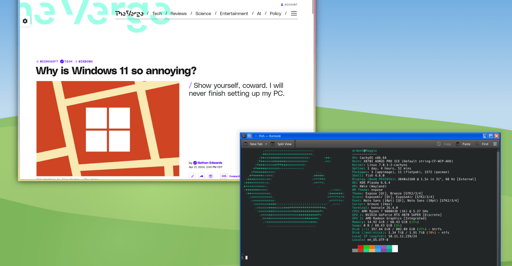
Life is more than browsers you know…
deleted by creator
Really not how most of the software works. I install ton of apps locally like games, Libre office, ect. Running all in browser is a pipe dream. Also extremely memory and CPU inefficient
It really is. WebASM is miles beyond what you’re probably thinking of in terms of browser based performance, and most companies these days do not have local applications installed for their office workers. Office 365 is by far the most popular version of office, and it’s entirely browser based. Most in-house corporate IT work from the last decade is electron wrappers of internal company websites acting as simple interfaces for actual heavy lifting.
While there’s definitely some apps that are a bit too heavy for WebASM (or just javascript/.net for the above examples) this list is vanishingly short these days. I’d say blender and other 3d rendering would be inefficient just because WebASM has weird interactions with anything other than OpenGL and Vulkan, But even Unreal 5 can export to WebASM and do it fairly well (as well as OpenGL can perform, that poor outdated thing).
Heck just go to itch.io or any website that has ported over games to WebGL/WebASM. You can run Half-life directly on your browser these days. Half Life of all games. That’s more demanding than anything not 3d that you’d run in an office.
I know what web assembly is. It’s not a golden one-for-all solution you try to paint it to be. There’s a reason why you won’t see any modern AAA games in Wasm except ancient stuff like half life or Quake 3. It’s just not fast enough and not memory efficient enough.
Jesus no. It’s obvious you don’t play games. Unreal engine can export to Wasm but noone does this. Everyone develops games natively with DirectX 12 api in mind (and very rarely Vulkan like in case of Doom or Red dead redemption 2) You’re just blatantly wrong with this.
What’s web assembly is good for is what’s in the God damn name: Web apps. You can squeeze in office into it, because office is ultra lightweight use case, that back in the day ran on 486dx4 with 16Megs of ram. It now runs on 3ghz CPU and requires hundreds of megs of ram, this is insanely wasteful. We can afford these resources, but it’s still wasteful as hell.
Office 365 also refers to the desktop apps as well as the web versions, has done for many years now. Though I suppose it’s all copilot 365 now.
Source: Am office worker where we use office 365, and we all use the native system software, with the browser versions as for quick editing when elsewhere.
Counter-example: secure encryption. You can’t do that in a browser.
You’re all over this thread posting bad takes. Of course you can do secure encryption in a browser. There’s absolutely nothing stopping you from using any encryption algorithms within a browser whatsoever. I don’t even understand what you could possibly mean. There are so many ways to achieve it.
There are numerous ways to place decryption backdoors into a website’s JavaScript. How would you make sure that there is no MITM when trying to safely encrypt (e.g.) an e-mail in your browser?
Talking about “bad takes”, aren’t we? There is no way to ensure that your end-to-end encryption is not decrypted on the fly when done by a website (= a potential attacker).
Who said anything about a website? You said browser. You can run fully-local resources in a browser, such as browser extensions, locally hosted tools, even just running in a .html file on your local disk somewhere. Javascript also isn’t the only option available to solve this problem.
Not sure if you’re just trolling at this point.
You said:
No, you can’t. I explained why.
…and I just explained to you how you can?
Ok, I’ll bite:
How would you do that without violating essential security measurements?
deleted by creator
That’s a very loose definition indeed.
“Close enough to a browser” isn’t a browser. GnuPG in a browser just won’t work and most other encryption facilities aren’t quite as secure (and transparent).