That leaves audio production (with a bunch of Windows-only plugins), video production, photo editing, CAD…
Sure, you can re-learn your entire stack and get by, but that’s a far shot from “ridiculously little difference”. Dropping familiar complex piece of software like Ableton is a hard sell for folks (and it’s OK).
I think once you’re into concepts like a “stack”, you’re working with very niche specific software that most users will never touch. And absolutely, use what fulfills your needs.
The vast majority of people I know that ever use a computer, just use it as google chrome. Web browsers work great in Linux. Depending on your needs, a lot of creative software works great on Linux too.
Your situation is legit, and I honestly wish these things were better because I wish all things were better, but I do feel like these are specialized programs that “most people” never touch in their entire lives.
But yes, for people who have a technical or creative career based on a proprietary tech stack, the story is more complicated.
Most likely your software will work via bottles or wine
No, for the examples above it will not. Quite a lot of professional software will not run under wine (and a lot of hobbyists use professional software) - games work particularly well because they mostly do their own thing and depend less on Windows-specific APIs. And if you use a VM via Winboat then you’re just using Windows in the background, which is a workaround, but kinda defeats OP’s argument that there’s “no difference”.
To be clear: I’m daily driving Linux and I’ve not booted into Windows for more than a year. But it’s just wrong to say that they are on par with each other for a lot of usecases.
If you need an emulator (yeah, “Wine Is Not an Emulator” yadda yadda, it still makes your software think you run a different OS) to run much of your most important software, you chose the wrong operating system.
If it works completely fine with Wine - in many cases, better than under Windows - why do you care if there’s a translation layer? Seems like a weird hill to die on. Do you also feel like running 32-bit applications on a 64-bit architecture means you chose the wrong architecture?
All of that is true for most other operating systems, some of which are even more customizable than some of today’s Linux distributions. My question was “why Linux?”, not “why not Windows?”.
Question is a not relevant to the discussion, and might be an (possibly unintentional?) attempt at derailing the conversation. @bearboiblake@pawb.social answered the question more than adequately. Their point still holds: If needed, there are many ways to run Windows apps under other operating systems (including Linux). Choosing an OS between Linux - and it’s various flavors, FreeBSD etc is outside the scope of the original discussion.
Oh – in that case, because Linux is vastly more popular than any other alternative free operating system or system distribution, has infinitely more support options and software available than alternatives, and a much larger community/install base, meaning that if you have a problem or want some tool, it’s far more likely to be available for Linux than any other free alternative.
There are converters that do wonders for a lot of VST plugins but some critical ones (Kontakt for example) are unfortunately stubborn. If I made music that didn’t use sample libraries I’d uninstall Windows today. I have got it on a very minimal partition at least.


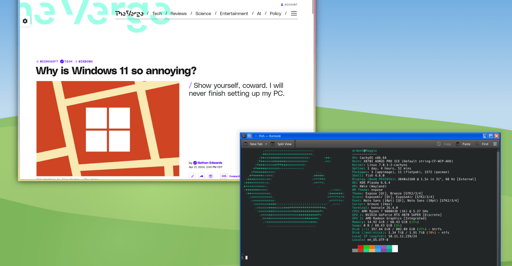
That leaves audio production (with a bunch of Windows-only plugins), video production, photo editing, CAD…
Sure, you can re-learn your entire stack and get by, but that’s a far shot from “ridiculously little difference”. Dropping familiar complex piece of software like Ableton is a hard sell for folks (and it’s OK).
I think once you’re into concepts like a “stack”, you’re working with very niche specific software that most users will never touch. And absolutely, use what fulfills your needs. The vast majority of people I know that ever use a computer, just use it as google chrome. Web browsers work great in Linux. Depending on your needs, a lot of creative software works great on Linux too.
Your situation is legit, and I honestly wish these things were better because I wish all things were better, but I do feel like these are specialized programs that “most people” never touch in their entire lives.
But yes, for people who have a technical or creative career based on a proprietary tech stack, the story is more complicated.
deleted by creator
No, for the examples above it will not. Quite a lot of professional software will not run under wine (and a lot of hobbyists use professional software) - games work particularly well because they mostly do their own thing and depend less on Windows-specific APIs. And if you use a VM via Winboat then you’re just using Windows in the background, which is a workaround, but kinda defeats OP’s argument that there’s “no difference”.
To be clear: I’m daily driving Linux and I’ve not booted into Windows for more than a year. But it’s just wrong to say that they are on par with each other for a lot of usecases.
If you need an emulator (yeah, “Wine Is Not an Emulator” yadda yadda, it still makes your software think you run a different OS) to run much of your most important software, you chose the wrong operating system.
If it works completely fine with Wine - in many cases, better than under Windows - why do you care if there’s a translation layer? Seems like a weird hill to die on. Do you also feel like running 32-bit applications on a 64-bit architecture means you chose the wrong architecture?
If you use a Windows “translation layer” for your software anyway, why would you choose Linux as the host platform in the first place?
There are so many reasons. Here’s just a few off the top of my head:
All of that is true for most other operating systems, some of which are even more customizable than some of today’s Linux distributions. My question was “why Linux?”, not “why not Windows?”.
Question is a not relevant to the discussion, and might be an (possibly unintentional?) attempt at derailing the conversation. @bearboiblake@pawb.social answered the question more than adequately. Their point still holds: If needed, there are many ways to run Windows apps under other operating systems (including Linux). Choosing an OS between Linux - and it’s various flavors, FreeBSD etc is outside the scope of the original discussion.
Oh – in that case, because Linux is vastly more popular than any other alternative free operating system or system distribution, has infinitely more support options and software available than alternatives, and a much larger community/install base, meaning that if you have a problem or want some tool, it’s far more likely to be available for Linux than any other free alternative.
Windows is more popular than Linux, so is macOS. Now is that a reason or not?
False.
Which tool does (e.g.) FreeBSD lack for you?
There are converters that do wonders for a lot of VST plugins but some critical ones (Kontakt for example) are unfortunately stubborn. If I made music that didn’t use sample libraries I’d uninstall Windows today. I have got it on a very minimal partition at least.