

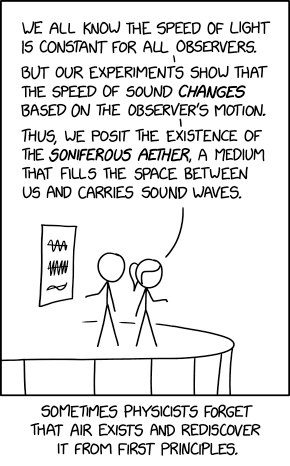
Title text:
Imagine you could ride alongside a sound wave. It would probably be pretty cool, right? We’re putting in a departmental budget request to buy a really fast plane so we can check it out.
Transcript:
Transcript will show once it’s been added to explainxkcd.com
Source: https://xkcd.com/3238/
iirc light does move through the fiber itself at more or less 1c its just that it doesn’t take straight path due to all the internal reflections which is what causes the slow down.
c is speed of light in a vacuum. Light does go slower in other media. This is why refraction, among other things, exists. I’m not sure what the speed of light in fiber is, and it may be very close to c, but it will not be c.
Oh, so it is not about the indirect path? Light taking the direct path would still be slower than in vacuum? What slows it down?
It’s quantum mechanical, so the maths gets complex. It can be simplified in a useful way however.
Basically, atoms can absorb photons and then re-emit them. You can think of the photon flying past at C, but getting absorbed and emitted along the way, adding delays. In QM however, neat particles don’t exist, it deals with quantised, probabilistic waves. The above effect gets blurred over the waveform. No one atom definitely absorbs it or doesn’t, it gets blurred together into a general slowing of the wavefront.
Like toll booths on highways. Understood.
That’s exactly the amount of QM I can understand. Which means I don’t understand QM. ;)
QM isn’t insane to understand. It’s main issue is that it doesn’t map well/at all to our normal experience. You need to dive into the maths, and accept what falls out.
The main deeper level here is how the blurring happens. The photons explore all possible paths. The result is an integral of them all. In general, vast areas cancel out, leaving classical (ish) behaviour. This makes sense mathematically, but has no classical analogy to compare to.
The darkness is thicker on earth than in space.
:D
I haven’t looked into it recently, and the only answer I recall is “because”. Ultimately, the higher the refractive index, the slower the speed of light in that substance. As for fiber optics, the 0.66 c, which isn’t a claim I made, could be in part due to reflection increasing the path length, or it could be net speed including repeaters/amplifiers, or something else.
Repeaters and refraction explain a lot. The remaining slow down of light - if you factor those effects out, feels a bit magical. The effect isn’t as big as on Pratchett’s Disc World, but the air actually slows down the light. And fiber does too.
Disc World wiki:
Well, it’s an explanation!