

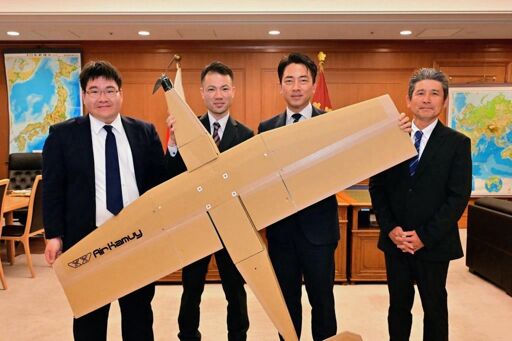
Japan’s Minister of Defense Shinjirō Koizumi posed with a cardboard drone on Monday during a meeting with drone manufacturer AirKamuy. The AirKamuy 150 is a cheap pre-fab cardboard drone meant to die on the battlefield and it comes shipped in a flatpack like an IKEA shelf.
Often non-native speakers don’t see puns the same way as native speakers. It might be a case of the kanji for origami and the kanji for kamikaze are unrelated and therefore may not rhyme in japanese. I don’t know enough about japanese to be sure though.
You’re basically right. The kami in origami means paper 紙 while the kami in kamikaze means god 神. That doesn’t mean you couldn’t make a pun about it, but the more fundamental problem is that kamikaze does not mean “suicide attack” in Japanese. The actual word for it is tokkou 特攻, a euphemism that means “special attack”.
Kamikaze originally refers to this historical event where a “divine wind” protected Japan from invasion. The term was later used in relation to suicide attacks, but I think tokkou is the word that’s more commonly associated with the WW2 suicide attacks in Japanese and kamikaze has kept its original definition.
Kami meaning god and kami* meaning paper do have different pitch accent patterns, but that’s never kept Japanese speakers from doing wordplay. In fact, the pun works even better in Japanese than it does in English. However, I think they would be confused why someone would want to name it that for a couple of reasons:
*) It becomes “gami” in “origami” because it’s the second part of a compound word, but the word on its own is “kami”.
EDIT: I just realised something: the company making these is called AirKamuy. “Kamuy” is the Ainu word for god. So if you squint real hard, it does kind of invoke kamikaze. Probably not intentional, though.
The Japanese absolutely love word puns.
And they can take it a step further with kanji similarities.
This is the only real reason I’ll accept, that they saw the pun as low hanging fruit and left it