Assume $70k median income, this means passive income would need to be $140k. In order to get $140k/yr one would need $4M to draw down at 3.5%/yr and meet that goal.
To get to $4M, using the following assumptions: 20% savings rate (not accounting for inflation, raises, bonuses, etc) per year and a 10%ROR on the index funds would take a little more than 35y.
It takes a substantial amount of discipline to do this. If one could make $70k/y starting the year they turn 18, it could be done by the time they’re 53.
Your forgetting inflation. You have to target the amount of saving you need at the end, not at the beginning. Double or triple the amount you are aiming for, if your lucky.
A lot of these calculations solve this by using a lower expected growth rate, to offset the expected inflation. It lets you have the more simple conversations in today’s currency values, which are easier to reason about.
That’s not the case in this particular example, and you’ve correctly identified a deficiency. I raise the point for the benefit of any curious readers who look into other conversations on the topic.
Thats true, but its also inserting some big assumptions into your retirement plans. For example, if you looked at 1955 - 1990 instead of 1990 to 2025 for your historical rate, youd need to double the target again to keep up with inflation. If you went back another 35 years the whole thing implodes on asset yields.
It’s likely that the $4M has some rate of return, meaning that you could do this on a bit less. Well, as long as the return exceeded the increase in median income each year. You don’t want the capital to run out before you.
You’re spot on. It also assumes one wants to maintain a particular lifestyle. If those interested in living on passive income can adjust their lifestyle more simply, or choose lower CoL locations (SE Asia, for example) dollars can go quite far.


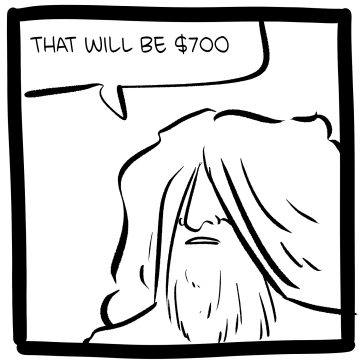
![Inner Peace [SMBC]](https://lemmy.world/pictrs/image/d4a98660-5ee8-4d4d-b915-187d36f58080.png)
Some quick math on what this looks like:
Assume $70k median income, this means passive income would need to be $140k. In order to get $140k/yr one would need $4M to draw down at 3.5%/yr and meet that goal.
To get to $4M, using the following assumptions: 20% savings rate (not accounting for inflation, raises, bonuses, etc) per year and a 10%ROR on the index funds would take a little more than 35y.
It takes a substantial amount of discipline to do this. If one could make $70k/y starting the year they turn 18, it could be done by the time they’re 53.
Your forgetting inflation. You have to target the amount of saving you need at the end, not at the beginning. Double or triple the amount you are aiming for, if your lucky.
A lot of these calculations solve this by using a lower expected growth rate, to offset the expected inflation. It lets you have the more simple conversations in today’s currency values, which are easier to reason about.
That’s not the case in this particular example, and you’ve correctly identified a deficiency. I raise the point for the benefit of any curious readers who look into other conversations on the topic.
Thats true, but its also inserting some big assumptions into your retirement plans. For example, if you looked at 1955 - 1990 instead of 1990 to 2025 for your historical rate, youd need to double the target again to keep up with inflation. If you went back another 35 years the whole thing implodes on asset yields.
These sorts of calculations always do my head in.
It’s likely that the $4M has some rate of return, meaning that you could do this on a bit less. Well, as long as the return exceeded the increase in median income each year. You don’t want the capital to run out before you.
You’re spot on. It also assumes one wants to maintain a particular lifestyle. If those interested in living on passive income can adjust their lifestyle more simply, or choose lower CoL locations (SE Asia, for example) dollars can go quite far.