I don’t understand how data centers work. Like are they hiring people to stand there with a hose spraying racks or something? Why the fuck isn’t this water being cycled?
The AC systems use adiabatic gas coolers to minimize their footprint and electricity use. An adiabatic gas cooler works very similarly to a standard AC condenser except that there is an aditional piece of media on the air inlet side of the condenser coil which is kept perpetually wet. Basically as air is pulled through that media it evaporates water and cools that air basically down to the local dew point. This means colder air cooling the refrigerant condenser and thus a smaller more electricity efficient condenser.
Adiabatic coolers are especially popular on CO2 based refrigeration systems because of the low critical temp of CO2. Basically once the ambient temp gets above 75-80F a standard gas cooler can no longer liquify CO2 because it just goes supercritical instead which results in a more inefficient refrigeration process. Adiabatic coolers can largely mitigate that issue.
Of course this whole process could be done without using water but it would require more electricity. Basically someone did the math and found out that using water was cheaper than using more electricity so that’s what they did. If we want data centers to stop using up all our water then the easiest fix is to just start charging them more for water.
With a little hindsight and vision, they could establish power generation to take advantage of that heat they are now wasting. I’m glad they don’t though so hopefully they will go out of business although I think we all know the government will bail them out.
The water in a rack, closed loop, it gets recirculated.
However, the closed loop will run through a liquid to liquid heat exchanger, and that second loop is usually going to a tower to get evaporated.
The plumbing in the rack can be very picky about water quality and want additives that would be very bad in an open loop scenario.
So you end up with people at the rack level talking about ‘closed loop’, but they run through a CDU that is open loop. Basically closed loop when picky about the water, moving heat to open loop where they can actually get rid of the heat effectively.
I was under the impression that the majority of them are not closed loop, any idea if there’s data (no pun intended) anywhere? A quick search found me not much
It sounds like the waste head they create is getting harder and harder to cool with heat exchangers. So evaporative cooling is more efficient (power wise, not water usage wise) and they basically spray water on the cooling towers and it blows away in the wind as vapor.
Or we can start running 9B models on a solar powered PI. Why tf we need data centers? AI won’t get much better than this with it’s current architecture.
The heat you have available in a data center is pretty low-quality (cold) heat. If you’re not familiar with the field, a (very) basic introduction is looking at the Carnot efficiency: In principle, you could increase the pressure in the water with a pump, then let it evaporate, before extracting work in a turbine. Then, you condense the steam (by heat-exchanging with the ambient) before sending it back into the pump.
Now, if this process is ideal (frictionless pumps and turbines, perfect heat exchangers, etc.) we can figure out how much of the heat energy that can be converted to useful work (turbine output - pump input). Assuming the ambient (our cold side) is about 25 C, and the racks we’re cooling (our hot side) operate at around 100 C, we get a Carnot efficiency of about 0.2. That means only 20 % of the heat can actually be converted work. Again, this is the ideal case. It is not thermodynamically possible to get better than this. Realistically, you could maybe get 10 % or something.
So, bottom line: The racks aren’t really hot enough to extract meaningful work. A better proposal would probably be to build things like this in places that are cold and require heating, so that you could use the waste heat as a district heating source. In that case, you could more or less completely eliminate the need for other heating sources in homes (which are far too often electrical). Then, we would be using the electrical power (which is high-quality) for something “useful” (disregarding whether or not a data center is useful in the first place), and use the low-quality heat for what it does best (heating things to moderate temperatures).
If you put a turbine in the cooling tower, it’ll take energy from the water by slowing it down. This will increase the humidity at the bottom of the tower, which impedes the liquid water from evaporating. This makes the tower cool slower.
By that logic, it’s not losing water, it’s just heating it. I’m not defending data centers but I feel like most of the info regarding data center water consumption isn’t accurate. It’s still bad, it’s contributing to global warming among other things but warm water doesn’t necessarily seem like waste water to me. Please correct me if I’m wrong.
Again, I’m not defending data centers. I am personally willing to learn how to build an EMP and detonate it inside one.
I think it’s unfair to downvote you for playing devils advocate here, especially when you’re making it obvious that that’s what you’re doing. People should do better and rather challenge themselves to explain why you’re wrong in a way that can convince the devils advocate. It serves as a nice exercise for re-thinking your position and arguments.
For my attempt: They’re “wasting” water in the sense that liquid water at ambient conditions is a limited resource. They’re taking that water, and either turning it into steam, or heating it a lot before releasing it back to the environment. Both uses reduce the amount of liquid water at ambient conditions available in reservoirs connected to infrastructure made to extract it for public use. That is the resource we use for everything from drinking water, to showering and cleaning, to making food and filling radiators.
You could say that “wasting water” is imprecise, but I would argue that it serves as a convenient shorthand for “wasting liquid water at ambient conditions accumulated in reservoirs that are connected to extraction and treatment infrastructure”, which becomes a mouthful when you say it often.
Furthermore liquid water at ambient conditions is needed by wildlife. Fish, amphibians, waterfowl, etc don’t like being in bath temperature water, and most plants and mammals don’t want to drink it.
Well some data centers are taking water from a source and move it somewhere else like into the air. Now people who use that source for their water needs have less water. Since the data centers take more water than what gets replenished back into the source naturally.
Many of them use what are called “evaporative cooling systems”, that consume massive amounts of water, and simply release it into the air, as steam. It is a very “energy efficient” method of cooling…meaning it uses less electricity, but a fuck-ton of water.
It’s because you seem like not wanting to understand.
They simply take water out of the public water system and it then either evaporates or goes into the waste system like in every normal household.
Of course it COULD be used to heat houses or fed back into the system but that’s not what’s happening simply because it would be too complicated.
It’s a bit like saying you are not wasting water when letting your tap running without doing anything because it would still be clean and could be used again.

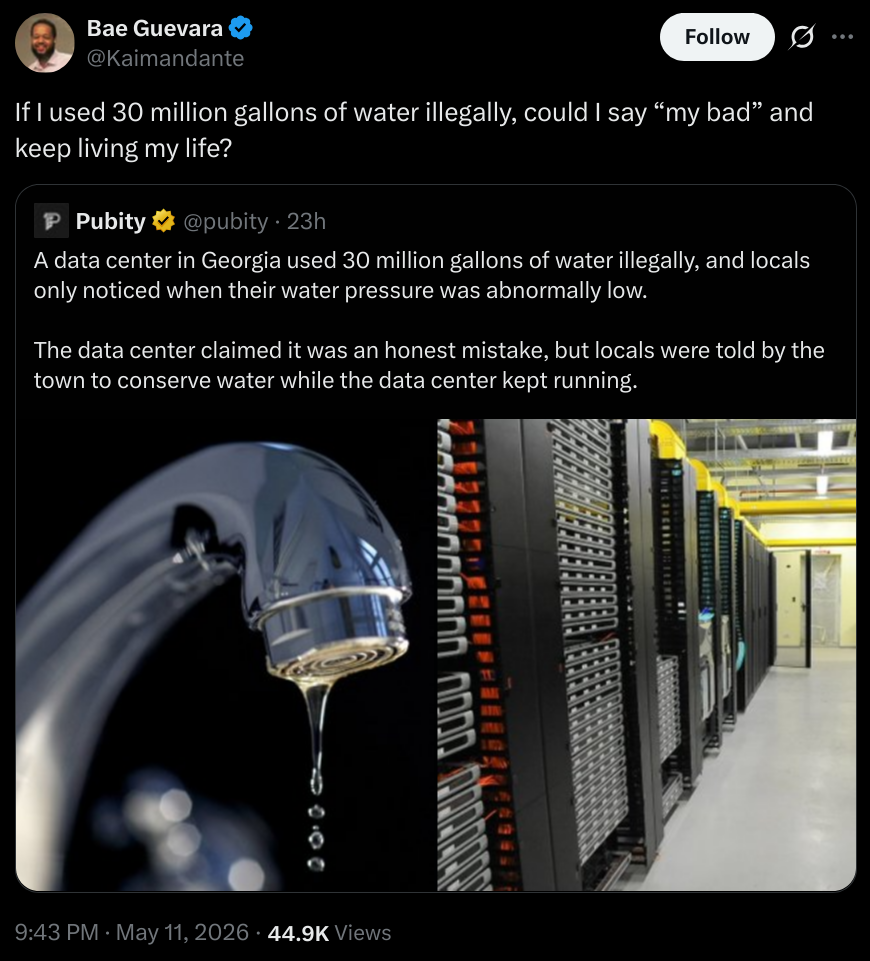
I don’t understand how data centers work. Like are they hiring people to stand there with a hose spraying racks or something? Why the fuck isn’t this water being cycled?
The AC systems use adiabatic gas coolers to minimize their footprint and electricity use. An adiabatic gas cooler works very similarly to a standard AC condenser except that there is an aditional piece of media on the air inlet side of the condenser coil which is kept perpetually wet. Basically as air is pulled through that media it evaporates water and cools that air basically down to the local dew point. This means colder air cooling the refrigerant condenser and thus a smaller more electricity efficient condenser.
Adiabatic coolers are especially popular on CO2 based refrigeration systems because of the low critical temp of CO2. Basically once the ambient temp gets above 75-80F a standard gas cooler can no longer liquify CO2 because it just goes supercritical instead which results in a more inefficient refrigeration process. Adiabatic coolers can largely mitigate that issue.
Of course this whole process could be done without using water but it would require more electricity. Basically someone did the math and found out that using water was cheaper than using more electricity so that’s what they did. If we want data centers to stop using up all our water then the easiest fix is to just start charging them more for water.
Finally, something informative versus the other comments that are beating a dead horse into pulp.
Having a closed loop is more expensive and energy intensive than running cold water through the heat exchanger.
With a little hindsight and vision, they could establish power generation to take advantage of that heat they are now wasting. I’m glad they don’t though so hopefully they will go out of business although I think we all know the government will bail them out.
most are closed loops, but some are not, i.e. cold water enters the datacenter, cools it, and then warm water leaves as waste water.
How dirty is the water leaving the cooling loop?
Closed loop is often relative.
The water in a rack, closed loop, it gets recirculated.
However, the closed loop will run through a liquid to liquid heat exchanger, and that second loop is usually going to a tower to get evaporated.
The plumbing in the rack can be very picky about water quality and want additives that would be very bad in an open loop scenario.
So you end up with people at the rack level talking about ‘closed loop’, but they run through a CDU that is open loop. Basically closed loop when picky about the water, moving heat to open loop where they can actually get rid of the heat effectively.
I was under the impression that the majority of them are not closed loop, any idea if there’s data (no pun intended) anywhere? A quick search found me not much
It sounds like the waste head they create is getting harder and harder to cool with heat exchangers. So evaporative cooling is more efficient (power wise, not water usage wise) and they basically spray water on the cooling towers and it blows away in the wind as vapor.
So they could not use the water too, but they are saving money and simply prefer stealing the water they don’t even need
Maybe, thermodynamics are a jerk, and it may be impossible to get enough cooling in some environments.
It could also use more power to compress refrigerants to cool it other ways. Then we’re trading carbon in the atmosphere for water waste.
Sure we could use solar, hydro, or nuclear, but we could also just stop the fucking slop and waste less of everything.
But without political revolt none of that will happen.
Or we can start running 9B models on a solar powered PI. Why tf we need data centers? AI won’t get much better than this with it’s current architecture.
Can’t they use that steam to spin a turbine or something?
The heat you have available in a data center is pretty low-quality (cold) heat. If you’re not familiar with the field, a (very) basic introduction is looking at the Carnot efficiency: In principle, you could increase the pressure in the water with a pump, then let it evaporate, before extracting work in a turbine. Then, you condense the steam (by heat-exchanging with the ambient) before sending it back into the pump.
Now, if this process is ideal (frictionless pumps and turbines, perfect heat exchangers, etc.) we can figure out how much of the heat energy that can be converted to useful work (
turbine output-pump input). Assuming the ambient (our cold side) is about 25 C, and the racks we’re cooling (our hot side) operate at around 100 C, we get a Carnot efficiency of about 0.2. That means only 20 % of the heat can actually be converted work. Again, this is the ideal case. It is not thermodynamically possible to get better than this. Realistically, you could maybe get 10 % or something.So, bottom line: The racks aren’t really hot enough to extract meaningful work. A better proposal would probably be to build things like this in places that are cold and require heating, so that you could use the waste heat as a district heating source. In that case, you could more or less completely eliminate the need for other heating sources in homes (which are far too often electrical). Then, we would be using the electrical power (which is high-quality) for something “useful” (disregarding whether or not a data center is useful in the first place), and use the low-quality heat for what it does best (heating things to moderate temperatures).
If you put a turbine in the cooling tower, it’ll take energy from the water by slowing it down. This will increase the humidity at the bottom of the tower, which impedes the liquid water from evaporating. This makes the tower cool slower.
It absolutely could be done efficiently, even if that method wouldn’t work well.
It’s unfortunately just warm water, not steam, so it’s pretty hard to extract energy into it in any meaningful way
By that logic, it’s not losing water, it’s just heating it. I’m not defending data centers but I feel like most of the info regarding data center water consumption isn’t accurate. It’s still bad, it’s contributing to global warming among other things but warm water doesn’t necessarily seem like waste water to me. Please correct me if I’m wrong.
Again, I’m not defending data centers. I am personally willing to learn how to build an EMP and detonate it inside one.
I think it’s unfair to downvote you for playing devils advocate here, especially when you’re making it obvious that that’s what you’re doing. People should do better and rather challenge themselves to explain why you’re wrong in a way that can convince the devils advocate. It serves as a nice exercise for re-thinking your position and arguments.
For my attempt: They’re “wasting” water in the sense that liquid water at ambient conditions is a limited resource. They’re taking that water, and either turning it into steam, or heating it a lot before releasing it back to the environment. Both uses reduce the amount of liquid water at ambient conditions available in reservoirs connected to infrastructure made to extract it for public use. That is the resource we use for everything from drinking water, to showering and cleaning, to making food and filling radiators.
You could say that “wasting water” is imprecise, but I would argue that it serves as a convenient shorthand for “wasting liquid water at ambient conditions accumulated in reservoirs that are connected to extraction and treatment infrastructure”, which becomes a mouthful when you say it often.
Furthermore liquid water at ambient conditions is needed by wildlife. Fish, amphibians, waterfowl, etc don’t like being in bath temperature water, and most plants and mammals don’t want to drink it.
Well some data centers are taking water from a source and move it somewhere else like into the air. Now people who use that source for their water needs have less water. Since the data centers take more water than what gets replenished back into the source naturally.
Many of them use what are called “evaporative cooling systems”, that consume massive amounts of water, and simply release it into the air, as steam. It is a very “energy efficient” method of cooling…meaning it uses less electricity, but a fuck-ton of water.
A portion os the water apparently evaporates. Of course water isn’t destroyed.
As far as I know, a portion of all water always evaporates.
Edit: I feel like people are misinterpreting my comments as defending data centers… Oh well
It’s because you seem like not wanting to understand.
They simply take water out of the public water system and it then either evaporates or goes into the waste system like in every normal household.
Of course it COULD be used to heat houses or fed back into the system but that’s not what’s happening simply because it would be too complicated.
It’s a bit like saying you are not wasting water when letting your tap running without doing anything because it would still be clean and could be used again.
Well in this case it isn’t a portion. It’s fucking all of it. That’s how evaporative cooling works.
There’s been more influxes of dumb people joining fediverse and just following others and down voting. Good news is none it fucking matters.
It evaporates in big cooling towers and joins the water cycle.