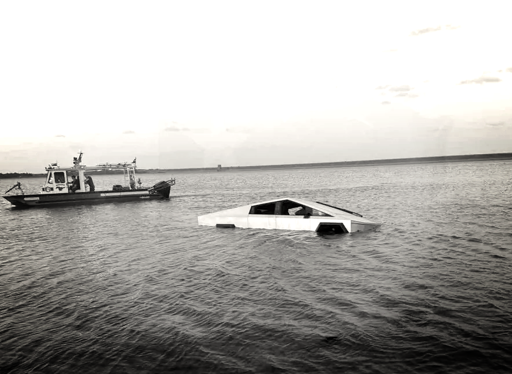
Somewhere in Texas, a Cybertruck owner saw the words “Wade Mode” and thought, let’s put that to the test. So he drove his Cybertruck down to Grapevine Lake, apparently to test the feature. The truck quickly became disabled. Thankfully the power windows didn’t lock up, and the people inside got out safely. Then Grapevine Fire […]
Well, I would say the test results were conclusive, if nothing else.
Normal trucks can wade water as high as their air intake, which usually is above one of the front wheels, inside the fender. You can go a bit above that for short distances if you keep a good momentum and create a wave in front of you, but that’s risky.
Of course modern trucks, having turned from work to luxury vehicles, may have issues.
air intake, which usually is above one of the front wheels, inside the fender.
That sounds wrong. Even on my normal car it’s at the top of the whole engine compartment, thus slightly higher than inside the fender, and less likely to get water sprayed.
Not that I know such things but from what I know you don’t want to unless you’ve waterproofed the electrical connections. You might be able to but it will accelerate corrosion.
Old trucks dgaf, 12-24V circuits handled water just fine, after all they already are splash (and pressure wash) proof. And if you don’t have electronic injection, the engine only needs electricity for the starter motor.
Old trucks gaf. Idk why you’d think otherwise. Most plugs are not expected to be submerged. If you go so old that there’s no powertrain electronics (which tends to also predate water resistant electrical connections), water is still going to accelerate corrosion at connections, especially chassis ground taps. Submerging it is how you ask for undiagnosed gremlins. Sounds fine for a trail rig, doesn’t sound fine if you still want your legally mandated lights to function.
Plus, it’s especially problematic when you get water inside the cabin. Tons of unprotected connections in there.
In MY old truck, which I rarely got into the water because the water near where I live would have carried me away, the lowest electrical components in the cabin would have been on top of the center console. Well, if you exclude the courtesy lights in the doors.
And while I didn’t get it in the water often, I knew plenty of people who did, we had a brand fan club.
Unfortunately my offroading days are long behind me, so I don’t know what’s the norm today.
Naw that’s pretty standard today, too! I’m in a 2021 Toyota Tacoma, that thing is bomb proof, I could spray a firehose in the main cabin and the worse damage I would do is, IDK, maybe shorting out the cabin light?
Totally disagree. Every single generation the bed gets smaller, the body gets bigger and the engine is moved further back for a lower center of gravity.
And yet, find me one parked on a lot (you know, where fleets buy from). In fact, look at every work truck* you see on your way home and count how many are reg cabs vs ext 4 door /crew with a 5.5 ft box. Bet you irl you see at least 4 crew to every reg, if not more.
Work truck: something with company decals or ladders / equipment attached.
Please, in what way am I being obtuse? I left an extremely broad definition of work truck lmao. And in what way are the graphics misleading? Seems you don’t like the fact trucks have grown
Work truck: something with company decals or ladders / equipment attached.
extremely broad definition
That’s not a broad definition. That’s quite limiting. A carpenter doing small commissions isn’t likely going to have massive decals on the side.
I have got a friend whose a landscaper, none of their work vehicles have decals. Not the vans or pickups.
in what way are the graphics misleading?
Already explained this. Ford still makes single cab trucks. The graphic doesn’t show that.
Seems you don’t like the fact trucks have grown
I never said they haven’t. Although neither did you, that graphic you showed that the actual size of one specific model of Ford hasn’t changed. Just the proportion of cab to bed.
But it sounds more like you already have a world in your head, and don’t like the fact the real world doesn’t line up with your views.
The real world does line up with my views though, lmao. Trucks have also grown bigger sideways, and longer. I daily a 96 Chevy in the winter, new Tacoma’s, rangers and Colorados are literally the same size or bigger than me, and they are supposed to 1/4 tons. Hell, the Colorado and a half ton are literally built on the same platform.
Yeah but the engine, suspensions, etc have shifted towards comfort rather than ruggedness, and those are mostly the same for all models.
That said I come from a place where we are used to real work vehicles, say Mercedes sprinter or Iveco Daily, and the comparison to American pick-up trucks is just ridiculous.


Normal trucks can wade water as high as their air intake, which usually is above one of the front wheels, inside the fender. You can go a bit above that for short distances if you keep a good momentum and create a wave in front of you, but that’s risky.
Of course modern trucks, having turned from work to luxury vehicles, may have issues.
That sounds wrong. Even on my normal car it’s at the top of the whole engine compartment, thus slightly higher than inside the fender, and less likely to get water sprayed.
If you search “truck snorkel” images, where the tube starts on the outside is where the air filter intake is.
Not that I know such things but from what I know you don’t want to unless you’ve waterproofed the electrical connections. You might be able to but it will accelerate corrosion.
Old trucks dgaf, 12-24V circuits handled water just fine, after all they already are splash (and pressure wash) proof. And if you don’t have electronic injection, the engine only needs electricity for the starter motor.
Old trucks gaf. Idk why you’d think otherwise. Most plugs are not expected to be submerged. If you go so old that there’s no powertrain electronics (which tends to also predate water resistant electrical connections), water is still going to accelerate corrosion at connections, especially chassis ground taps. Submerging it is how you ask for undiagnosed gremlins. Sounds fine for a trail rig, doesn’t sound fine if you still want your legally mandated lights to function.
Plus, it’s especially problematic when you get water inside the cabin. Tons of unprotected connections in there.
In MY old truck, which I rarely got into the water because the water near where I live would have carried me away, the lowest electrical components in the cabin would have been on top of the center console. Well, if you exclude the courtesy lights in the doors.
And while I didn’t get it in the water often, I knew plenty of people who did, we had a brand fan club.
Unfortunately my offroading days are long behind me, so I don’t know what’s the norm today.
Naw that’s pretty standard today, too! I’m in a 2021 Toyota Tacoma, that thing is bomb proof, I could spray a firehose in the main cabin and the worse damage I would do is, IDK, maybe shorting out the cabin light?
Love ya, thanks for letting us know
Still plenty of work trucks about. They didn’t stop making them because some pavement princess wanted all the options.
Totally disagree. Every single generation the bed gets smaller, the body gets bigger and the engine is moved further back for a lower center of gravity.
Hmm, same % you see again and again in US political polls. Coincidence?
Again you’re just comparing the top of the line options.
A single cab 150 is still available to purchase.
You’ve been done in by someone pushing an agenda by obscuring facts.
And yet, find me one parked on a lot (you know, where fleets buy from). In fact, look at every work truck* you see on your way home and count how many are reg cabs vs ext 4 door /crew with a 5.5 ft box. Bet you irl you see at least 4 crew to every reg, if not more.
Work truck: something with company decals or ladders / equipment attached.
I don’t see any Brazilians on the way home. But I know for sure that’s a real place that people come from.
Also doesn’t change the fact you’re spreading misleading graphics. And deliberately being obtuse with your definitions.
Please, in what way am I being obtuse? I left an extremely broad definition of work truck lmao. And in what way are the graphics misleading? Seems you don’t like the fact trucks have grown
That’s not a broad definition. That’s quite limiting. A carpenter doing small commissions isn’t likely going to have massive decals on the side.
I have got a friend whose a landscaper, none of their work vehicles have decals. Not the vans or pickups.
Already explained this. Ford still makes single cab trucks. The graphic doesn’t show that.
I never said they haven’t. Although neither did you, that graphic you showed that the actual size of one specific model of Ford hasn’t changed. Just the proportion of cab to bed.
But it sounds more like you already have a world in your head, and don’t like the fact the real world doesn’t line up with your views.
The real world does line up with my views though, lmao. Trucks have also grown bigger sideways, and longer. I daily a 96 Chevy in the winter, new Tacoma’s, rangers and Colorados are literally the same size or bigger than me, and they are supposed to 1/4 tons. Hell, the Colorado and a half ton are literally built on the same platform.
https://carbuzz.com/how-why-pickup-trucks-have-grown-over-years/
Yeah but the engine, suspensions, etc have shifted towards comfort rather than ruggedness, and those are mostly the same for all models.
That said I come from a place where we are used to real work vehicles, say Mercedes sprinter or Iveco Daily, and the comparison to American pick-up trucks is just ridiculous.