

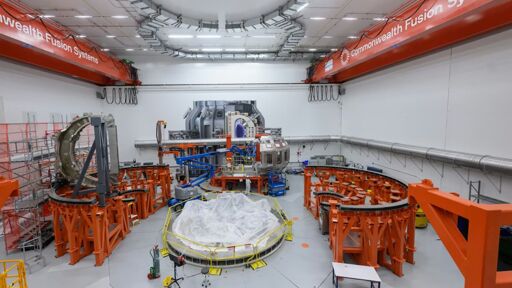
Commonwealth Fusion Systems (CFS) has verified the core plasma physics assumptions for its upcoming ARC fusion power plant following a peer-reviewed study published in the Journal of Plasma Physics.
The research confirms the ARC reactor design aligns with known physics, allowing the company to shift its focus toward detailed hardware engineering…
According to the validated models, the ARC plant will produce approximately 1.1 gigawatts (GW) of fusion power to generate 400 megawatts (MW) of net electricity for the grid…
CFS engineers are using this simulation framework to optimize upcoming design iterations, adjusting dimensions like tokamak width and divertor length to refine reactor performance before manufacturing begins.
My bet has always been on Commonwealth Systems getting there first. But they aren’t there yet… so time will tell.
Helios also has a really novel reactor, it would be amazing to see that work. It’s arguably a much more elegant design than a tokamak.
Sure but who can get to market the fastest and have a product that can easily adapt to the needs of data centers?
Well to be honest, I personally think that data centers are a huge waste of this emerging technology, but yeah, I suppose it’s probably a perfect use case for fusion…
My question, is who can miniaturize their technology sufficiently to put it in a spacecraft? When we get fusion reactors in space we’ll be able to use electric propulsion to make vehicles with insane range. We could send humans to Jupiter in a matter of months and have plenty of propellant for a return trip in a perfectly reusable vehicle. We already have all the tech for this, all except a suitable power source.
Not in the top five problems of a Jupiter trip.
Power and propulsion aren’t in the top 5 problems?
Well enlighten me, what’s more important that we haven’t figured out?
Keeping a human alive healthy and capable of re-entry.
We’ve done that. The ISS has been occupied for the last 25 years uninterrupted. The space station can go months between resupplies. In other words, we’ve shown that a crew can survive in a spacecraft without aid from earth for months. With some mission specific planning, I don’t see why we couldn’t manage a 6 month mission.
You’re the expert.
we can already put a nuclear fission power plant into a spaceship to generate very fast effective exhaust velocities.
i’m not sure what the exact reason is why we aren’t doing this already, but i suspect it has a lot to do with ease-of-use and price being significantly on the side of chemicals
the only reason why we use nuclear power on submarines at all is because there’s literally no other power source for them. they have to stay underwater for weeks / months, chemical fuel to run life support system for that long would be difficult to bring, no solar energy because underwater, battery would be insanely heavy … nuclear is the only option there.
that’s not true for spaceships. for launch, chemicals are available and cheaper / fire up faster. for mid-flight, solar panels are available.
Well the reason we don’t have nuclear thermal rockets boils down to budget cuts at NASA and environmental/safety concerns around nuclear. We made significant progress on two different nuclear rocket designs before they were scrapped for entirely political/budgetary reasons. And by budgetary reasons I don’t mean that the program proved to be too expensive or difficult, I mean that NASA’s annual budget was year after year and they simply had to drop some projects.
Chemical propellants are great for launch, but the advantage of nuclear for deep space missions are really immense. The additional efficiency means you can make shorter trips, bring more supplies, and have more redundancy for equipment failures. It also provides the possibility of bringing the entire craft back home for future missions rather than simply expending it.
And as a power source, solar is fine around earth. But for trips further out, like to Jupiter, well at that distance your panels would only get about 4% of what we get here around earth… That’s just not going to cut it for crewed missions.
Honestly, spacecraft are probably the absolute best use case for fusion power. They’re one of the few contexts where the energy density is extremely important and the high cost is still worthwhile.