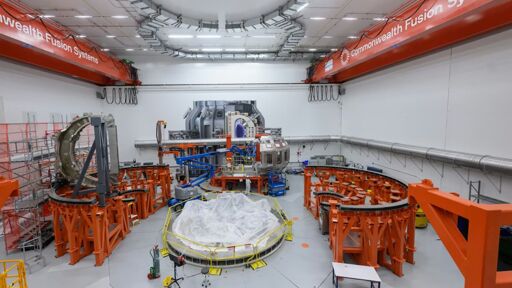
Commonwealth Fusion Systems (CFS) has verified the core plasma physics assumptions for its upcoming ARC fusion power plant following a peer-reviewed study published in the Journal of Plasma Physics.
The research confirms the ARC reactor design aligns with known physics, allowing the company to shift its focus toward detailed hardware engineering…
According to the validated models, the ARC plant will produce approximately 1.1 gigawatts (GW) of fusion power to generate 400 megawatts (MW) of net electricity for the grid…
CFS engineers are using this simulation framework to optimize upcoming design iterations, adjusting dimensions like tokamak width and divertor length to refine reactor performance before manufacturing begins.
Just watched a really good and incredibly informative video on this, https://youtube.com/watch?v=nt4rZgndOoE. From what is explained in the video is that this is mostly filing paperwork, they haven’t verified their reactor works or that it’s able to output power, let alone output more power than what is required to start and maintain a fusion reaction. So over all, a little exciting, but really nothing to get too excited about yet.
Edit: grammar fixes
Ah I was wondering this and my cursory search result was that :
- Their design (ARC) is sound for its physics.
- their design would produce more energy if nothing goes wrong with the hardware.
- The hardware is designed but not built yet.
Basically it’s really promising because on paper it should really work as expected. But at the same time without building it, there will be obstacles along the way. The materials could last too little time for it to be commercially viable.
So they seem to be at the very last theoretical step of fusion energy but there is still a huge challenge in actually building the thing and most importantly, it to be viable commercially.
Fusion power is still basically TRL 3 and every time it looks like they might be going to move up a level everyone loses their damn minds. It’s not really possible to put a timeline on any of this because the technology doesn’t exist yet and we can’t simulate in computers what we’ve never seen before, not with any degree of accuracy.
Meanwhile the Chinese have working thorium reactors, which are incapable of meltdown.
So are Canadian CANDU reactors.
What’s the connection? This is fusion, not fission
i assume the point is we could have been building clean nuclear energy without waiting for fusion.
That’s a crappy point, since it isn’t a choice between the two. Our collective (bad) decision to abandon fission has nothing to do with this.
if fission hadn’t been abandoned, solar wouldn’t have been developed. so it’s good, actually
It does a little. funding isn’t unlimited. If the goal is to get off fossil fuels ASAP, to me it makes more sense to invest in building technologies that we know work.
Once we stop the house from burning down we can look into upgrading the sprinkler system.
R&D and actual practical power plant construction are worlds apart. It’s extremely questionable that cutting off funding to fusion would have changed any opinions on nuclear. Govts didn’t abandon nuclear due to a lack of technology, it was mainly FUD by lobbyists.
If the goal is to get off fossil fuels ASAP
Problem is, that was never the goal for the people in power, it could have been accomplished easily.
Nucluler
Thorium is cool but so is this. Also ITER is almost finished.
Yeah this feels more like a long-shot gamble by a hungry start up that the beginning of a new transformative tech.
So we only need 23 of them to power that one new data center in Utah.
The research confirms the ARC reactor design aligns with known physics
That’s…assuring? I guess?
“We aren’t completely batshit insane!”
Physically possibility is one thing. Materials and engineering constraints are another thing entirely.
Physically possible =/= Feasible.
Isn’t this how Half-Life began?
No, that had nothing to do with fusion or fission. The Resonance Cascade was a quantum event created when Gordon inserted a Xen crystal sample into a Anti-Mass Spectrometer.
have a very safe day
They’re waiting for you Gordon… In the test chamber
Test chamberrrrrrr
Gordon doesn’t need to know all that!
@CapuccinoCoretto @Delta_V cant wait to have another being attatch to my head
Amazing. Fusion has been 20 years away since I was in school 50 years ago. I know this isn’t the actual reactor but it’s a big step - so maybe 10 years now?
Honestly, less. At least less for a working fusion reactor. Probably 10 - 20 before first commercial deployment.
That’s incredible. I hope it happens in my lifetime.
I thought this was 30 years away?
(I feel the need to point out that it’s been 30 years since people started saying this…)
Oh man though this one is cool - I have a dear dear friend working on this project, and it’s absolutely wild. Nothing they’re doing is new, exactly but modern magnet designs have enabled SPARC to simultaneously hit a bunch of metrics that were previously entirely reliant on purpose-built machines.
Excerpt from them when I asked them about this yesterday:
While no existing tokamak has reached the same parameters that SPARC will simultaneously, there is empirical evidence in part for all of the major parameters it seeks to reach. the purple dot is ARC, the power plant design, and the red X is ITER, the gigantic international tokamak being built which doesn’t take advantage of newer and more powerful magnets (which is what allowed SPARC/ARC to have much smaller volume)
so like yeah, we’ve built a ton of reactors that could do all this individually and then CFS have managed a system that has combined those results into a single machine and that has been the big goal for years (beyond stopping the plasma from fizzling out). There’s still challenges to solve, but this system has cleared all the previous hurdles (barring some of the noncritical ones). It’s so damn cool. It’s not fusion happening now, the headline is sensationalist, but it’s the biggest step forward we’ve had probably since research into plasma fusion started.
This just says in theory it should work. In practice, it might never work.
My bet has always been on Commonwealth Systems getting there first. But they aren’t there yet… so time will tell.
Helios also has a really novel reactor, it would be amazing to see that work. It’s arguably a much more elegant design than a tokamak.
Sure but who can get to market the fastest and have a product that can easily adapt to the needs of data centers?
Well to be honest, I personally think that data centers are a huge waste of this emerging technology, but yeah, I suppose it’s probably a perfect use case for fusion…
My question, is who can miniaturize their technology sufficiently to put it in a spacecraft? When we get fusion reactors in space we’ll be able to use electric propulsion to make vehicles with insane range. We could send humans to Jupiter in a matter of months and have plenty of propellant for a return trip in a perfectly reusable vehicle. We already have all the tech for this, all except a suitable power source.
Not in the top five problems of a Jupiter trip.
Power and propulsion aren’t in the top 5 problems?
Well enlighten me, what’s more important that we haven’t figured out?
Keeping a human alive healthy and capable of re-entry.
We’ve done that. The ISS has been occupied for the last 25 years uninterrupted. The space station can go months between resupplies. In other words, we’ve shown that a crew can survive in a spacecraft without aid from earth for months. With some mission specific planning, I don’t see why we couldn’t manage a 6 month mission.
You’re the expert.
we can already put a nuclear fission power plant into a spaceship to generate very fast effective exhaust velocities.
i’m not sure what the exact reason is why we aren’t doing this already, but i suspect it has a lot to do with ease-of-use and price being significantly on the side of chemicals
the only reason why we use nuclear power on submarines at all is because there’s literally no other power source for them. they have to stay underwater for weeks / months, chemical fuel to run life support system for that long would be difficult to bring, no solar energy because underwater, battery would be insanely heavy … nuclear is the only option there.
that’s not true for spaceships. for launch, chemicals are available and cheaper / fire up faster. for mid-flight, solar panels are available.
i’m not sure what the exact reason is why we aren’t doing this already, but i suspect it has a lot to do with ease-of-use and price being significantly on the side of chemicals
Well the reason we don’t have nuclear thermal rockets boils down to budget cuts at NASA and environmental/safety concerns around nuclear. We made significant progress on two different nuclear rocket designs before they were scrapped for entirely political/budgetary reasons. And by budgetary reasons I don’t mean that the program proved to be too expensive or difficult, I mean that NASA’s annual budget was year after year and they simply had to drop some projects.
That’s not true for spaceships. for launch, chemicals are available and cheaper / fire up faster. for mid-flight, solar panels are available.
Chemical propellants are great for launch, but the advantage of nuclear for deep space missions are really immense. The additional efficiency means you can make shorter trips, bring more supplies, and have more redundancy for equipment failures. It also provides the possibility of bringing the entire craft back home for future missions rather than simply expending it.
And as a power source, solar is fine around earth. But for trips further out, like to Jupiter, well at that distance your panels would only get about 4% of what we get here around earth… That’s just not going to cut it for crewed missions.
Honestly, spacecraft are probably the absolute best use case for fusion power. They’re one of the few contexts where the energy density is extremely important and the high cost is still worthwhile.
Validate sustained 10:1 energy excess and tritium breeding excess, at an economically acceptable price point first.
1.1 Jiggawatts? Pshaw, not even one lightning bolt.
So that’s, what, a 36% efficiency? What are the values of some other sources such as nuclear and solar. Or am i misunderstanding the values supplied?
It’s 36% net positive. So it uses the rest to maintain the fusion reaction, but you still get energy out of it.
Well, it’s not really an “efficiency” number.
For instance, we’re definitely concerned with efficiency when burning gas, we want to get as much energy as we can out of it per unit of fuel. But with fusion, the fuel cost is negligible, so you can treat it as essential free and in infinite supply. And because maintaining the magnetic containment simply costs electricity, you basically just take the net excess power as the output rating of the plant.
Probably the most useful way to compare these two technologies is by cost per MW. That said, early fusion reactors will not be in any way cheap. Working fusion may be around the corner, but it will in fact be a long time before fusion is really “a good choice” economically.
Extremely complex and expensive engineering and technology development for 400 MW of net electricity generation. Why not just build a 400 MW solar farm (with battery shortage, of course)? There’s a massive, natural fusion reactor in the sky blasting the Earth with petawatts of energy every day, for absolutely free.
This is like asking “why do R&D to invent solar panels when gas has always been 25¢/gallon?”
Technological progress isn’t free.
Technological progress isn’t free.
I’m just not convinced progress scales 1:1 with increasing technological complexity. In fact, I think progress might be better achieved by lowering costs and complexity, rather than increasing them. Maybe more isn’t always better.
The amount of electricity we will be able to extract from nuclear fusion, while using an extremely small amount of fuel, means that solar panels may cease to be practical in the first place.
Fusion still has a massive up front cost that needs to be recouped for decades.
So you’re saying solar panels were a mistake and we should have stuck to horses?
I should clarify. I think increasing technological complexity can lead to progress, but I don’t think it always does. I think progress from increasing technological complexity often follows an s-curve. I’m not denying the progress that has come from the significant technological advancement of the last few centuries, I’m just not sure continued technological advancement will lead to that same level of progress over the next few centuries.
Maybe, but many things are increasingly efficient. Maybe energy need for most things is plateauing and flat id goud enough. You’ll just need fusion for datacenters
It’s funny you should mention scaling, because fusion does not scale like that at all, it scales much better. If you can get a small reactor to work at all, a larger reactor designed with the same principles is significantly more efficient. With fusion, bigger is better.
I do hear what you’re saying though. Sometimes there are just simpler solutions. And I actually think you’re right, in most use cases solar + batteries is a better solution than a fusion plant. That said, solar + batteries has only become truly economical within the last 5-10 years. At this point there’s really nothing “Simple” about photovoltaic or battery technology, lifetimes of study have gone into them. And 25 years ago, solar was cute, it was pie in the sky. And you’d hear these same arguments “shouldn’t we be focusing efforts on something we already know works?”
Because this is how research works and if we manage to get fusion power generation working well, we’ll have practically limitless clean energy available.
Thats what musk masturbates to…
If musk gets off on limitless clean energy that’s actually okay.
Oh the energy isn’t for public usage but for clean AI. Pleps have to pay for the energy that can’t be used to this end.
still better than AI powered from natural gas.
Elon Musk doesn’t give a fuck about the environment.
Because you can’t stably power a grid on solar. You need to buffer with a source of energy not dependent on environment.
well, the idea that you can’t is a far fetch. battery installments are growing exponentially; it’s possible to produce clean hydrogen and burn it half a year later.
That said, fusion (and fission as well) isn’t really a great buffer because you don’t really want to be switching it on and off. It’s so expensive that it’s only really economical to run it constantly 24/7. So while fusion could be an awesome and perfectly consistent base load, it doesn’t solve the energy variability problems.
Ultimately utilizing renewables just requires some amount of energy storage and/or quick to activate gas generators.
deleted by creator