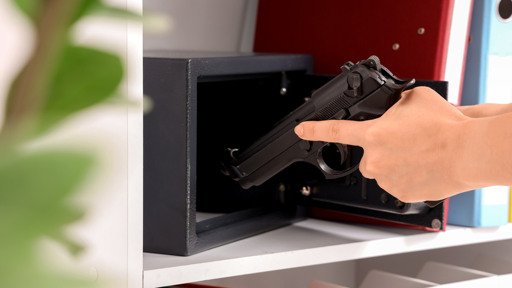
A new study led by epidemiologists at Brown University found that among firearm owners, less safe storage was associated with higher blood lead levels in children.
Interesting take. That’s not the conclusion that they’re drawing but it’s certainly possible. I also want to know the mechanism for the increased lead levels. Are kids chewing on the bullets? Is lead somehow deposited in the home?
Edit: I read it again and I feel like something is still missing. Firing a gun leads to lead particles on clothing that come back home. But lack of storage leads to more lead in the children. If you don’t store your gun, are you waving it around your house? Firing it in the basement?
I also want to know the mechanism for the increased lead levels. Are kids chewing on the bullets? Is lead somehow deposited in the home?
I think you can interpolate what’s happening from this part:
Firing a gun leads to lead particles on clothing that come back home.
So it sounds to me, like when you fire a gun, a few things happen. The bullet travels down the barrel and as it does, it makes some contact with the barrel, some particles of lead scrape or spald off. These particles are largely expelled by the barrel exhaust, but some of it can be deposited in or on the gun. So any gun that has been fired many times becomes a source of lead particulates that can get into the air. I’d expect a gun safe provides the same amount of protection from this exposure as a zip lock bag would. (But i’d still recommend using the gun safe). Theoretically, you could also reduce this exposure by thoroughly cleaning the gun before bringing it into the home, though I have no idea what level of cleaning would be necessary to achieve this, it could be a lot.
I totally agree with your Ziploc bag analogy lol. If the only concern was reducing lead exposure, I bet just a plastic bag would be enough. However, if we are only talking about using the weapon and bringing it home, does storage really matter? If the particles are all over your clothes, you are just dragging that lead everywhere.
I’m thinking it’s more to do with what one of the other commenters said, lack of storage suggests a certain attitude. If you’re not storing it, you are probably moving it around the house, cleaning it on the table, etc. So maybe both groups of people have the same amount of lead on their weapon, but the storage group takes it straight to the gun safe instead of leaving it in their pants and letting it sprinkle heavy metal surprises around the house?
I skimmed the paper (tiny pdf text on a phone screen is hard to read) and it sounds like merely having a gun out results in airborne contaminants. Any particles light enough to be carried by air currents will be carried around the house instead of just inside the safe. I wasn’t able to read and analyze the tables.
If you place a fired gun (contaminated with GSR) on a surface, particularly where you eat (kitchen counter, dining table) or on a fabric (couch, bed), it contaminates your living space and doesn’t really go away without cleaners that are effective on heavy metals.
Doesn’t even have to be “stored”. Cleaning your gun on the dining table, for example.
Yeah I think this is part of it. I think it has less to do with the storage and more to do with the other activities. Maybe someone who doesn’t lock up their gun is more likely to clean it on the kitchen table, for example


Interesting take. That’s not the conclusion that they’re drawing but it’s certainly possible. I also want to know the mechanism for the increased lead levels. Are kids chewing on the bullets? Is lead somehow deposited in the home?
Edit: I read it again and I feel like something is still missing. Firing a gun leads to lead particles on clothing that come back home. But lack of storage leads to more lead in the children. If you don’t store your gun, are you waving it around your house? Firing it in the basement?
I think you can interpolate what’s happening from this part:
So it sounds to me, like when you fire a gun, a few things happen. The bullet travels down the barrel and as it does, it makes some contact with the barrel, some particles of lead scrape or spald off. These particles are largely expelled by the barrel exhaust, but some of it can be deposited in or on the gun. So any gun that has been fired many times becomes a source of lead particulates that can get into the air. I’d expect a gun safe provides the same amount of protection from this exposure as a zip lock bag would. (But i’d still recommend using the gun safe). Theoretically, you could also reduce this exposure by thoroughly cleaning the gun before bringing it into the home, though I have no idea what level of cleaning would be necessary to achieve this, it could be a lot.
I totally agree with your Ziploc bag analogy lol. If the only concern was reducing lead exposure, I bet just a plastic bag would be enough. However, if we are only talking about using the weapon and bringing it home, does storage really matter? If the particles are all over your clothes, you are just dragging that lead everywhere.
I’m thinking it’s more to do with what one of the other commenters said, lack of storage suggests a certain attitude. If you’re not storing it, you are probably moving it around the house, cleaning it on the table, etc. So maybe both groups of people have the same amount of lead on their weapon, but the storage group takes it straight to the gun safe instead of leaving it in their pants and letting it sprinkle heavy metal surprises around the house?
I skimmed the paper (tiny pdf text on a phone screen is hard to read) and it sounds like merely having a gun out results in airborne contaminants. Any particles light enough to be carried by air currents will be carried around the house instead of just inside the safe. I wasn’t able to read and analyze the tables.
If you place a fired gun (contaminated with GSR) on a surface, particularly where you eat (kitchen counter, dining table) or on a fabric (couch, bed), it contaminates your living space and doesn’t really go away without cleaners that are effective on heavy metals.
Doesn’t even have to be “stored”. Cleaning your gun on the dining table, for example.
Yeah I think this is part of it. I think it has less to do with the storage and more to do with the other activities. Maybe someone who doesn’t lock up their gun is more likely to clean it on the kitchen table, for example
Insecure storage speaks to an overall blasé attitude towards firearms that’s for sure.