what i want to know is whether making up an explanation is universal, or if other people would just go “no clue”.
Because if EVERYONE with a severed corpus callosum just makes up explanations that is very fucking uncomfortable to think about, and i’ll treasure having mine intact
I’m no neuroscientist but I don’t think this has anything to do with the two hemispheres being separated - it’s just how the human mind works. When something happens we come up with an explanation for it that’s sometimes factual and sometimes completely made up. These people don’t know that they’re making it up - they genuinely believe the reason they’re giving. We’re not comfortable with uncertainty, especially when it comes to our own behavior.
I’m personally one of the people who doesn’t believe in free will so these findings make perfect sense to me and are in no way in conflict with my worldview, but I get how hearing about this might make someone else uncomfortable.
What’s your source (and i don’t mean a citation, more like reasoning) for us making things up even without brain damage? That, uh; feels made up, ironically.
Like i’m not saying i sit around contemplating every single assumption i make, but i can’t recall ever realizing my explanation for something was just completely not based in reality. If i’m not sure then i just say i’m not sure, it’s something i’ve specifically made an effort to be precise about (for example i’ve rewritten a bunch of this text several times as i decide what parts i know and what parts i recon).
The idea of uncontrollably coming up with incorrect explanations is uncomfortable to me not because of uncertainty, but because it would make me fundamentally unable to approach closer and closer to “”“objective”“” reality.
I like uncertainty because it means i’m not mistakenly stating something as fact, and thus deluding myself (and potentially others). I kind of prefer to say “i’m not sure” because it means i’m not risking accidentally hiding the truth, it can always be improved upon later.


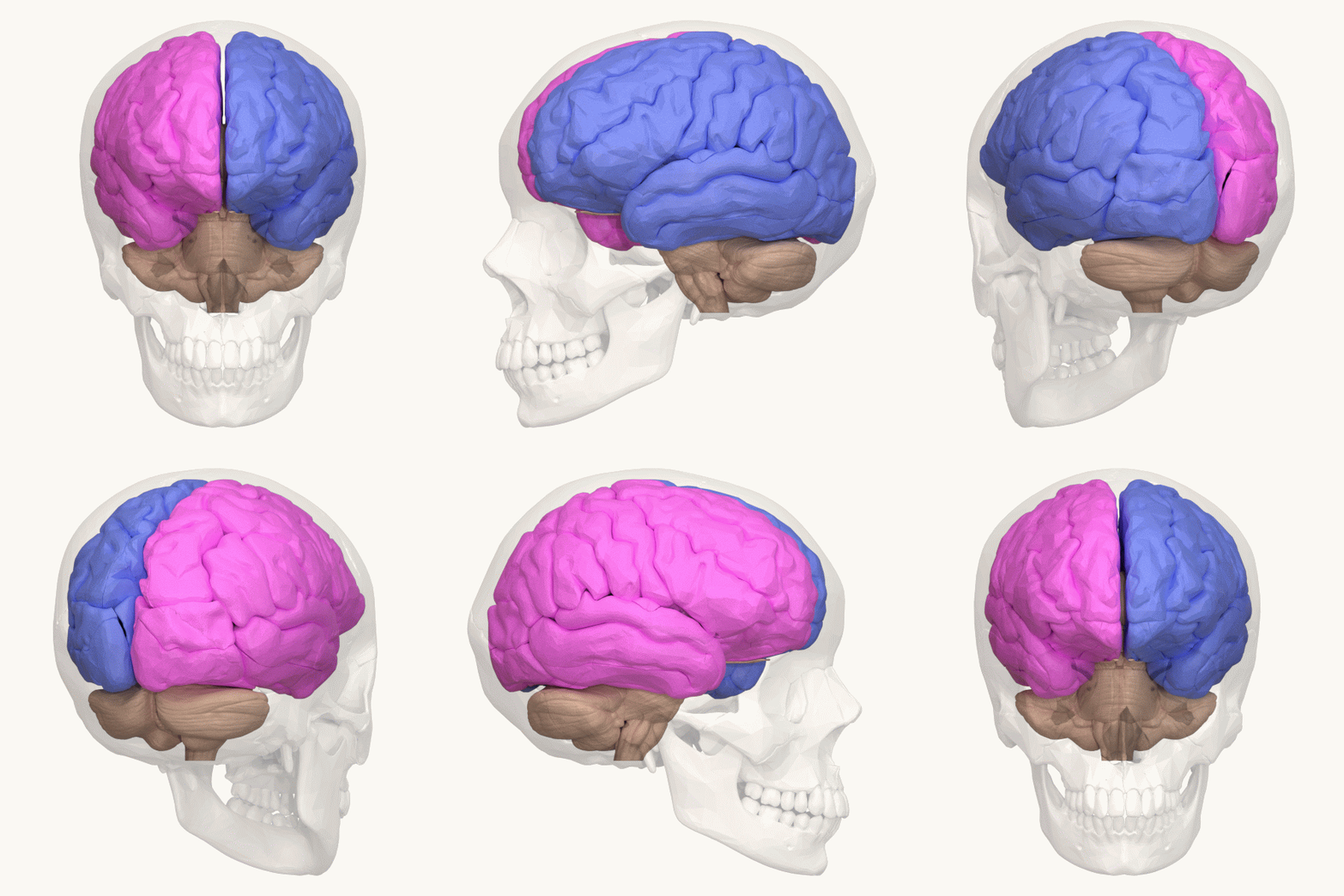
what i want to know is whether making up an explanation is universal, or if other people would just go “no clue”.
Because if EVERYONE with a severed corpus callosum just makes up explanations that is very fucking uncomfortable to think about, and i’ll treasure having mine intact
I’m no neuroscientist but I don’t think this has anything to do with the two hemispheres being separated - it’s just how the human mind works. When something happens we come up with an explanation for it that’s sometimes factual and sometimes completely made up. These people don’t know that they’re making it up - they genuinely believe the reason they’re giving. We’re not comfortable with uncertainty, especially when it comes to our own behavior.
I’m personally one of the people who doesn’t believe in free will so these findings make perfect sense to me and are in no way in conflict with my worldview, but I get how hearing about this might make someone else uncomfortable.
What’s your source (and i don’t mean a citation, more like reasoning) for us making things up even without brain damage? That, uh; feels made up, ironically.
Like i’m not saying i sit around contemplating every single assumption i make, but i can’t recall ever realizing my explanation for something was just completely not based in reality. If i’m not sure then i just say i’m not sure, it’s something i’ve specifically made an effort to be precise about (for example i’ve rewritten a bunch of this text several times as i decide what parts i know and what parts i recon).
The idea of uncontrollably coming up with incorrect explanations is uncomfortable to me not because of uncertainty, but because it would make me fundamentally unable to approach closer and closer to “”“objective”“” reality.
I like uncertainty because it means i’m not mistakenly stating something as fact, and thus deluding myself (and potentially others). I kind of prefer to say “i’m not sure” because it means i’m not risking accidentally hiding the truth, it can always be improved upon later.