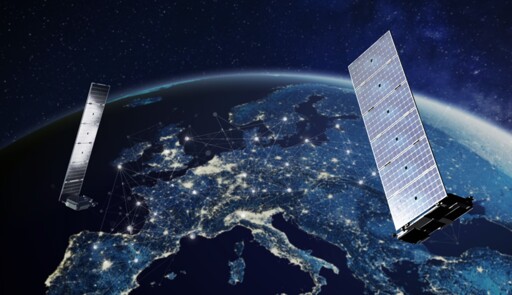
Russia and China have developed a joint plan to counter the U.S. Starlink satellite communications constellation.This was reported by The Insider as part of a joint investigation with Der Spiegel […]
Orbits are elipses, which are loops. So after the explosion gives an object more energy it’s in a new orbit right? That orbit has LOOP. Which means it has to come back to a similar point it’s at now. Therefore if an object passes through low orbit, no one explosion can make it be in a high orbit. At best it’ll be an ellipse with a point in high orbit and a point in low orbit.
Any amount in low orbit means a decaying orbit due to drag with eventual falling out of the sky.
If you get to the high orbit point and you get a SECOND explosion that’s perfectly timed you could theoretically enter a new high orbit that’s stable over the long term and contribute to Kessler syndrome.
Blowing up a low orbit satellites can lead to many particles reaching high altitudes, if only temporary as you say, where they can cause cascades. Unstable orbits make the probability of collisions smaller, but they need to shatter only one satellite to end up with a mess in stable orbits.
There’s a whole concept about this, a Kessler countdown of some sort. Some scientists are trying to figure out in the hypothetical situation where all satellites in orbit lost attitude control and evasive maneuver capabilities, how long would it take to initiate the Kessler syndrome. Apparently we went from months to days within the last decade.
An astrophysicist I follow on Matodon is super vocal about it. I’ll have to find her posts.
There is a low altitude and a high altitude point in an orbit. (Apogee for the high point, perigee for the low point) If you slow down at perigee, the altitude of the apogee decreases. If perigee is in atmosphere, then every time you go through that point, you slow down and the apogee decreases again. Sooner or later too much of the orbit is below atmosphere, and whatever it is that was in orbit burns up or falls down.
Happens all the time with meteors. There’s a lot of atmoshpere and only so many Starlink satellites; far too few satellites to meaningfully affect anything.


Yay!
Kessler Syndrome! Kessler Syndrome! Kessler Syndrome!
/s
Low Earth orbit means that the debris will get dragged down by the atmosphere before it becomes a cascading problem. Thankfully.
Assuming none of the debris gets pushed into higher orbits.
Orbits are elipses, which are loops. So after the explosion gives an object more energy it’s in a new orbit right? That orbit has LOOP. Which means it has to come back to a similar point it’s at now. Therefore if an object passes through low orbit, no one explosion can make it be in a high orbit. At best it’ll be an ellipse with a point in high orbit and a point in low orbit.
Any amount in low orbit means a decaying orbit due to drag with eventual falling out of the sky.
If you get to the high orbit point and you get a SECOND explosion that’s perfectly timed you could theoretically enter a new high orbit that’s stable over the long term and contribute to Kessler syndrome.
Blowing up a low orbit satellites can lead to many particles reaching high altitudes, if only temporary as you say, where they can cause cascades. Unstable orbits make the probability of collisions smaller, but they need to shatter only one satellite to end up with a mess in stable orbits.
Space is pretty big. I understand the odds are non zero but it’s still really small in this scenario.
I think it will depend on how they would disable the satellites. There’s a lot of Starlink satellites, it’s a lot of particles if they use explosives…
I’ll grab my popcorn and watch all the fireworks and Star link bits twinkle
There’s a whole concept about this, a Kessler countdown of some sort. Some scientists are trying to figure out in the hypothetical situation where all satellites in orbit lost attitude control and evasive maneuver capabilities, how long would it take to initiate the Kessler syndrome. Apparently we went from months to days within the last decade.
An astrophysicist I follow on Matodon is super vocal about it. I’ll have to find her posts.
Ok found it, is is pretty relevant.
https://mastodon.social/@sundogplanets/116880423574782457
If bits of satellite get propelled in the original direction of travel, they will stabilize into a higher orbit.
Much like how you can do the rocket equivalent of hitting the gas and end up in higher orbit.
Not without a second impulse at the minimum. There are no stabilising forces like friction or drag in space.
They’ll slow down whenever they hit their original altitude (or lower), no? Is it impossible for this to result in a stable higher orbit?
There is a low altitude and a high altitude point in an orbit. (Apogee for the high point, perigee for the low point) If you slow down at perigee, the altitude of the apogee decreases. If perigee is in atmosphere, then every time you go through that point, you slow down and the apogee decreases again. Sooner or later too much of the orbit is below atmosphere, and whatever it is that was in orbit burns up or falls down.
I think.
Ah, so you’d need an impulse around the apogee, and acceleration around just the perigee can’t create a stable orbit? Makes sense, thanks!
Ah, at last someone properly qualified to talk on the matter. So nice to see another graduate from the Kerbal Space Program.
Yes. Gravity! Provided by the orbit-ee.
Which it absolutely will, at least in the sense no part of the ellipse is lower.
So we can directly pollute the upper atmosphere with heavy metals? I’m sure that’s a good thing. /s
Happens all the time with meteors. There’s a lot of atmoshpere and only so many Starlink satellites; far too few satellites to meaningfully affect anything.
On the plus side, global cooling achieved through a shield of reflective debris!
Who needs GPS and climate data anyway, right?
GPS is comically higher than starlink.
I’d be much more worried about a direct attack.
Yea but you still have to get the GPS satellites up there safely. I see though that it might actually not be that big of an issue of GPS.
Yes, but a screen of tiny reflective particles spread through orbit between the Earth and the GPS satellites might cause communication problems.
That’s not what these satellites are used for.