

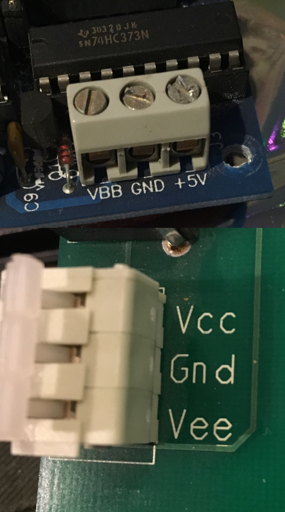
I am reading up on logic circuits, families and levels because it’s fun. I have no formal education in physics, computing or electronics.
For power supplies, sometimes one of the supply rails is referred to as ground (abbreviated “GND”) – positive and negative voltages are relative to the ground. In digital electronics, negative voltages are seldom present, and the ground nearly always is the lowest voltage level. In analog electronics (e.g. an audio power amplifier) the ground can be a voltage level between the most positive and most negative voltage level.
I know from previous reading, that electricity - at least when it comes to direct current, but perhaps even when it comes to AC? - has a way in (“line”?) and a way out (“neutral” or “ground”? - disregarding for a second the fact that ground also carries current in case of a ground fault).
Again, from previous reading, I know that we work computers by either supplying them voltage or not (or in some circuits a higher voltage and a lower voltage). In any case, it’s a choice between one or the other, since that is what we are trying to represent: boolean true or false.
So, what is this “negative voltage”? Is this a figure of speech or can voltage actually have a negative value? The part from the article that I quoted above states in relativistic terms, that “the ground can be a voltage level between the most positive and most negative voltage level” (italic text by me), which makes me assume “yes”. But if voltage is electromotive force, how can it be negative? I amusingly imagine a force “sucking” the current backwards. 🤭
Explain it to me as if I was five. 👶
That’s awesome! Thanks for the explanation! So, with my (maximum) 12V computer chassi fans, what are we comparing to? What is “ground” here? I slapped the fans onto my server rack, bought a DC adapter with variable voltage and wired them up so that I can manually select the voltage and thus the speed of the fans. Is this also a situation in which the various voltages/speeds are 3V, 4.5V, 5V etc higher than something that the person who built the electric grid in my house decided to call “ground”?
Sorry for the blurry pic.
Nothing to do with the electrical grid. It is just that the positive lead of the output of the power supply is whatever voltage you select above the negative lead on the output side of the power supply. Those are the two relative points in this situation. You can call the negative lead ground if you want. Wiring diagrams for the device you connect it to will likely call it ground. It is not the same thing as the grounding wire in a plug socket.
Note that the grounding wires in a home have nothing to do with any live circuit in your house. They are to make faults in the system safer by giving a path for electrons to flow if a conductive casing ever gets into contact with a live wire. In normal operation nothing should be flowing through it at all. With doubly insulated devices (like that power supply) the grounding wire in the plug socket is probably not connected to anything at all in the device. The plug likely does not even have a grounding wire in it.
Thanks for the clarification! So, there is an overlap, then, when it comes to the term “ground”? Grounding - and its wiring - in the greater electric grid is actually there in case there is a ground fault, while ground wires in smaller DC circuits can refer to the “outgoing” lead/terminal/wire?
First, the DC voltage of these fans is a separate voltage system from the AC/mains of the house.
Whether the 12v comes from a transformer or a switching power supply, the DC and AC circuits are effectively separated by that device.
The ground reference of the 12v system exists only within that system (and is provided by the transformer/power supply).
Consider the tranformer/power supply to be a battery with a positive and negative terminal. Inside, a chemical reaction will take place that moves electrons from one set of plates to another, leaving “holes” in one set, and extra electrons on the other.
This creates an imbalance - an electrical potential - and entropy says everything should try to balance. So those extra electrons provide the voltage, and once a circuit is made, will immediately try to balance the potential by moving through the circuit to the other terminal.
Using a transformer/power supply provides those electrons (and a sink - somewhere for those electrons to return to) from AC/mains voltage.
This is a pretty simple way to view it, there are more details that an EE would take me to task for, but it’s a good starting point.
This was great! Thanks!