

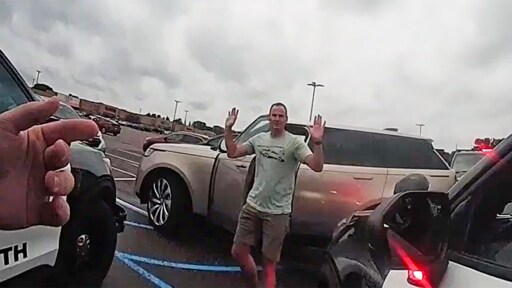
A brief recap: a few weeks ago I’d taken the $155,000 Range Rover I was testing out to run some errands with my wife in Plymouth, Minnesota. I was backing out of a parking space in front of my local Kohl’s when four cop cars came screaming up and “initiated a box and pin on the vehicle,” as the police report says. Hands on their guns, the officers ordered us out of the vehicle, patted us down, and eventually told us the Range Rover’s license plate—New Jersey 34 10 DTM—was stolen, they suspected the vehicle itself was stolen too, and they’d used Flock cameras to track me down over the last two days.
The scenario involving my wife and I is just one of many like it. Thomas noted that the system is 99% accurate today, but it’s performing 20 billion reads a month. That 1% error rate, of which I was a part of in June, makes for two hundred million misreads a month.
False equivalence. Expressing yourself through material means, like art, music, heck, even bumper stickers, that’s perfectly reasonable. You don’t “own” that license plate. It’s not yours, its an identity being externally pushed on you. They let you customize it somewhat, to make it feel like something you’re choosing to do. You’re not choosing it. It’s not an expression of the self, it’s an identity externally imposed, and that’s a meaningful distinction, even if you understand and agree with why it’s being imposed.
But you don’t own the art you watch/listen to. You don’t own the message on the bumper sticker. There is no difference.