Was a tincture or tea of white willow used as a folk medicine for generations until it got studied and the compound in it isolated by Bayer
Cocaine.
Indigenous population would chew coca leaves as a stimulant for various reasons and someone figured found out about it, studied it, and found out how to isolate the active compound and now we have Cocaine
Opiates
Opium Poppy was used for centuries for a variety of uses, but mostly recreational in the form of opium, then it got studied and turned into some of the most effective painkillers we have. (Morphine, codeine, heroin are naturally derived opium compounds, some others are synthetic or a blend such as oxycodone, methadone, fentanyl, carfentanyl)
Edit: white birch bark(I’m not 100% certain this is the right tree, but it was a tree, please correct me if I’m wrong) found the correction in another comment
I think it depends how you frame this question. For example, aspirin originated from a compound in willow bark. Currently, most of us aren’t chewing on willow bark to relieve pain, but at some point that (or making willow bark teas, etc.) was the case. Whether you consider that as “alternative” depends on what point in history you ask that question.
Leeches, which are still used today, also come to mind. Modern medicine has greatly refined how they’re used, but that’s not how it started.
There are quite a few things that people noticed produced effects but didn’t understand the mechanism. Science changed that.
However, if you consider using things with known properties in a wildly irresponsible manner as the definition of “alternative medicine,” that’s a very different question.
Even when novel therapies from existing medicine do come to light at times, generally this is through scientific observation and testing, not Cletus taking horse medicine.
My pharma professors liked to say that if Aspirin was discovered today, it would never pass the bar for human trials, because after all these years the mechanism of action isn’t properly understood.
That’s the best argument for alternative medicines that I’ve heard, and it’s also something to consider when we think about how insanely high the bar is for compounds that are approved as medicines.
I wonder if thats because we know very little about how the brain actually works in regards to how the brain create thoughts. It’s so very much a mystery in many ways where thoughts are created
Let’s just assume dose-response is linear. So, go find what concentration of chemical X (medicine, food additive, cosmetic, whatever) kills 50% of the bacteria/rodent/etc population. Draw a line from there down to 0% dead at 0 concentration.
Now decide what % of deaths is acceptable, given the benefit of chemical X. Use the line we just drew and that tells you what the regulations should set for max concentration under as-directed usage.
This ignores facts like
response curves are very often literally curves, sometimes with more than 1 minimum
response curves (and lines!) often depend heavily on all sorts of other chemicals’ presence in the environment, in varying mixtures & amounts
It’s a combinatorial explosion we can never meaningfully test against. We do what we can, with the tools that we have.
Almost every signal response, and certainly in chemistry, is an S curve. A small span of that curve may be approximately linear, but you absolutely can not approximate the slope of that linear span by just the mid point.
I was also going to use aspirin as an example, there is also psychedelics as a treatment for various psychological ailments.
I’m also going to post a response i made to a comment further up.
I need to be more specific in how I mean “alternative” here.
What I mean is “not of the current scientific consensus” , which I realise isn’t exactly the same wording as the wikipedia definition
Thats my bad.
I also failed to mention that it also works the other way as well, where current science is discredited(fully or partially) , due to flaws in it’s methodology, reproducibility or some other reason.
In generalities i was thinking more of how certain branches or offshoots of what was considered to be mainstream ( or mainstream adjacent ) science were later found to be scientifically provable.
They were posited over the years in varied forms by multiple independent people, but they weren’t really fully accepted until the invention of a way of actually observing them.
This is largely what medicine was prior to the current , formal scientific method.
Local “medicine people” would have salves, cures, potions and other such concoctions passed down to apprentices, they might have some knowledge of how it works, but most of that knowledge would be in the practical application and treatment using said concoctions.
That’s not to dismiss this practice, the years of experience and experimentation (of a kind) was, in some cases, essentially a precursor to modern scientific method.
There are ways of analysing effects and positing theories without fully understanding how the underlying mechanism works.
Sometimes that leads to legitimate data around the effects of a medicine or treatment being dismissed as “alternative”, at least until formal experimentation is done and verified
As i said in another reply, I’m not saying it’s common, all i was saying was that it’s a possibility.
Nowadays we can potentially evaluate what is considered “alternative” for actual benefit, and if benefit is found then elevate it to actual medical science.
Formal science isn’t the only source of potential hypotheses.
If it’s not considered beneficial we can discard (for now), perhaps a fresh look later when our tooling and understanding has improved.
That way we can try to gain benefit where possible, and definitively ( for the current level of technology and resource ) suggest people kindly not overdose on de-wormer because we’ve scientifically determined it’s stupid and potentially lethal.
Formal science isn’t the only source of potential hypotheses.
It’s hard to believe that, considering all low hanging fruits were picked already and now new hypotheses are obtained through hard work of teams of scientists.


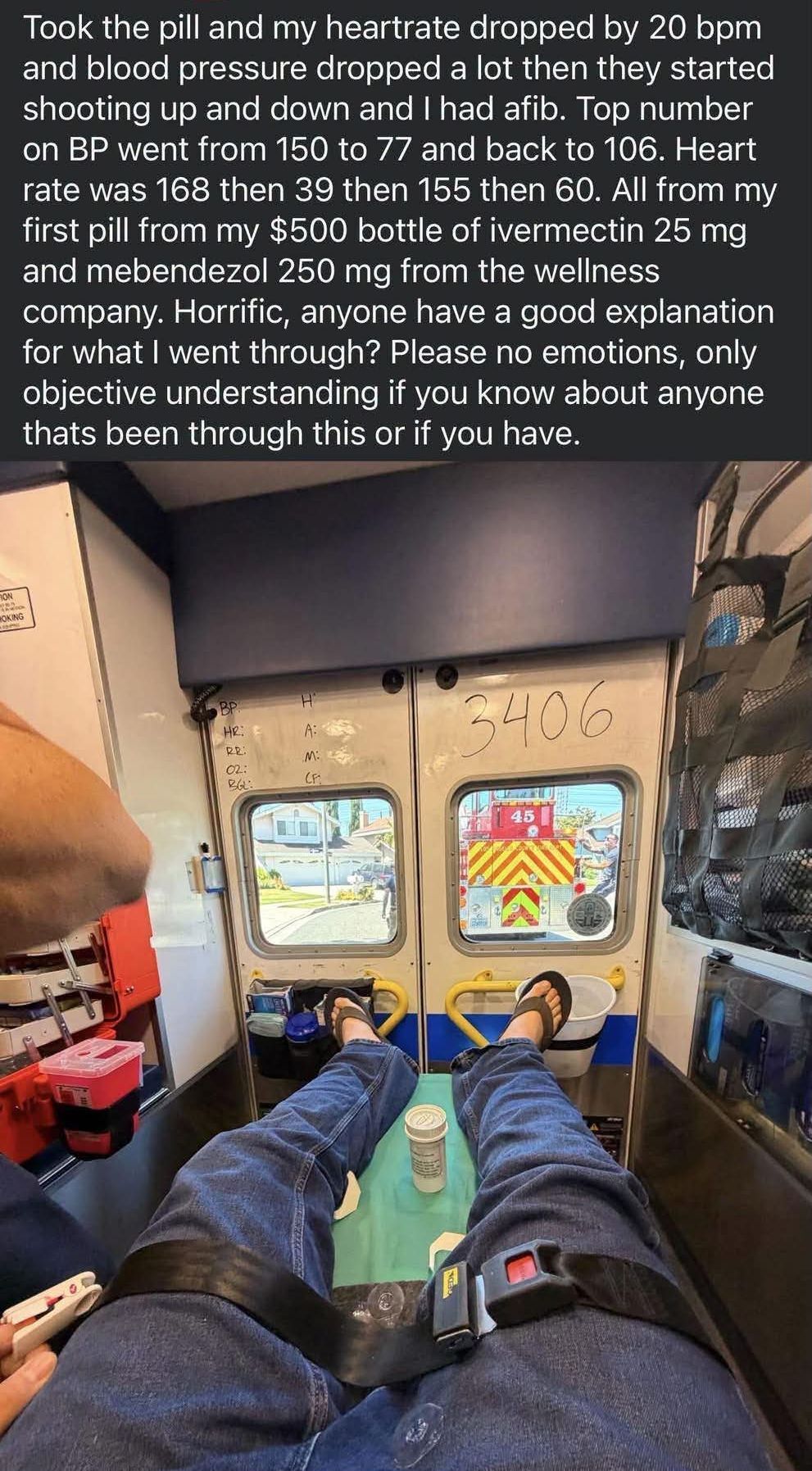
What are those?
Aspirin.
Was a tincture or tea of white willow used as a folk medicine for generations until it got studied and the compound in it isolated by Bayer
Cocaine.
Indigenous population would chew coca leaves as a stimulant for various reasons and someone figured found out about it, studied it, and found out how to isolate the active compound and now we have Cocaine
Opiates
Opium Poppy was used for centuries for a variety of uses, but mostly recreational in the form of opium, then it got studied and turned into some of the most effective painkillers we have. (Morphine, codeine, heroin are naturally derived opium compounds, some others are synthetic or a blend such as oxycodone, methadone, fentanyl, carfentanyl)
Edit:
white birch bark(I’m not 100% certain this is the right tree, but it was a tree, please correct me if I’m wrong)found the correction in another commentI think it depends how you frame this question. For example, aspirin originated from a compound in willow bark. Currently, most of us aren’t chewing on willow bark to relieve pain, but at some point that (or making willow bark teas, etc.) was the case. Whether you consider that as “alternative” depends on what point in history you ask that question.
Leeches, which are still used today, also come to mind. Modern medicine has greatly refined how they’re used, but that’s not how it started.
There are quite a few things that people noticed produced effects but didn’t understand the mechanism. Science changed that.
However, if you consider using things with known properties in a wildly irresponsible manner as the definition of “alternative medicine,” that’s a very different question.
Even when novel therapies from existing medicine do come to light at times, generally this is through scientific observation and testing, not Cletus taking horse medicine.
Thank you.
At the time mainstream medicine was rejecting use of willow bark? Or why it’s considered alternative medicine?
Usually herbs found by ethnographers.
Aspirin, for example, IIRC discovered by a scientist investigating traditional therapeutics (tree bark)
My pharma professors liked to say that if Aspirin was discovered today, it would never pass the bar for human trials, because after all these years the mechanism of action isn’t properly understood.
That’s the best argument for alternative medicines that I’ve heard, and it’s also something to consider when we think about how insanely high the bar is for compounds that are approved as medicines.
That wasn’t a blocker with antidepressants, for better or worse.
I wonder if thats because we know very little about how the brain actually works in regards to how the brain create thoughts. It’s so very much a mystery in many ways where thoughts are created
Most medications are poorly understood (at best!) lol, it’s trial and error all the way down.
With some exceptions like the RNA messenger covid vaccine…
Oh God LD50 is the craziest thing ever.
Here’s how it works:
Let’s just assume dose-response is linear. So, go find what concentration of chemical X (medicine, food additive, cosmetic, whatever) kills 50% of the bacteria/rodent/etc population. Draw a line from there down to 0% dead at 0 concentration.
Now decide what % of deaths is acceptable, given the benefit of chemical X. Use the line we just drew and that tells you what the regulations should set for max concentration under as-directed usage.
This ignores facts like
It’s a combinatorial explosion we can never meaningfully test against. We do what we can, with the tools that we have.
Almost every signal response, and certainly in chemistry, is an S curve. A small span of that curve may be approximately linear, but you absolutely can not approximate the slope of that linear span by just the mid point.
I was also going to use aspirin as an example, there is also psychedelics as a treatment for various psychological ailments.
I’m also going to post a response i made to a comment further up.
In generalities i was thinking more of how certain branches or offshoots of what was considered to be mainstream ( or mainstream adjacent ) science were later found to be scientifically provable.
An example of this is microbes.
They were posited over the years in varied forms by multiple independent people, but they weren’t really fully accepted until the invention of a way of actually observing them.
This is largely what medicine was prior to the current , formal scientific method. Local “medicine people” would have salves, cures, potions and other such concoctions passed down to apprentices, they might have some knowledge of how it works, but most of that knowledge would be in the practical application and treatment using said concoctions.
That’s not to dismiss this practice, the years of experience and experimentation (of a kind) was, in some cases, essentially a precursor to modern scientific method.
There are ways of analysing effects and positing theories without fully understanding how the underlying mechanism works.
Sometimes that leads to legitimate data around the effects of a medicine or treatment being dismissed as “alternative”, at least until formal experimentation is done and verified
As i said in another reply, I’m not saying it’s common, all i was saying was that it’s a possibility.
I think it’s safe to say nowadays we can rely on scientific method to find new cures, and completely abandon “alternative” medicine.
that’s the exact opposite of what i was saying.
Nowadays we can potentially evaluate what is considered “alternative” for actual benefit, and if benefit is found then elevate it to actual medical science.
Formal science isn’t the only source of potential hypotheses.
If it’s not considered beneficial we can discard (for now), perhaps a fresh look later when our tooling and understanding has improved.
That way we can try to gain benefit where possible, and definitively ( for the current level of technology and resource ) suggest people kindly not overdose on de-wormer because we’ve scientifically determined it’s stupid and potentially lethal.
It’s hard to believe that, considering all low hanging fruits were picked already and now new hypotheses are obtained through hard work of teams of scientists.
All low hanging fruits we know of.
This is one of those unknown unknown situations where there are things were don’t even know to be looking for.
Like microbes, yes we posited something like them, but the full implications the confirmation weren’t understood until after.
You believe a layman is still able to discover something in medicine. We’ll see.
Various new snake oils (ivermectin or urine for cancer , COVID and whatnot) sure aren’t it.
I think the belief that “the only place innovation can come from is trained scientists” is arrogant and unscientific, even in specialised fields.
Im not suggesting people will be producing testable medical end- products on the weekends.
Just that some things are worth testing/looking into, even if its suggested by someone not wearing a white coat.
If anything, the lack of low hanging fruit in the current common knowledge base should be an incentive to look in unorthodox places.
In addition there’s a wealth of historical information that is siloed by culture, language and accessibility (among other things).
That includes dusty old tomes in buried cities but also folk remedies passed down among small villages or families and everything in-between.
Absolutely agree.